Bernstein Network Computational Neuroscience
  • Home
  • Network
    • The Bernstein Network
    • Bernstein Centers
      • Berlin
      • Freiburg
      • Göttingen
      • Munich
      • Tübingen
      • Heidelberg-Mannheim
    • Bernstein Nodes
      • Bernstein Node Bochum
      • Bernstein Node Bonn-Cologne
      • Bernstein Node Chemnitz
      • Bernstein Node Hamburg
      • Bernstein Node Rhine-Main Region
      • Bernstein Node Taiwan
    • Research Infrastructure
      • High Performance Simulation and Data Analysis
      • Research Data Management
      • Science Communication
      • Scientific Coordination
    • Awards and Initiatives
      • Valentin Braitenberg Award
      • Brains for Brains Young Researcher Award
      • Bernstein SmartSteps
    • Committees
    • Mission Statement
    • Statutes
    • Membership
    • History
    • Donation
    • Contact
  • Newsroom
    • Newsroom
    • News
    • Events
    • Calls
    • Media Coverage
    • Network Publications
    • Bernstein Bulletin
    • Press
  • Teaching and Research
    • Teaching and Research
    • Meet the Scientist
    • Find a Scientist
    • Degree Programs
      • Master Programs
      • PhD Programs
    • Study and Training
      • Bernstein Student Workshop Series
      • Online Learning
      • Advanced Courses
      • Internships and Master theses
      • Podcasts
  • Career
    • Career
    • Job Pool
    • Internships and Master theses
  • Bernstein Conference
    • Bernstein Conference
    • Program
      • Schedule
      • Satellite Workshops
      • Conference Dinner
    • Early Career Scientists
      • PhD Symposium
      • Postdoc Meeting
      • Travel Grants
      • Buddy Program
    • General Information
      • Important Dates & FAQ
      • Plan Your Visit
      • Press
      • Code of Conduct
      • PR Media Policy
      • Data Policy
    • Past and future Bernstein Conferences
  • DE
  • EN
  • Click to open the search input field Click to open the search input field Search
  • Menu Menu
You are here: Home1 / Newsroom2 / News3 / Quantum sensors: Highly precise measurements in moving brains
Bonn, Germany – December 10, 2025

Quantum sensors: Highly precise measurements in moving brains

What is happening in the brain during an epileptic seizure? How do nerve cells function after a stroke-induced paralysis? What happens in the heads of those suffering from Parkinson’s disease? Investigating these types of questions has been difficult up to now because patients had to keep still. However, Optical Pumped Magnetoencephalography (OPMEG) is making it possible to also scan the brain while the patient is moving. Prof. Dr. Dominik Bach, Hertz Chair for Artificial Intelligence and Neuroscience at the University of Bonn, is currently setting up this type of research infrastructure on the campus of the University Hospital Bonn (UKB) and will receive funding of almost four million euros over the next three years from the EFRE/JTF program run by the European Union and the state government of North Rhine-Westphalia.
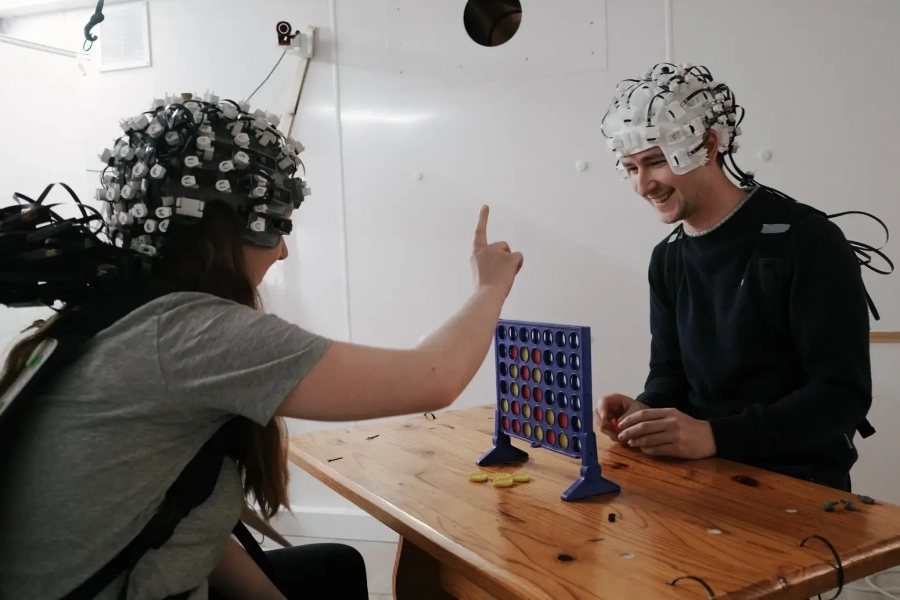
The photo shows two test subjects in a study - at the Wellcome Centre for Human Neuroimaging am University College London (UCL) during an OPMEG scan. © Photo: Robert Seymour

Bernstein member involved: Dominik Bach

The novel and cutting-edge OPMEG research infrastructure will be built in the basement of the Life & Brain building on the campus of the University Hospital Bonn. Active brain cells produce tiny electrical currents that form magnetic fields. A helmet equipped with sensors is used to measure these magnetic fields. The brain scan is carried out in a shielded booth measuring several square meters to ensure that the measurement results are not falsified by external influences such as the Earth’s magnetic field.

“In contrast to conventional imaging methods such as magnetic resonance imaging or traditional magnetoencephalography, the patient can move during the scan,” says Prof. Dr. Dominik Bach to explain the benefits of this method. “It also delivers much more precise measurements compared to EEG.”

Measurements in virtual reality

OPMEG can measure the brain waves of the person being examined while they are moving. It can thus handle the involuntary movements of people with illnesses such as epilepsy or Parkinson’s disease. The researchers use the images to look for characteristic rhythms of the brain. They can also scan the brain waves of healthy people while they are carrying out intentional movements such as spatial navigation tasks or when trying to escape in simulations of dangerous situations. Prof. Bach and his team have just developed OPMEG-compatible VR glasses that are able to simulate real environments in virtual reality.

This type of brain scan lasts up to one and a half hours on average. The test subject wears an imaging helmet and at the same time is hooked up to various other sensors – such as a heart rate monitor or motion sensor – depending on the study. The person than enters the booth and is given several game-based tasks to complete in order to stimulate certain areas of the brain. The test person can move around freely in the magnetically shielded booth and importantly is also able to sit down and relax to take a break. A member of the project team in an anteroom equipped with several screens monitors the data collected during the scan, which is later evaluated by computer.

Sensors use quantum effects

“OPMEG allows us to combine brain imaging with behavioral and motion studies,” says Bach. “This was either not previously possible or only possible with a far lower data quality.” Other applications for this technology include examining mild traumatic brain injuries or strokes and developing brain-computer interfaces. The centerpiece of this infrastructure are around 100 sensors that can measure tiny magnetic fields in the human brain – which are around one thousand times weaker than the Earth’s magnetic field – with the aid of quantum effects.

Further links

Original press release

> more

Quantum sensors: Highly precise measurements in moving brains

15. December 2025/in Ausgewählter Aktuelles-Post für die Startseite /by Elena Reiriz Martinez

Kontakt Aktuelles

Contact

Prof. Dr. Dominik Bach

Centre for Artificial Intelligence and Neuroscience (caian)
University of Bonn

d.bach@uni-bonn.de

Bernstein Netzwerk Computational Neuroscience Logo

Become a member
Statutes
Donation
Subscribe to Newsletter


Follow us on

LinkedIn
Bluesky
Vimeo
X
© 2025 Bernstein Network Computational Neuroscience
  • Contact
  • Imprint
  • Privacy Policy
Scroll to top Scroll to top Scroll to top
Cookie-Zustimmung verwalten
We use cookies to optimize our website and our service.
Functional Always active
Der Zugriff oder die technische Speicherung ist unbedingt für den rechtmäßigen Zweck erforderlich, um die Nutzung eines bestimmten Dienstes zu ermöglichen, der vom Abonnenten oder Nutzer ausdrücklich angefordert wurde, oder für den alleinigen Zweck der Übertragung einer Nachricht über ein elektronisches Kommunikationsnetz.
Vorlieben
Die technische Speicherung oder der Zugriff ist für den rechtmäßigen Zweck der Speicherung von Voreinstellungen erforderlich, die nicht vom Abonnenten oder Nutzer beantragt wurden.
Statistics
Die technische Speicherung oder der Zugriff, der ausschließlich zu statistischen Zwecken erfolgt. Die technische Speicherung oder der Zugriff, der ausschließlich zu anonymen statistischen Zwecken verwendet wird. Ohne eine Aufforderung, die freiwillige Zustimmung Ihres Internetdienstanbieters oder zusätzliche Aufzeichnungen von Dritten können die zu diesem Zweck gespeicherten oder abgerufenen Informationen allein in der Regel nicht zu Ihrer Identifizierung verwendet werden.
Marketing
Die technische Speicherung oder der Zugriff ist erforderlich, um Nutzerprofile zu erstellen, um Werbung zu versenden oder um den Nutzer auf einer Website oder über mehrere Websites hinweg zu ähnlichen Marketingzwecken zu verfolgen.
Manage options Manage services Manage {vendor_count} vendors Read more about these purposes
Settings
{title} {title} {title}