Bernstein Network Computational Neuroscience
  • Home
  • Network
    • The Bernstein Network
    • Bernstein Centers
      • Berlin
      • Freiburg
      • Göttingen
      • Munich
      • Tübingen
      • Heidelberg-Mannheim
    • Bernstein Nodes
      • Bernstein Node Bochum
      • Bernstein Node Bonn-Cologne
      • Bernstein Node Chemnitz
      • Bernstein Node Hamburg
      • Bernstein Node Rhine-Main Region
      • Bernstein Node Taiwan
    • Research Infrastructure
      • High Performance Simulation and Data Analysis
      • Research Data Management
      • Science Communication
      • Scientific Coordination
    • Awards and Initiatives
      • Valentin Braitenberg Award
      • Brains for Brains Young Researcher Award
      • Bernstein SmartSteps
    • Committees
    • Mission Statement
    • Statutes
    • Membership
    • History
    • Donation
    • Contact
  • Newsroom
    • Newsroom
    • News
    • Events
    • Calls
    • Media Coverage
    • Network Publications
    • Bernstein Bulletin
    • Press
  • Teaching and Research
    • Teaching and Research
    • Meet the Scientist
    • Find a Scientist
    • Degree Programs
      • Master Programs
      • PhD Programs
    • Study and Training
      • Bernstein Student Workshop Series
      • Online Learning
      • Advanced Courses
      • Internships and Master theses
      • Podcasts
  • Career
    • Career
    • Job Pool
    • Calls
    • Internships and Master theses
  • Bernstein Conference
    • Bernstein Conference
    • Program
      • Satellite Workshops
    • Past and future Bernstein Conferences
  • DE
  • EN
  • Click to open the search input field Click to open the search input field Search
  • Menu Menu
You are here: Home1 / Newsroom2 / News3 / Reaping the benefits of the brain’s information processing principles
Chemnitz, Germany – January 30, 2026

Reaping the benefits of the brain’s information processing principles

The Chair of Artificial Intelligence at Chemnitz University of Technology and the Chair of Neuropsychology at Otto von Guericke University Magdeburg want to make artificial intelligence more powerful by drawing inspiration from the brain's habit learning processes.
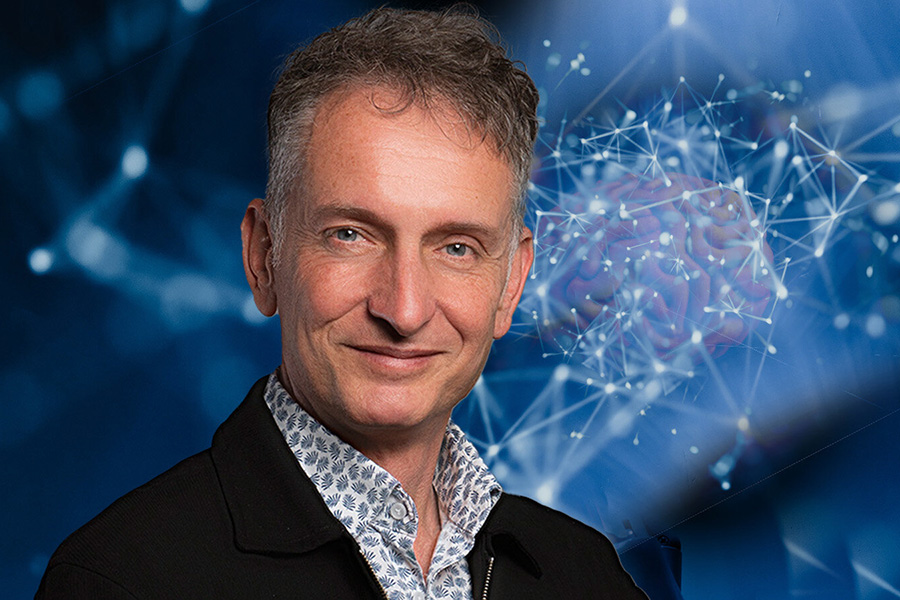
Prof. Dr. Fred Hamker, Chair of Artificial Intelligence, leads the research work of the interdisciplinary project team at Chemnitz University of Technology. | Photo: Jacob Mülle

Bernstein member involved: Fred Hamker

On January 28, 2026, a kick-off meeting launched a pilot project on the topic of “Brain-inspired use of efficient shortcuts in artificial intelligence” at Chemnitz University of Technology. Over the next three years, researchers from the Chair of Artificial Intelligence (headed by Prof. Dr. Fred Hamker) at Chemnitz University of Technology and the Chair of Neuropsychology (headed by Prof. Dr. Markus Ullsperger) at Otto von Guericke University Magdeburg will work together to develop a solution for increasing computing and energy efficiency in large modular neural transformer networks. This solution aims to draw inspiration from the brain’s remarkable ability to learn routines.

Background: The development of habitual behavior in both animal and human brains reflects the nervous system’s ability to efficiently delegate cognitive and neural resources. By automating frequently repeated responses, the brain minimizes the need for cognitive effort and decision-making. This allows individuals to focus on other complex tasks. “Just as the human brain automates frequently repeated responses to free up cognitive capacity, AI systems can benefit from habit-like mechanisms to optimize processing efficiency,” says Hamker. By learning and automating frequently used decision patterns, AI can minimize redundant calculations, reduce the computational load, and shorten response times. “This not only improves overall efficiency, but also contributes to energy savings, as neural networks and reinforcement learning models require considerable computing power,” says the Chemnitz-based AI expert.

From the researchers’ point of view, future AI systems could therefore be significantly improved if they enabled both detailed model-based learning and automated habit learning. The team from Chemnitz and Magdeburg wants to translate the shortcut connections that exist in the brain into AI. “We assume that these shortcut-like concepts are advantageous when calculating routine tasks, as they require significantly less computing power and thus reduce energy consumption considerably, while at the same time maintaining the flexibility of AI systems,” says Hamker. The brain-inspired AI model will be compared with existing AI methods in terms of performance and energy consumption, as well as with the cognitive flexibility of humans.

The interdisciplinary project will receive approximately € 365,000 in funding by the German Federal Ministry of Research, Technology, and Space (BMFTR) until December 2028 as part of the “Neurobiologically Inspired Artificial Intelligence” call. The project results are intended to lay the foundation for a novel, computationally and energy-efficient AI system, suitable for learning automation and solving complex tasks in a wide range of application areas.

Translated from German by Elena Reiriz Martínez/BCOS

Further links

Original press release (in German)

> more

Reaping the benefits of the brain’s information processing principles

3. February 2026/in /by Elena Reiriz Martinez

Kontakt Aktuelles

Contact

Prof. Dr. Fred Hamker

Scientific contact
Chair of Artificial Intelligence
Chemnitz University of Technology

+49 (0) 371 531-37875
fred.hamker@informatik.tu-chemnitz.de

Bernstein Netzwerk Computational Neuroscience Logo

Become a member
Statutes
Donation
Subscribe to Newsletter


Follow us on

LinkedIn
Bluesky
Vimeo
Mastodon
© 2026 Bernstein Network Computational Neuroscience
  • Contact
  • Imprint
  • Privacy Policy
Scroll to top Scroll to top Scroll to top
Cookie-Zustimmung verwalten
We use cookies to optimize our website and our service.
Functional Always active
Der Zugriff oder die technische Speicherung ist unbedingt für den rechtmäßigen Zweck erforderlich, um die Nutzung eines bestimmten Dienstes zu ermöglichen, der vom Abonnenten oder Nutzer ausdrücklich angefordert wurde, oder für den alleinigen Zweck der Übertragung einer Nachricht über ein elektronisches Kommunikationsnetz.
Vorlieben
Die technische Speicherung oder der Zugriff ist für den rechtmäßigen Zweck der Speicherung von Voreinstellungen erforderlich, die nicht vom Abonnenten oder Nutzer beantragt wurden.
Statistics
Die technische Speicherung oder der Zugriff, der ausschließlich zu statistischen Zwecken erfolgt. Die technische Speicherung oder der Zugriff, der ausschließlich zu anonymen statistischen Zwecken verwendet wird. Ohne eine Aufforderung, die freiwillige Zustimmung Ihres Internetdienstanbieters oder zusätzliche Aufzeichnungen von Dritten können die zu diesem Zweck gespeicherten oder abgerufenen Informationen allein in der Regel nicht zu Ihrer Identifizierung verwendet werden.
Marketing
Die technische Speicherung oder der Zugriff ist erforderlich, um Nutzerprofile zu erstellen, um Werbung zu versenden oder um den Nutzer auf einer Website oder über mehrere Websites hinweg zu ähnlichen Marketingzwecken zu verfolgen.
Manage options Manage services Manage {vendor_count} vendors Read more about these purposes
Settings
{title} {title} {title}