
Bernstein Network Computational Neuroscience
  • Home
  • Network
    • The Bernstein Network
    • Bernstein Centers
      • Berlin
      • Freiburg
      • Göttingen
      • Munich
      • Tübingen
      • Heidelberg-Mannheim
    • Bernstein Nodes
      • Bernstein Node Bochum
      • Bernstein Node Bonn-Cologne
      • Bernstein Node Chemnitz
      • Bernstein Node Hamburg
      • Bernstein Node Rhine-Main Region
      • Bernstein Node Taiwan
    • Research Infrastructure
      • High Performance Simulation and Data Analysis
      • Research Data Management
      • Science Communication
      • Scientific Coordination
    • Awards and Initiatives
      • Valentin Braitenberg Award
      • Brains for Brains Young Researcher Award
      • Bernstein SmartSteps
    • Committees
    • Mission Statement
    • Statutes
    • Membership
    • History
    • Donation
    • Contact
  • Newsroom
    • Newsroom
    • News
    • Events
    • Calls
    • Media Coverage
    • Network Publications
    • Bernstein Bulletin
    • Press
  • Teaching and Research
    • Teaching and Research
    • Meet the Scientist
    • Find a Scientist
    • Degree Programs
      • Master Programs
      • PhD Programs
    • Study and Training
      • Bernstein Student Workshop Series
      • Online Learning
      • Advanced Courses
      • Internships and Master theses
      • Podcasts
  • Career
    • Career
    • Job Pool
    • Calls
    • Internships and Master theses
  • Bernstein Conference
    • Bernstein Conference
    • Program
      • Satellite Workshops
    • Past and future Bernstein Conferences
  • DE
  • EN
  • Click to open the search input field Click to open the search input field Search
  • Menu Menu
You are here: Home1 / Newsroom2 / News3 / How the brain conquers space
Magdeburg, Germany – January 8, 2026

How the brain conquers space

An international research team led by biologist Prof. Andrew Parker from Otto von Guericke University Magdeburg has succeeded in demonstrating, without invasive procedures, how the human brain perceives and processes spatial depth and distances. The scientists used high-resolution magnetic resonance imaging to visualize the activity of small, distinct processing units in humans non-invasively for the first time.
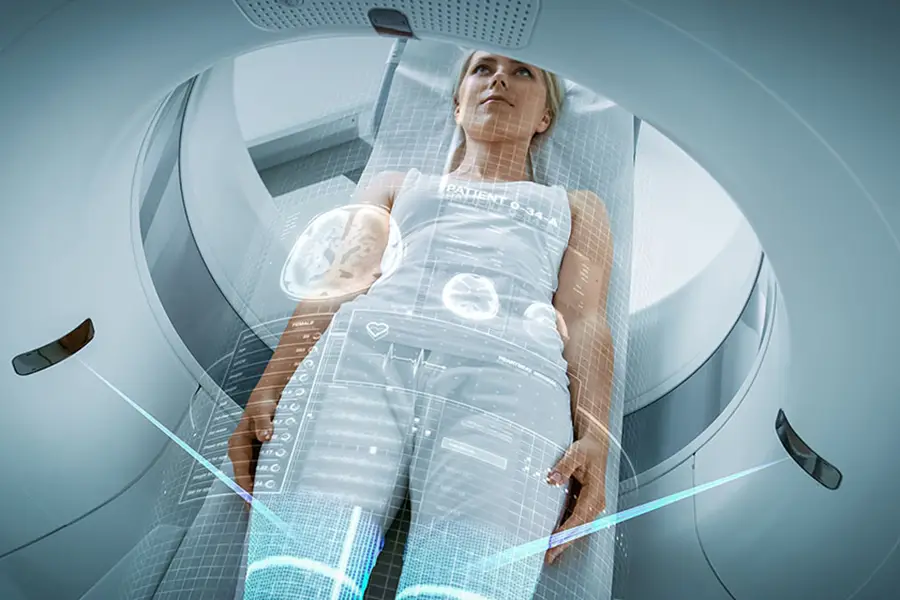
Woman undergoing high-resolution MRI scan to measure brain activity (Photo: Shutterstock)

Bernstein member involved: Kristiane Krug

The study results provide important insights for the diagnosis and possible treatment of central visual disorders that originate not in the eye itself, but in the brain. “We can now track very precisely how the brain processes spatial information,” says Prof. Andrew Parker. “This gives us a better understanding of how depth perception disorders arise and how they could be diagnosed or treated in the future.”

In addition, the work explains a fundamental principle of visual orientation that is important for medicine, robotics, virtual reality systems, and other technological applications. People who can see with both eyes can recognize distances and depth differences, for example, when a ball is flying toward them. The perception of spatial depth arises from the comparison of the slightly different images from both eyes.

It was previously known that individual nerve cells process certain stimuli such as shape, movement, or depth. However, it remained unclear how this information is combined and organized in humans. Prof. Parker’s team has now been able to show that the brain uses individual groups of nerve cells for this purpose, each of which responds to specific characteristics such as shape, movement, or depth. These so-called receptive fields form the basis for processing the many image impressions that our brain assembles in fractions of a second.

For the study, test subjects viewed specially developed 3D patterns while a particularly sensitive MRI device recorded their brain activity. The test subjects lay in a cylindrical channel that generates a strong magnetic field. They viewed the 3D images with a specially developed viewer that presents visual patterns to the left and right eyes independently of each other. When the depth of the patterns was changed, small changes in local blood flow within the visual cortex could be detected with the MR scanner with an accuracy of 1-2 mm.

From this data, the research team reconstructed how the brain processes different depth levels. The activity patterns indicated that the human brain is particularly sensitive to small differences in depth.

The study was published under the title “Receptive fields from single-neuron recording and MRI reveal similar information coding for binocular depth” in the Proceedings of the National Academy of Sciences (PNAS), one of the world’s leading scientific research journals. PNAS publishes peer-reviewed articles from biology, medicine, physics, and related disciplines and is one of the most cited scientific journals worldwide.

Researchers from Otto von Guericke University Magdeburg, the University of Oxford, the Leibniz Institute for Neurobiology in Magdeburg, and the University of Pisa participated in the study.

Further links

Original press release (in German)

> more

Original publication

> more

How the brain conquers space

15. January 2026/in /by Elena Reiriz Martinez

Kontakt Aktuelles

Contact

Scientific contact

Andrew J. Parker
Otto von Guericke University Magdeburg
39106 Magdeburg
Germany

presseteam@ovgu.de

Press contact

Katharina Vorwerk
Otto von Guericke University Magdeburg
39106 Magdeburg
Germany

+49 391-67-58751
katharina.vorwerk@ovgu.de

Bernstein Netzwerk Computational Neuroscience Logo

Become a member
Statutes
Donation
Subscribe to Newsletter


Follow us on

LinkedIn
Bluesky
Vimeo
Mastodon
© 2026 Bernstein Network Computational Neuroscience
  • Contact
  • Imprint
  • Privacy Policy
Scroll to top Scroll to top Scroll to top
Cookie-Zustimmung verwalten
We use cookies to optimize our website and our service.
Functional Always active
Der Zugriff oder die technische Speicherung ist unbedingt für den rechtmäßigen Zweck erforderlich, um die Nutzung eines bestimmten Dienstes zu ermöglichen, der vom Abonnenten oder Nutzer ausdrücklich angefordert wurde, oder für den alleinigen Zweck der Übertragung einer Nachricht über ein elektronisches Kommunikationsnetz.
Vorlieben
Die technische Speicherung oder der Zugriff ist für den rechtmäßigen Zweck der Speicherung von Voreinstellungen erforderlich, die nicht vom Abonnenten oder Nutzer beantragt wurden.
Statistics
Die technische Speicherung oder der Zugriff, der ausschließlich zu statistischen Zwecken erfolgt. Die technische Speicherung oder der Zugriff, der ausschließlich zu anonymen statistischen Zwecken verwendet wird. Ohne eine Aufforderung, die freiwillige Zustimmung Ihres Internetdienstanbieters oder zusätzliche Aufzeichnungen von Dritten können die zu diesem Zweck gespeicherten oder abgerufenen Informationen allein in der Regel nicht zu Ihrer Identifizierung verwendet werden.
Marketing
Die technische Speicherung oder der Zugriff ist erforderlich, um Nutzerprofile zu erstellen, um Werbung zu versenden oder um den Nutzer auf einer Website oder über mehrere Websites hinweg zu ähnlichen Marketingzwecken zu verfolgen.
Manage options Manage services Manage {vendor_count} vendors Read more about these purposes
Settings
{title} {title} {title}