
How social experiences shape behavior
In a German-US collaboration with participation of the European Neuroscience Institute Göttingen (ENI-G), researchers have shown that fruit flies can adapt their social behavior and learn from these experiences. These fundamental mechanisms of social information processing are also important for understanding mental illness. The results have been published in the journal Current Biology. Based on these findings, a follow-up project is being funded by the Ministry of Science and Culture of Lower Saxony and the Volkswagen Foundation with more than 400,000 Euros over two years.
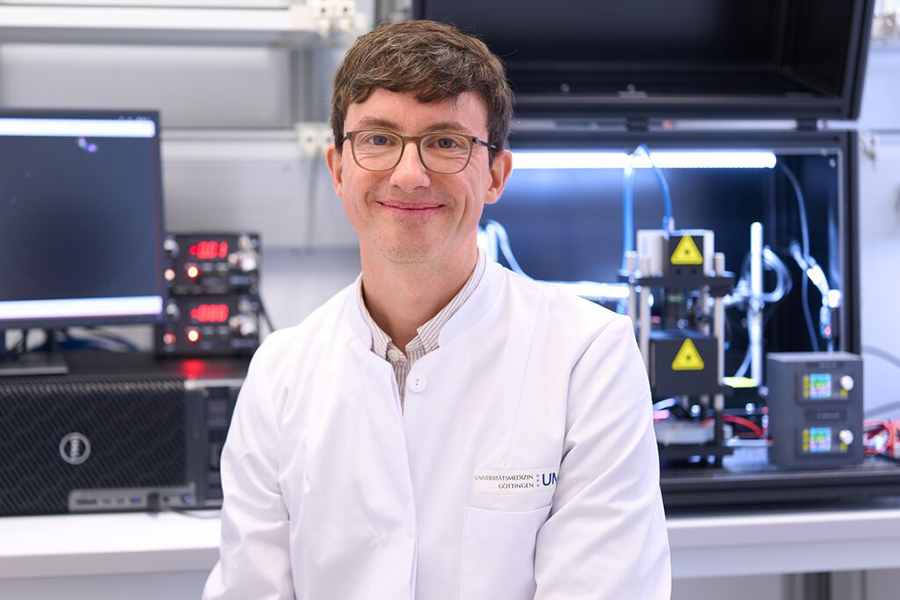
Dr. Frederic Römschied, Group leader at the European Neuroscience Institute Göttingen (ENI-G), in front of the experimental setup used in the funded follow-up project. Photo: umg/frank stefan kimmel
Bernstein member involved: Frederic Römschied
Many animals — including mammals, birds, and insects — learn from social experiences. They adapt their behavior to previous interactions, thereby increasing their chances of survival and reproduction. However, how social experiences shape behavior is still poorly understood.
Dr. Frederic Alexander Römschied, group leader at the European Neuroscience Institute Göttingen (ENI-G) — a collaboration between the University Medical Center Göttingen (UMG) and the Max Planck Institute for Multidisciplinary Sciences — has shown, in collaboration with researchers at Princeton University in New Jersey, USA, that male fruit flies, like humans, can flexibly adapt their behavior to changing social conditions. Using a novel method, the researchers succeeded in controlling the behavior of interacting flies, even against their natural instincts. To do this, the flies’ nerve cells were genetically modified so that they could be specifically activated using LED light. The result: if a fly behaves differently than usual, its counterpart learns from this experience and develops new behavioral strategies to adapt.
“We can now experimentally control social experiences and then examine how behavior adapts to these experiences,” says Dr. Römschied, first author. “This provides us with a basis for understanding how individual social experiences influence neural processes in the long term, enabling learning from social experience. These mechanisms of social information processing are also important for understanding mental illness and could contribute to the development of new treatment approaches in the long term.”
The results have been published in the journal Current Biology.
Building on these findings, the Ministry of Science and Culture of Lower Saxony and the Volkswagen Foundation are funding the follow-up project “ethoLASR: Towards a neuroethology of learning in alternative social realities” with more than 400,000 euros over two years. The aim is to decipher the neural basis for the discovered flexibility of social behavior.
The optogenetic closed-loop stimulation
A new method known as optogenetic closed-loop stimulation was used to study social interactions. This method allows analyzing the behavior of genetically modified and freely interacting flies in real time and influencing their reactions using light as a stimulus. This is based on machine learning, in which computers are trained to learn from recorded data, recognize patterns, and draw conclusions from them. In this study, machine learning is trained to rapidly recognize the behavior of flies based on the incoming data. This allows a targeted influencing of the animals based on their ongoing behavior in real time.
Specifically, pairs of flies, one male and one female, were studied during courtship. Male flies try to persuade the female to mate by “singing” with one of their wings. The female’s nerve cells responsible for backward movement, known as “moonwalker” nerve cells, were activated with LED light every time the male sang. This creates an “alternative social reality” for the male, to which he must adapt because the female is not moving as usual.
Dr. Römschied developed the approach for this method during his time as a postdoctoral researcher in the working group of Prof. Dr. Mala Murthy at Princeton University in New Jersey, USA, who is also the last author of the study. In Göttingen, the method was further developed into a laser-based closed-loop system that can now be used to influence several interacting animals independently of each other. This was supported by the Klaus Tschira Boost Fund.