
The ghosts we see: How afterimages reveal why the world appears stable
Researchers at the Science of Intelligence (SCIoI) Cluster of Excellence are investigating how the brain produces a stable image despite the jerky movements of our eyes. To do this, they use afterimages as an experimental tool.
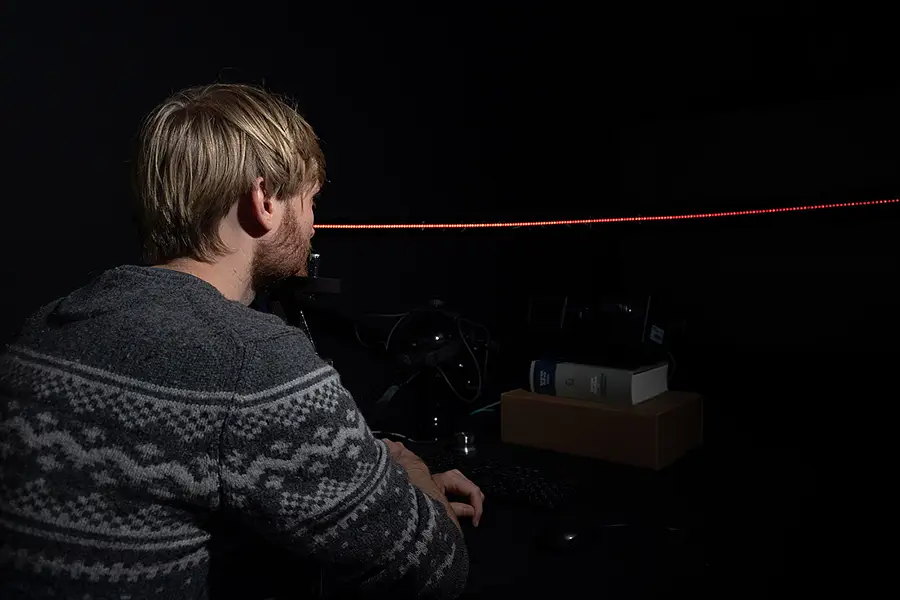
Experimental setup for an experiment conducted by the Science of Intelligence (SCIoI) Cluster of Excellence in Berlin: A subject’s eye movements are recorded in complete darkness using a video-based eye-tracking system. Photo: Martin Rolfs/HU Berlin
Bernstein member involved: Martin Rolfs
Contrary to everyday experience, our eyes do not provide a continuous, stable image of the world. Instead, they make rapid movements several times a second, known as saccades. As the eye projects the environment onto the retina, our gaze would actually have to shift jerkily every time our eyes move. Our perception would be unstable. To prevent this, the brain employs sophisticated mechanisms.
A study recently published in Science Advances now shows that it is ordinary afterimages – blurred outlines that we see, for example, after looking into a bright light source – that provide us with insights into these stability mechanisms. A team of researchers from Humboldt-Universität zu Berlin (HU) and the Technical University of Berlin (TU), led by Dr Richard Schweitzer at the Cluster of Excellence Science of Intelligence (SCIoI), has used such afterimages to investigate exactly how the brain predicts the visual consequences of eye movements. The result: these predictions are astonishingly precise, but contain a small systematic deviation.
Afterimages as a window into the brain’s internal signals
To investigate the brain’s mechanisms, the experiments had to take place in complete darkness – conditions that are virtually the opposite of normal vision. In everyday life, the visual environment provides continuous feedback that helps the brain estimate eye movements.
During the experiments, participants sat in the dark. First, they fixed their gaze on a bright flash of light that produced an afterimage. They then looked at a second light source that flashed briefly. As soon as the afterimage was clearly visible, brief test lights appeared at specific positions. The participants indicated whether the afterimage appeared to the left of the light spot, to the right of it, or exactly at the same height. From these answers, the researchers were able to reconstruct where the afterimage was perceived. At the same time, an eye-tracking system precisely recorded where the participants were actually looking, thus allowing a comparison between eye movement and perception.
Key finding: precise prediction by the brain – but minimal deviation
The afterimages followed the eye movements with astonishing accuracy: the greater the eye movement, the further the afterimage appeared to shift in space. Nevertheless, the correspondence was not perfect.
“On average, the perceived shift of the afterimage corresponded to about 94 per cent of the actual eye movement,” says Dr Richard Schweitzer, a cognitive scientist at HU (now at the University of Trento) and lead author of the study. “Perception therefore follows eye movements very closely – but not completely.”
This slight shortfall, known in technical terms as hypometry, was observed in all participants and remained stable regardless of the direction and magnitude of the eye movements. This suggests that these are not random errors, but rather a systematic inaccuracy in the brain’s prediction. Although the deviation is so small that it is scarcely noticed in everyday life, it provides important insights into how the brain updates the spatial image after every eye movement.
Why a small error might be useful
The minimal discrepancy may be an expected feature of the system. This is because natural eye movements regularly miss their target, for example due to fatigue of the eye muscles. It is therefore plausible that the brain’s internal estimate reflects this behaviour. If eye movements tend to fall slightly short, it makes sense to expect a slightly smaller shift in the visual scene as well. What may be crucial, then, is not so much perfect accuracy as a reliable coordination between movement and perception.
Relevance for robotics and other fields of application
“Afterimages are a useful tool for investigating how the brain stabilises the visual world by predicting the sensory consequences of its own movements,” says Schweitzer. A better understanding of these mechanisms could be relevant beyond basic research, for example in the fields of robotics, virtual reality or clinical research into eye movement disorders, where a reliable link between movement and perception is crucial.