
Bernstein Network News. Find the latest news from our researchers regarding current research results, new research projects and initiatives as well as awards and prizes.
News
News

Tübingen –
June 13, 2024
From dawdling to doing: the science of procrastination
Procrastination, the deliberate but detrimental deferring of tasks, has many forms. Sahiti Chebolu of the Max Planck Institute for Biological Cybernetics uses a precise mathematical framework to understand its different patterns and their underlying reasons. Her insights could help tailor individual strategies to tackle the issue.

Frankfurt am Main –
May 23, 2024
Like ripples in the sand: the young cerebral cortex forms spontaneous patterns
The cortex allows us humans to think, perceive our environment and act purposefully. Certain patterns of brain activity enable this; they emerge early in brain development through dynamic processes of self-organisation. This is shown by researchers from the University of Minnesota (UoM) and the Frankfurt Institute for Advanced Studies (FIAS) in a study published in Nature Communications. They found that the networks of the young cortex convert unstructured input into highly organised activity patterns. The organisation of these patterns is therefore not determined externally (e.g. by sensory input), but arises through interaction between the nerve cells and follows dynamic laws.

Berlin –
May 16, 2024
BIH Researchers develop theory on traveling waves of activity in the human brain
Researchers at the Berlin Institute of Health at Charité (BIH) have used brain simulations to develop a theory on the formation of traveling waves of activity. These waves influence cognitive processes in the human brain such as learning or remembering. Understanding traveling waves of activity can support in treating patients with cognitive disorders.

Munich –
May 15, 2024
Seeing not just with the eyes: degree of arousal affects perception
The brain modulates visual signals according to internal states, as a new study by LMU neuroscientist Laura Busse reveals.

Göttingen, Germany –
April 26, 2024
The right frame determines the movement
Knowledge of spatial reference systems is necessary for the control of neuroprostheses.
Berlin –
April 18, 2024
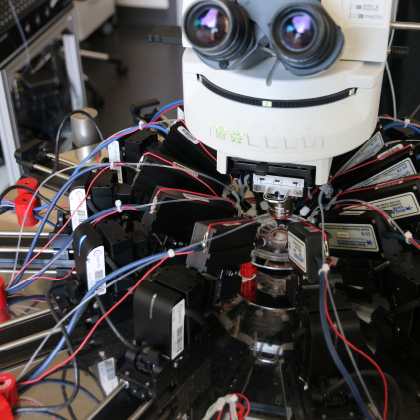
Charité study in Science decodes wiring of the human neocortex
Contrary to previous assumptions, nerve cells in the human neocortex are wired differently than in mice. Those are the findings of a new study conducted by Charité – Universitätsmedizin Berlin and published in the journal Science. The study found that human neurons communicate in one direction, while in mice, signals tend to flow in loops. This increases the efficiency and capacity of the human brain to process information. These discoveries could further the development of artificial neural networks.

Magdeburg –
April 17, 2024
The language of the brain: How memories guide us to rewards
Now in spring, some of us have a particular craving for ice cream. Picture this: You want to take a walk to your favourite ice cream parlour for the first time after winter. You can probably remember how to get there. How does our brain guide us to such rewarding places? In a study recently published in the journal Nature Communications, researchers from the Leibniz Institute of Neurobiology (LIN) in Magdeburg used state-of-the-art methods to answer this question. They discovered that our brain uses a special code to guide us to places that promise rewards.
Göttingen –
April 3, 2024
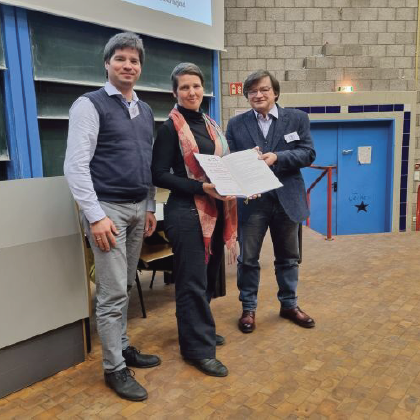
Young Scientist Award für Viola Priesemann
During this year's spring conference of the German Physical Society (DPG), Viola Priesemann received the Young Scientist Award for Socio- and Econophysics. The physicist conducts research at the Max Planck Institute for Dynamics and Self-Organization (MPI-DS) and the University of Göttingen. The prize is endowed with 7,500 euros and honors her work on propagation processes in complex systems.
Jülich –
March 14, 2024
EBRAINS Germany established
EBRAINS Germany, the German National Node of the EBRAINS digital research infrastructure for neuroscience, has been formally established with the signing of a cooperation agreement between the participating institutions: Forschungszentrum Jülich (FZJ, Node Lead), Charité Universitätsmedizin Berlin, Heidelberg University, Central Institute of Mental Health Mannheim, Heidelberg Institute for Theoretical Studies, and Bernstein Network Computational Neuroscience.
Mainz –
February 27, 2024
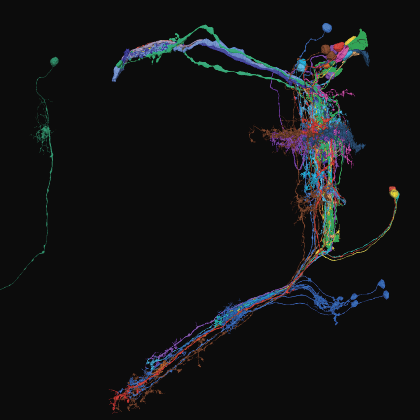
Nerve cells in the visual system of flies are surprisingly heterogeneously connected
Analysis of the Drosophila melanogaster connectome as part of the FlyWire consortium provides new insights into the organization of the visual system

Follow us on