Gottfried Wilhelm Leibniz Prize awarded to Klaus-Robert Müller
The main committee of the German Research Foundation (DFG) today announced the recipients of the Gottfried Wilhelm Leibniz Prize, considered the highest honor for researchers in Germany. Among the ten awardees is Prof. Dr. Klaus-Robert Müller, co-director of BIFOLD and head of the Machine Learning Group at TU Berlin. He is regarded as a pioneer of machine learning and has been driving this important area of artificial intelligence (AI) since 1989. His work combines excellence in formal mathematical reasoning with a strongly application-oriented approach. His interdisciplinary method brings together fields such as biology, medicine, chemistry, mathematics, and computer science.
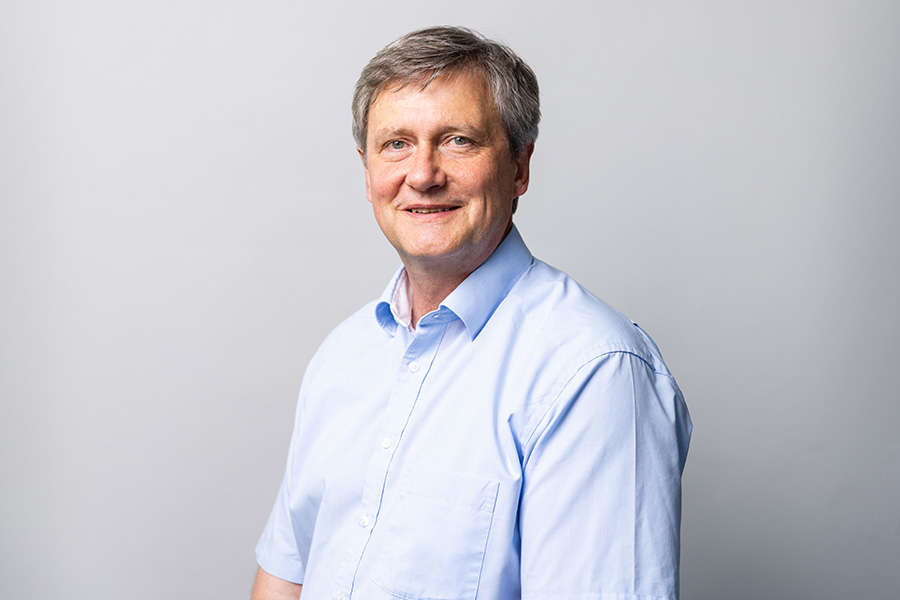
Newly honored Leibniz Prize winner Klaus-Robert Müller. © BIFOLD
An approach that adapts the visual understanding of computer models to that of humans (published in Nature), a new AI-supported method for more precise prognoses for lung cancer patients (Nature Communications), simulations of large biomolecules with quantum-mechanical accuracy (Journal of the American Chemical Society), or revealing faulty prediction strategies in AI (Nature Machine Intelligence): these are just a few of the scientific achievements published in 2025 by Klaus-Robert Müller together with leading international researchers.
Pioneer of Machine Learning
The mathematical tool he uses is machine learning, which Klaus-Robert Müller has helped establish in both academia and industry. It includes statistical algorithms that solve problems through learning, problems for which the solution path cannot simply be described by rules. These algorithms are trained on example data, image recognition being a well-known application. Klaus-Robert Müller has been advancing this key branch of AI since 1989.
Inventor of One of the Most Prominent Methods in Pattern Recognition
One notable example is “support vector machines” (SVMs), among the most prominent theoretical developments in machine learning. These are mathematical methods for pattern recognition in which objects, for example, are classified into categories. Together with his group, Klaus-Robert Müller laid the foundations for these methods, working closely with his mentor Vladimir Vapnik at AT&T Bell Labs in the United States. Many of the most influential and widely cited works in the area of support vector machines originate from Müller’s research group and are regarded as groundbreaking classics.
Deep Neural Networks and Explainable AI
Müller has also produced outstanding theoretical and practical work on so-called deep neural networks, a subfield of machine learning in which algorithms are organized analogously to biological neurons in the human brain. His 2012 book Neural Networks: Tricks of the Trade Link! remains a standard reference today. Since 2010, Klaus-Robert Müller has laid the foundations for explainable AI (XAI), a technology aimed at making the processes involved in training and executing machine learning algorithms transparent and understandable. Understanding why learning algorithms arrive at their predictions is now considered essential for their broad and trustworthy use in science and industry.
Previously Unobserved Properties of Proteins
During his 2011 sabbatical at the Institute for Pure and Applied Mathematics (IPAM) at the University of California, Los Angeles, Klaus-Robert Müller had the groundbreaking idea of using machine learning to predict the outcomes of the Schrödinger equation from quantum mechanics. Working with collaborators, this idea led to a series of publications featuring highly successful applications to molecules. For example, when determining quantum-mechanical molecular properties, accelerations by a factor of roughly 20 million can be achieved compared to traditional methods. Notably, Klaus-Robert Müller also developed the first transformer architecture for quantum chemistry, enabling scaling to larger systems and the detection of previously unobserved protein properties.
Start-ups with Over 500 Employees in Berlin
With more than 600 peer-reviewed scientific publications, an h-index of 168, and over 171,000 citations by other researchers, Klaus-Robert Müller is an exceptionally productive and influential scientist. Forty-eight former members of his research group have become professors. His group has also produced more than 20 start-ups, resulting in over 500 jobs in Berlin. Müller is therefore also exemplary in the field of knowledge transfer for societal benefit.
Co-Director of the Berlin Institute for the Foundations of Learning and Data (BIFOLD)
Since July 1, 2022, Klaus-Robert Müller has co-led the Berlin Institute for the Foundations of Learning and Data (BIFOLD) together with Prof. Dr. Volker Markl. BIFOLD is one of Germany’s six national AI research centers and is jointly funded by the State of Berlin and the Federal Ministry for Research, Technology, and Space. BIFOLD conducts fundamental research in machine learning, data management, and their interfaces, and operates as a cross-university central institute of TU Berlin and Charité – Universitätsmedizin Berlin. Currently, BIFOLD employs over 200 researchers across 14 research groups. BIFOLD has already appointed four new professorships at TU Berlin and one at Charité; two additional professorships at TU Berlin and another at Charité are currently being advertised.