
Bernstein Network Computational Neuroscience
  • Home
  • Network
    • The Bernstein Network
    • Bernstein Centers
      • Berlin
      • Freiburg
      • Göttingen
      • Munich
      • Tübingen
      • Heidelberg-Mannheim
    • Bernstein Nodes
      • Bernstein Node Bochum
      • Bernstein Node Bonn-Cologne
      • Bernstein Node Chemnitz
      • Bernstein Node Hamburg
      • Bernstein Node Rhine-Main Region
      • Bernstein Node Taiwan
    • Research Infrastructure
      • High Performance Simulation and Data Analysis
      • Research Data Management
      • Science Communication
      • Scientific Coordination
    • Awards and Initiatives
      • Valentin Braitenberg Award
      • Brains for Brains Young Researcher Award
      • Bernstein SmartSteps
    • Committees
    • Mission Statement
    • Statutes
    • Membership
    • History
    • Donation
    • Contact
  • Newsroom
    • Newsroom
    • News
    • Events
    • Calls
    • Media Coverage
    • Network Publications
    • Bernstein Bulletin
    • Press
  • Teaching and Research
    • Teaching and Research
    • Meet the Scientist
    • Find a Scientist
    • Degree Programs
      • Master Programs
      • PhD Programs
    • Study and Training
      • Bernstein Student Workshop Series
      • Online Learning
      • Advanced Courses
      • Internships and Master theses
      • Podcasts
  • Career
    • Career
    • Job Pool
    • Calls
    • Internships and Master theses
  • Bernstein Conference
    • Bernstein Conference
    • Program
      • Schedule
      • Satellite Workshops
      • Conference Dinner
    • Early Career Scientists
      • PhD Symposium
      • Postdoc Meeting
      • Travel Grants
      • Buddy Program
    • General Information
      • Important Dates & FAQ
      • Plan Your Visit
      • Press
      • Code of Conduct
      • PR Media Policy
      • Data Policy
    • Past and future Bernstein Conferences
  • DE
  • EN
  • Click to open the search input field Click to open the search input field Search
  • Menu Menu
You are here: Home1 / Newsroom2 / News3 / What mitochondria reveal about the brain
Berlin, Germany – December 15, 2025

What mitochondria reveal about the brain

International researchers have analysed the distribution of mitochondria, the energy producers of cells, in the brain. The results offer new perspectives on the organisation of neuronal networks and their performance.
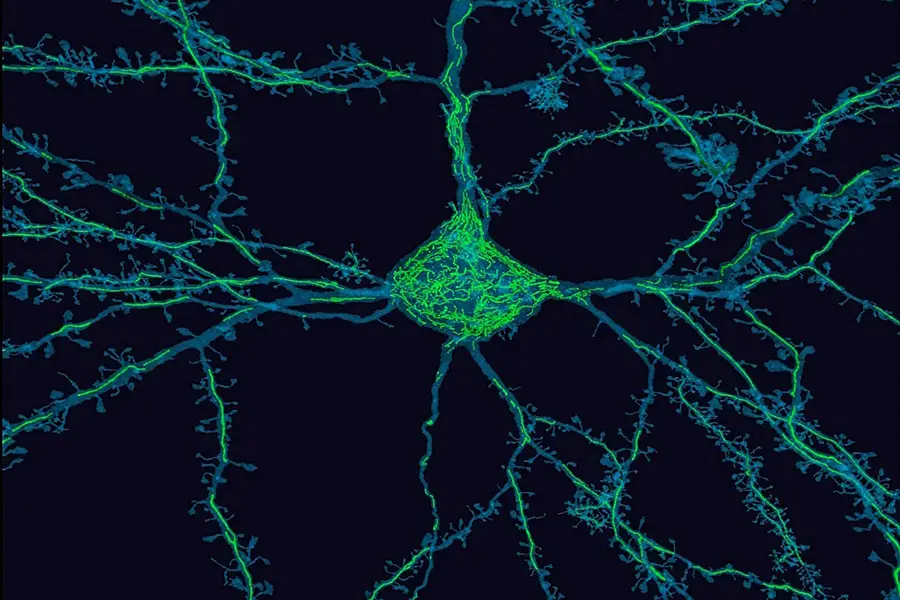
The brain's performance depends not only on its connections, but also on the microscopic organization of its energy systems. Photo: Paul Pfeiffer with data from the MICrONS Consortium displayed with neuroglancer., License: CC-BY, Source: MICrONS Consortium

Bernstein members involved: Paul Pfeiffer, Susanne Schreiber

Researchers at Humboldt-Universität zu Berlin and Yale University have investigated how mitochondria, the cells’ energy producers, are distributed in the brain. Their findings open up new perspectives on the organisation of neuronal networks.

Mapping the brain is currently experiencing a huge boom. Thanks to artificial intelligence and state-of-the-art electron microscopy, researchers are now able to reconstruct the nerve networks of a wide range of animal species – from insects to humans – in unprecedented detail. This results in complex connectomes, three-dimensional maps that show how thousands of nerve cells are connected to each other.

Cellular fingerprint

However, a study now published in the journal Science by researchers from Humboldt-Universität zu Berlin (HU) and Yale University (USA) looks inside these networks. Instead of just looking at the interconnections between cells, they analysed how the “power plants” of the cell, the mitochondria, are distributed within the neuronal network.

Mitochondria provide energy for almost all processes in the body and fulfil far more tasks than previously assumed: They influence the transmission of signals between nerve cells, control sleep and help decide whether a cell lives or dies. Each nerve cell contains hundreds of these tiny organelles. As the brain consumes a particularly large amount of energy, their arrangement can provide crucial information on the functioning of neuronal circuits.

For their study, the international research team analysed an electron microscopy data set of the fruit fly brain with over 100,000 mitochondria – a volume of data that would have been unthinkable just a few years ago – and developed new statistical methods to identify biological structures from this abundance. One surprising result: the shape of the mitochondria acts like a cellular fingerprint. Based on their external shape alone, the researchers were able to predict which cell type the organelles belong to and which neurotransmitter, i.e. biochemical messenger substances, the respective nerve cell utilises. Their distribution also follows clear rules: Mitochondria cluster near synapses, differ between cell areas and show characteristic distribution patterns depending on the cell class.

In comparison with a mouse connectome, many of these principles proved to be surprisingly similar. However, one detail distinguishes the two species: While mitochondria in fruit flies are spaced apart, in mice they form clusters – an observation that raises new questions about the functional significance of this arrangement.

New insights into the performance of the brain

“When we include mitochondria in the analysis of connectomes, we see the brain from a completely new perspective,” says Susanne Schreiber from Humboldt-Universität who led the study together with Damon Clark from Yale University. “It’s not just about which cells are connected, but also about how each cell organises its interior to enable and best support these connections.”

The study bridges the gap between cell biology and systems neuroscience. It shows that the performance of the brain does not depend solely on its wiring, but also on the microscopic organisation of its energy systems. The analysis illustrates how finely tuned the processes within cells are – a finding that suggests that other organelles in connectomes should also be investigated in future in order to understand their role in the function of neuronal circuits.

Further links

Original press release

> more

Original publication

> more

What mitochondria reveal about the brain

16. December 2025/in Ausgewählter Aktuelles-Post für die Startseite /by Elena Reiriz Martinez

Kontakt Aktuelles

Contact

Prof. Dr. rer. nat. Susanne Schreiber

Faculty of Life Sciences
Department of Biology
Computational Neurophysiology
Humboldt University

+49 30 2093 98405
s.schreiber@rz.hu-berlin.de

Bernstein Netzwerk Computational Neuroscience Logo

Become a member
Statutes
Donation
Subscribe to Newsletter


Follow us on

LinkedIn
Bluesky
Vimeo
X
© 2026 Bernstein Network Computational Neuroscience
  • Contact
  • Imprint
  • Privacy Policy
Scroll to top Scroll to top Scroll to top
Cookie-Zustimmung verwalten
We use cookies to optimize our website and our service.
Functional Always active
Der Zugriff oder die technische Speicherung ist unbedingt für den rechtmäßigen Zweck erforderlich, um die Nutzung eines bestimmten Dienstes zu ermöglichen, der vom Abonnenten oder Nutzer ausdrücklich angefordert wurde, oder für den alleinigen Zweck der Übertragung einer Nachricht über ein elektronisches Kommunikationsnetz.
Vorlieben
Die technische Speicherung oder der Zugriff ist für den rechtmäßigen Zweck der Speicherung von Voreinstellungen erforderlich, die nicht vom Abonnenten oder Nutzer beantragt wurden.
Statistics
Die technische Speicherung oder der Zugriff, der ausschließlich zu statistischen Zwecken erfolgt. Die technische Speicherung oder der Zugriff, der ausschließlich zu anonymen statistischen Zwecken verwendet wird. Ohne eine Aufforderung, die freiwillige Zustimmung Ihres Internetdienstanbieters oder zusätzliche Aufzeichnungen von Dritten können die zu diesem Zweck gespeicherten oder abgerufenen Informationen allein in der Regel nicht zu Ihrer Identifizierung verwendet werden.
Marketing
Die technische Speicherung oder der Zugriff ist erforderlich, um Nutzerprofile zu erstellen, um Werbung zu versenden oder um den Nutzer auf einer Website oder über mehrere Websites hinweg zu ähnlichen Marketingzwecken zu verfolgen.
Manage options Manage services Manage {vendor_count} vendors Read more about these purposes
Settings
{title} {title} {title}