
Mathematics reveals brain changes
The brain’s internal communication patterns change over the course of our lives and also differ in people with certain neurological conditions. Understanding these processes is one of the central challenges of modern neuroscience. A new study introduces a novel mathematical approach which enables identification of specific brain regions whose connectivity shifts with age or differs in autism spectrum disorder (ASD) - offering insights that could inform targeted brain stimulation therapies.
© MiS
Bernstein member involved: Jürgen Jost
To the point / key findings:
- Bridge between pure mathematics and clinical neuroscience.
- Mathematical topology reveals multiscale changes in brain connectivity in aging and autism.
- New mathematical measure node persistence identifies specific brain regions most affected by these changes, and some of these regions are known to be clinically relevant.
- Findings highlight potential targets for non-invasive brain stimulation therapies.
It is a central question in neuroscience to understand how different regions of the brain interact, how strongly they “talk” to each other. Researchers from the Max Planck Institute for Mathematics in the Sciences Leipzig, Germany, the Institute of Mathematical Sciences in Chennai, India, and colleagues demonstrate how mathematical techniques from topological data analysis (TDA) can provide a new, multiscale perspective on brain connectivity. The study was published in the journal Patterns.
A topological lens on the brain
With the rise of large neuroimaging datasets, scientists now work with detailed maps of brain connectivity—network representations that show how hundreds of brain regions fluctuate and coordinate their activity over time. But making sense of these enormous networks poses a challenge: What patterns matter? Which changes signal healthy aging, and which reflect differences associated with autism spectrum disorder (ASD)? The study introduces a mathematical innovation that helps answer precisely these questions. Researchers applied persistent homology, a tool from topological data analysis (TDA), to detect how brain connectivity reorganizes during healthy aging and in ASD.
Topological data analysis (TDA) is a sophisticated mathematical framework that examines the underlying “shape” of complex data. At its core is persistent homology (PH), a technique that identifies and tracks topological features—such as connected components, loops, and voids—across multiple scales. Unlike conventional network analyses that rely on arbitrary thresholds, PH provides a robust, parameter-free characterization of brain network structure.
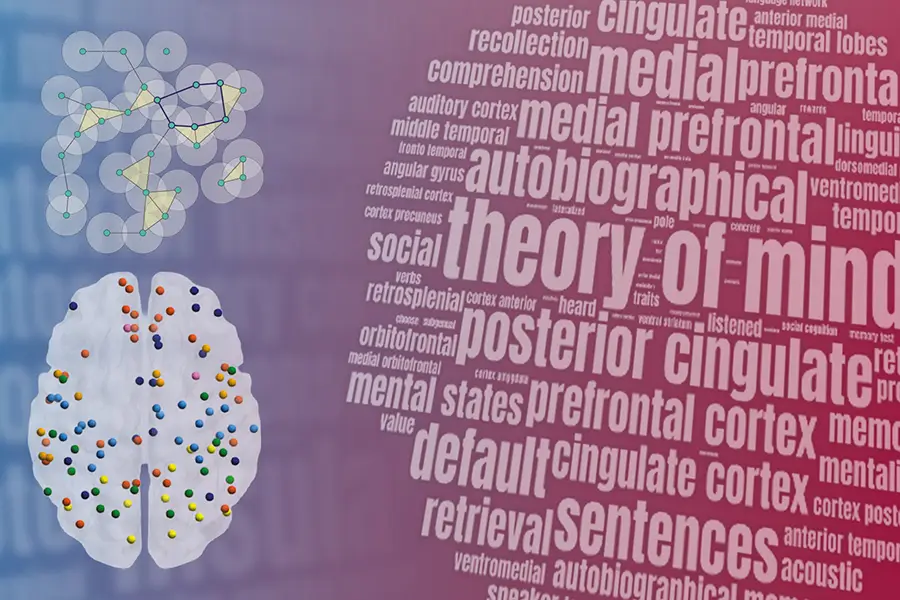
The key innovation of this research is the development of node persistence, a new, computationally efficient measure that identifies specific brain regions with significant differences in functional connectivity. The scientists transformed brain connectivity into a sequence of simplicial complexes, which includes edges gradually, starting from those with the strongest correlations and moving toward weaker correlations between brain regions. As weaker connections gradually enter the picture, new loops and structures appear and disappear. Persistent homology measures how long these features survive—how persistent they are. This local measure allows to pinpoint not just that a simplicial complex has changed, but where and how these changes occur at the regional level. Long-lasting features tend to reflect important, biologically meaningful structures.
Three scales of analysis: from the whole brain to individual regions
Using resting-state fMRI data from over 1,000 individuals the team conducted a comprehensive multiscale analysis investigating changes in brain connectivity across three spatial scales. At the global level, the researchers used topological measures such as persistent entropy and persistence landscapes to characterize the overall “shape” of functional brain networks. They found that young adults exhibit more complex and longer-lasting topological features than older adults, while autistic individuals show higher persistent entropy but less-persistent one-dimensional structures compared with typically developing individuals. These results indicate that the global organization of functional connectivity shifts both with age and in autism.
At the mesoscopic level, the team examined seven major resting-state networks, including the somatomotor, default mode, and dorsal attention networks. Their analyses revealed that aging particularly affects the somatomotor, dorsal attention, salience/ventral attention, and default mode networks, whereas autism-related differences are concentrated in the somatomotor, salience/ventral attention, and default mode networks. This demonstrates that global effects do not arise uniformly across the brain but stem from specific functional systems.
At the local level, the authors used the new topological measure node persistence to identify individual brain regions that contribute most strongly to connectivity differences. Using this approach, they detected 108 regions showing age-related alterations and 27 regions showing ASD-related alterations. Many of these regions are linked to well-known functions such as movement, language, memory, and social cognition. Notably, several overlap with areas previously shown to respond to non-invasive brain stimulation techniques such as TMS (transcranial magnetic stimulation) or tDCS (transcranial direct current stimulation).
“This is more than just a new analytical tool,” underline Prof. Jürgen Jost and Prof. Areejit Samal, lead authors of the study. “We’ve created a bridge between pure mathematics and clinical neuroscience. Node persistence doesn’t just detect changes, it identifies the specific brain regions that are most vulnerable or altered in these conditions. This gives us a powerful new way to generate hypotheses for targeted therapies.”
Why mathematics matters & clinical relevance
By bridging algebraic topology and functional neuroimaging, this work demonstrates how mathematical frameworks can yield biologically and clinically meaningful insights into brain connectivity. The authors note that their local measures currently focus on one-dimensional features, and future work could extend these tools to capture higher-dimensional structures. Nonetheless, this study provides the first demonstration that persistent homology can effectively detect aging- and ASD-related changes across multiple scales—from whole-brain architecture down to individual regions—and that these mathematical features align with established cognitive domains and clinical intervention targets.
Through this multiscale, topologically grounded lens, node persistence offers a new way of understanding how the brain’s functional landscape changes across the lifespan and varies between neurotypical and atypical development. Its promise extends beyond aging and ASD, potentially opening new pathways for analyzing diverse neuropsychiatric conditions and guiding therapeutic approaches that rely on identifying the most affected neural circuits.