Bernstein Network Computational Neuroscience
  • Home
  • Network
    • The Bernstein Network
    • Bernstein Centers
      • Berlin
      • Freiburg
      • Göttingen
      • Munich
      • Tübingen
      • Heidelberg-Mannheim
    • Bernstein Nodes
      • Bernstein Node Bochum
      • Bernstein Node Bonn-Cologne
      • Bernstein Node Chemnitz
      • Bernstein Node Hamburg
      • Bernstein Node Rhine-Main Region
      • Bernstein Node Taiwan
    • Research Infrastructure
      • High Performance Simulation and Data Analysis
      • Research Data Management
      • Science Communication
      • Scientific Coordination
    • Awards and Initiatives
      • Valentin Braitenberg Award
      • Brains for Brains Young Researcher Award
      • Bernstein SmartSteps
    • Committees
    • Network Ethics and Values
    • Statutes
    • Membership
    • History
    • Donation
    • Contact
  • Newsroom
    • Newsroom
    • News
    • Events
    • Calls
    • Media Coverage
    • Network Publications
    • Bernstein Bulletin
    • Press
  • Teaching and Research
    • Teaching and Research
    • Meet the Scientist
    • Find a Scientist
    • Degree Programs
      • Master Programs
      • PhD Programs
    • Study and Training
      • Bernstein Student Workshop Series
      • Online Learning
      • Advanced Courses
      • Internships and Master theses
      • Podcasts
  • Career
    • Career
    • Job Pool
    • Calls
    • Internships and Master theses
  • Bernstein Conference
    • Bernstein Conference
    • Program
      • Satellite Workshops
    • Past and future Bernstein Conferences
  • DE
  • EN
  • Click to open the search input field Click to open the search input field Search
  • Menu Menu
You are here: Home1 / Newsroom2 / News3 / Brain network identified for effective treatment of Parkinson’s disease
Cologne, Germany – February 6, 2026

Brain network identified for effective treatment of Parkinson’s disease

Deep brain stimulation is a key procedure in the treatment of Parkinson's disease. Researchers have now identified the optimal target network in the human brain.
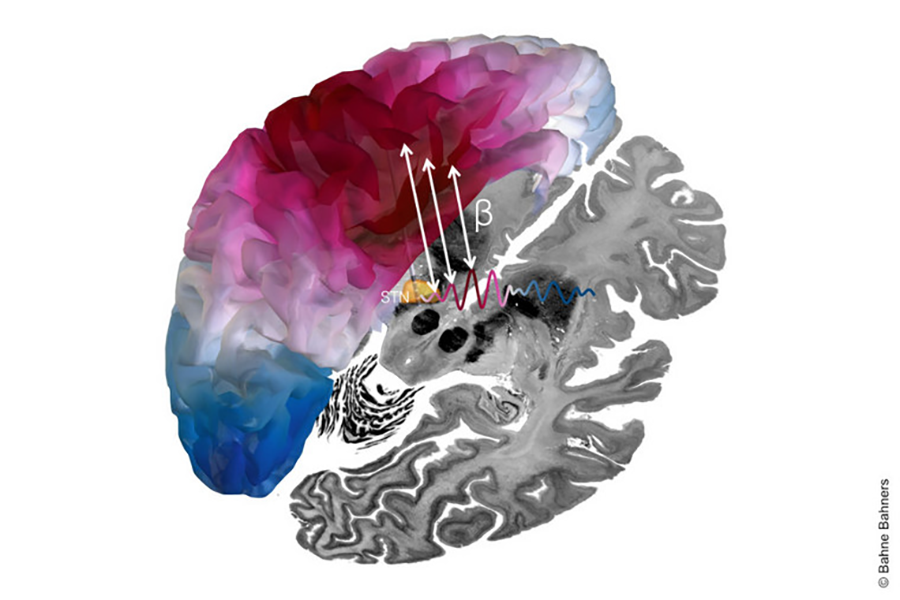
3D representation of beta connectivity between the site of stimulation (subthalamic nucleus, STN) and the cerebral cortex, as well as a schematic representation of connectivity over time. The Big Brain Atlas is shown in the background (Amunts et al. 2013. Science). © Bahne Bahners

Bernstein member involved: Wolf-Julian Neumann

Deep brain stimulation (DBS) improves motor symptoms of Parkinson’s disease by modulating a specific brain network that is mainly active in the fast beta frequency range (20 to 35 Hz). This conclusion was reached by an interdisciplinary team of neuroscientists and clinicians from the University Hospitals of Cologne and Düsseldorf, Harvard Medical School and Charité Berlin. The study ‘The Deep Brain Stimulation Response Network in Parkinson’s Disease Operates in the High Beta Band’ in the journal Brain is the first to bridge the gap between two ways of analyzing DBS response that were previously widely separate: electrophysiology and brain imaging.

“For the first time, we were able to characterize the DBS response network in Parkinson’s disease in terms of space and time, simultaneously,” says Professor Dr Andreas Horn from the University of Cologne, who led the study and specializes in computational neurology. “We show that Parkinson’s disease can best be treated if we stimulate a very precisely defined network. This network operates synchronized within a specific frequency band, and offers an explanation for how well patients respond to deep brain stimulation.”

Deep brain stimulation of the subthalamic nucleus is an established treatment method for alleviating motor symptoms in people with Parkinson’s disease by delivering small electric pulses to deep regions of the brain. Whereas previous imaging studies have shown where in the brain the stimulation works best, and electrophysiological studies described the frequency of the underlying signals, no study has yet been able to capture both dimensions simultaneously in space and time.

The research team analysed data from a large multi-centre cohort with one hundred brain hemispheres from fifty patients. Using brain signals that were simultaneously recorded via the implanted DBS electrode and magnetoencephalography (MEG), the scientists mapped the functional connectivity between the deep and superficial areas of the brain.

The study showed that the relevant network between the subthalamic nucleus and frontal brain regions largely communicates at a comparatively fast frequency (20-35 Hz). The strength of this connection explains how well the motor symptoms of individual patients improved after electrode implantation.

“These results suggest that a certain rhythm of the brain acts as a communication channel between the subthalamic nucleus and the cerebral cortex and may mediate the therapeutic effects of deep brain stimulation,” explains Dr Bahne Bahners, first author of the study, who works at Düsseldorf University Hospital. “By stimulating regions that are connected to the identified network, we will probably be able to adjust DBS settings more precisely in the future, especially in patients who have not yet benefited optimally from deep brain stimulation.”

In the future, the researchers plan to take a closer look at the causal effects of deep brain stimulation on brain networks. Studies to this effect are currently being conducted.

The study was largely funded by the Professor Klaus Thiemann Foundation.
Further links

Original press release

> more

Original publication

> more

Video (in German): Tiefe Hirnsimulation als Therapie bei Parkison

> more

Brain network identified for effective treatment of Parkinson’s disease

9. February 2026/in /by Elena Reiriz Martinez

Kontakt Aktuelles

Contact

Professor Dr. Andreas Horn

Scientific contact
Institute for Network Stimulation
University of Cologne

+49 221 470 2309
andreas.horn@uni-koeln.de

Dr. Anna Euteneuer

Press contact
University of Cologne

+49 221 470 1700
a.euteneuer@verw.uni-koeln.de

Bernstein Netzwerk Computational Neuroscience Logo

Become a member
Statutes
Donation
Subscribe to Newsletter


Follow us on

LinkedIn
Bluesky
Vimeo
Mastodon
© 2026 Bernstein Network Computational Neuroscience
  • Contact
  • Imprint
  • Privacy Policy
Scroll to top Scroll to top Scroll to top
Cookie-Zustimmung verwalten
We use cookies to optimize our website and our service.
Functional Always active
Der Zugriff oder die technische Speicherung ist unbedingt für den rechtmäßigen Zweck erforderlich, um die Nutzung eines bestimmten Dienstes zu ermöglichen, der vom Abonnenten oder Nutzer ausdrücklich angefordert wurde, oder für den alleinigen Zweck der Übertragung einer Nachricht über ein elektronisches Kommunikationsnetz.
Vorlieben
Die technische Speicherung oder der Zugriff ist für den rechtmäßigen Zweck der Speicherung von Voreinstellungen erforderlich, die nicht vom Abonnenten oder Nutzer beantragt wurden.
Statistics
Die technische Speicherung oder der Zugriff, der ausschließlich zu statistischen Zwecken erfolgt. Die technische Speicherung oder der Zugriff, der ausschließlich zu anonymen statistischen Zwecken verwendet wird. Ohne eine Aufforderung, die freiwillige Zustimmung Ihres Internetdienstanbieters oder zusätzliche Aufzeichnungen von Dritten können die zu diesem Zweck gespeicherten oder abgerufenen Informationen allein in der Regel nicht zu Ihrer Identifizierung verwendet werden.
Marketing
Die technische Speicherung oder der Zugriff ist erforderlich, um Nutzerprofile zu erstellen, um Werbung zu versenden oder um den Nutzer auf einer Website oder über mehrere Websites hinweg zu ähnlichen Marketingzwecken zu verfolgen.
Manage options Manage services Manage {vendor_count} vendors Read more about these purposes
Settings
{title} {title} {title}