

Bernstein Network News. Find the latest news from our researchers regarding current research results, new research projects and initiatives as well as awards and prizes.

News
News

Frankfurt –
March 3, 2020
How we learn to see. Active efficient coding explains the development of binocular vision
Using a new model, scientists from the Frankfurt Institute for Advanced Studies (FIAS) and Goethe University can explain the development of binocular vision, which is the joint vision of the right and left eye. In doing so, they show how amblyopic visual impairment can occur.

Cologne –
February 28, 2020
Quantifying objects: bees recognize that six is more than four
A new study at the University of Cologne proves that insects can perform basic numerical cognition tasks. Their neuronal network can also be used to perform successful machine learning
Mainz –
January 30, 2020
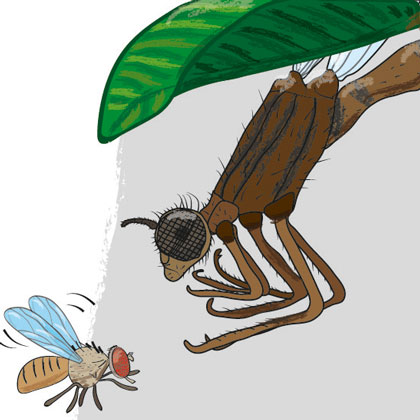
Fruit flies respond to rapid changes in the visual environment thanks to luminance-sensitive lamina neurons
Neurons in the visual system sensitive to luminance make it possible to maintain effective vision and react appropriately when encountering sudden decreases in illumination

Bonn –
January 23, 2020
How moon jellyfish get about
Researchers at the University of Bonn use a mathematical model to show how nerve cells control swimming.

Göttingen –
January 17, 2020
Swing feel in the lab
The role of temporal fluctuations for the swing feel in jazz music

Berlin –
January 15, 2020
Novel cutting-edge AI research Centre in Berlin is funded with millions of euros by the German Government and the State of Berlin
The Berlin Institute for the Foundation of Learning and Data (BIFOLD) bundles AI expertise in the German capital merging the Berlin Centre for Machine Learning (BZML) and the Berlin Big Data Center (BBDC).

Freiburg –
December 15, 2019
Sparking research enthusiasm amongst young and old
The booth of the Bernstein Network at the FORSCHA in Munich was one of the biggest magnet for inquisitive visitors of all ages.
Cambridge –
December 13, 2019
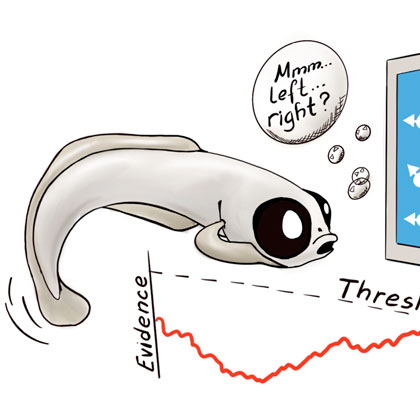
Larval zebrafish as a model for perceptual decision-making
How larval zebrafish can be used for the study of perceptual decision-making

Berlin –
December 10, 2019
ERC Grants for Susanne Schreiber and Martin Rolfs in Berlin
The European Research Council supports three excellent projects at the Humboldt-Universität, two of which are headed by members of the Bernstein Network Computational Neuroscience.
Göttingen –
December 9, 2019
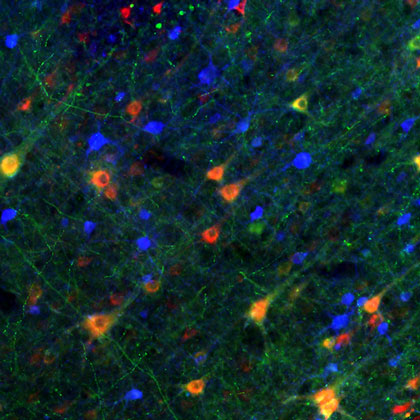
How a penalty shootout is decided in the brain
Decision-making is controlled by different nerve cells

Follow us on