
The shoal remembers: How signs of a collective memory shape a predator-prey arms race
Beneath the tropical trees of southern Mexico, enormous shoals of sulphur mollies blanket the water surface of toxic sulphur springs, where survival depends on collective defence against relentless attacks from predatory birds. The tiny fish survive attacks of birds through creating spectacular collective waves. But new research now shows that their avian predators are adapting too, changing where they attack to avoid triggering the fish’s powerful group defence. The fish, in turn, appear to fight back with a surprising form of collective “memory.” The study by the Cluster of Excellence “Science of Intelligence” (SCIoI) in collaboration with the Leibniz Institute of Freshwater Ecology and Inland Fisheries (IGB) was published today in the journal Proceedings of the Royal Society B.
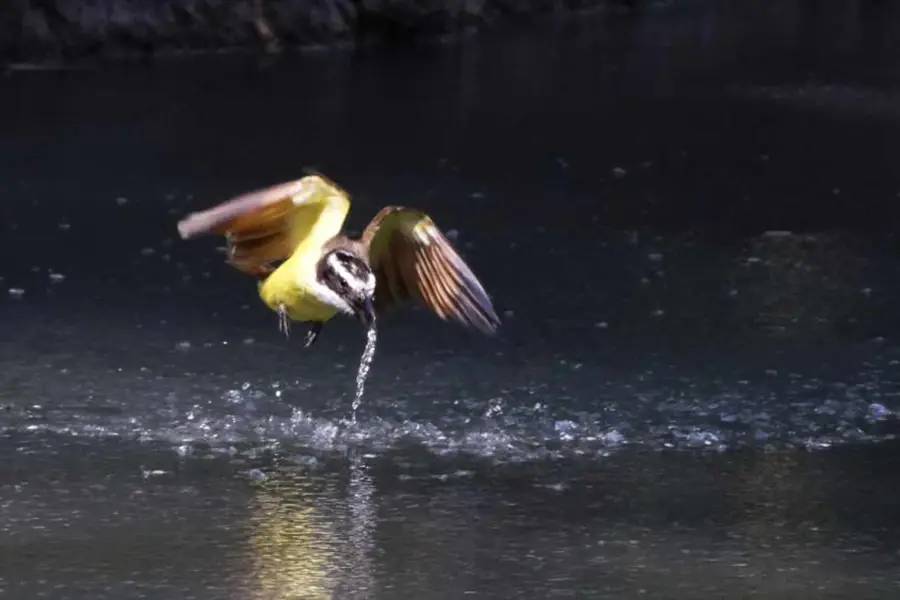
Great kiskadee in full flight after an (unsuccessful) overflight attack on a sulphur molly shoal. | Photo: Max Licht
Bernstein member involved: Pawel Romanczuk
For years, scientists have known that animal groups can achieve remarkable things by working together. Fish schools, bird flocks and insect swarms can collectively evade predators, process information and coordinate movements with astonishing precision. And sulphur mollies are among the most striking examples. When predatory birds attack these fish shoals, the mollies respond with so-called collective repeat waves: rapid, synchronized diving movements that ripple visibly across the water surface like shockwaves. Earlier research had already shown that these waves are an effective defence mechanism, reducing predator efficiency and increasing the time birds wait before attacking again.
But one major question remained unanswered: what do predators do in response? Do they simply accept the costs imposed by the prey, or do they actively try to outsmart the group?
Birds adapt their attacks to avoid triggering waves
To investigate this, the research team from the Cluster of Excellence SCIoI and IGB analysed nearly 800 attacks by three bird species hunting sulphur mollies in the wild: Amazon kingfishers, green kingfishers and great kiskadees. For weeks, the team sat almost motionless beside the sulphur river in Tabasco, Mexico, waiting for birds to appear. A test of patience that eventually resulted in around 120 hours of video footage and one of the largest datasets ever collected on this unusual predator-prey system.
The birds did not only attack where their chance of success was highest. Instead, kingfishers preferentially targeted the edges of the fish shoals, regions that triggered fewer collective waves. This came at a cost. Attacks into the centre of the shoal were actually more successful. But they also provoked much stronger collective responses, forcing predators into longer waiting times before they could strike again. By attacking the periphery instead, the birds appeared to sacrifice immediate hunting success in exchange for avoiding the disruptive effects of the waves. The predators, in other words, seemed to strategically exploit weak points in the prey’s collective defence.
Different predators reveal the logic behind the arms race
Not all birds behaved the same way, however, and this turned out to be one of the study’s most revealing findings. Great kiskadees used a very different hunting strategy from the kingfishers. Rather than launching highly visible attacks, they performed fast, cryptic overflight strikes that often caught fish before the shoal could fully react. Because these attacks triggered only weak collective waves, kiskadees could attack directly into the centre of the shoal, where capture success was highest. This distinction helped reveal what the predators were truly avoiding. The birds were not avoiding the shoal centre itself. They were avoiding the powerful collective response associated with attacking there. As soon as a predator could circumvent the waves through another strategy, the centre once again became the preferred target. The findings therefore suggest that the fish’s collective behavior is an active force shaping predator decision-making in real time.
The shoal appears to “remember”
But the most unexpected discovery has been observed in the behavior of the fish collective. The researchers found evidence that sulphur mollies collectively “remember” previous predator attacks. When two attacks occurred close together in space, the fish responded with significantly stronger waves during the second strike. The team calls this phenomenon priming. Priming is known from many biological systems, including brains and the immune system, where previous exposure changes how strongly a system reacts in the future. But observing such an effect in a large animal collective is highly unusual. “Usually, we think of memory as something stored inside brains or individuals”, said lead author Korbinian Pacher. “Here, we see indications that previous predator attacks can temporarily change how the collective itself responds. The shoal appears to carry a trace of past danger.”
Importantly, the fish were not only reacting to the immediate attack in front of them. Their response was also shaped by what had happened before. Areas of the shoal that had recently experienced danger appeared to become temporarily more sensitive, producing stronger collective waves when predators returned nearby. In response, predators again adjusted their behavior: after triggering many waves, kingfishers tended to place their next attacks farther away. This creates a feedback loop between predator and prey.
Birds attempt to minimize the fish’s collective defence by attacking locations that produce weaker waves. The fish, meanwhile, appear to counter this strategy through priming, effectively increasing their responsiveness in recently threatened regions and forcing predators to vary their attacks more widely. Who ultimately has the upper hand in this behavioral arms race remains unclear. “What makes this system so fascinating is that both sides constantly adjust to each other”, said senior author Jens Krause. “The predators change where they attack to avoid triggering strong waves, while the fish appear to collectively retain information about previous attacks. It shows how dynamic and sophisticated collective behavior in nature can be.”
What the study reveals is a far more dynamic picture of collective behavior than previously understood. The findings suggest that animal groups may not only coordinate collectively in the moment, but can also temporarily retain traces of past events within the dynamics of the collective itself, allowing previous experiences to shape future group responses without any central coordination or leader.