
Bernstein Network Computational Neuroscience
  • Home
  • Network
    • The Bernstein Network
    • Bernstein Centers
      • Berlin
      • Freiburg
      • Göttingen
      • Munich
      • Tübingen
      • Heidelberg-Mannheim
    • Bernstein Nodes
      • Bernstein Node Bochum
      • Bernstein Node Bonn-Cologne
      • Bernstein Node Chemnitz
      • Bernstein Node Hamburg
      • Bernstein Node Marburg
      • Bernstein Node Paris
      • Bernstein Node Rhine-Main Region
      • Bernstein Node Taiwan
    • Bernstein Facilities
      • High Performance Simulation and Data Analysis
      • Research Data Management
      • Bernstein Coordination Site (BCOS)
    • Awards and Initiatives
      • Valentin Braitenberg Award
      • Brains for Brains Young Researcher Award
      • Promoting Young Scientists
    • Committees
    • Network Ethics and Values
    • Statutes
    • Membership
    • History
    • Donation
    • Contact
  • Newsroom
    • Newsroom
    • News
    • Events
    • Calls
    • Media Coverage
    • Network Publications
    • Bernstein Bulletin
    • Press
  • Teaching and Research
    • Teaching and Research
    • Meet the Scientist
    • Find a Scientist
    • Degree Programs
      • Master Programs
      • PhD Programs
    • Study and Training
      • Bernstein Student Workshop Series
      • Online Learning
      • Advanced Courses
      • Internships and Master theses
      • Podcasts
  • Career
    • Career
    • Job Pool
    • Calls
    • Internships and Master theses
  • Bernstein Conference
    • Bernstein Conference
    • Abstract Submission
    • Registration
    • Exhibition
    • Program
      • Program at a Glance
      • Satellite Workshops
      • Conference Dinner
    • Early Career Scientists
      • Travel Grants
      • PhD Symposium
      • Postdoc Meeting
    • General Information
      • Important Dates & FAQ
      • Plan Your Visit
      • Press
      • Code of Conduct
      • PR Media Policy
      • Data Policy
    • Past and future Bernstein Conferences
  • DE
  • EN
  • Click to open the search input field Click to open the search input field Search
  • Menu Menu
You are here: Home1 / Newsroom2 / News3 / Limited connections: How stress affects our brain
Hamburg, Germany – June 1, 2026

Limited connections: How stress affects our brain

Our brain automatically compares new information with existing memories and links them together. Through this integration into our memory, we build knowledge. An international research team led by Prof. Dr. Lars Schwabe from the Department of Cognitive Psychology at the University of Hamburg has now demonstrated that acute stress negatively affects these processes in the brain. The study was published in Science Advances.
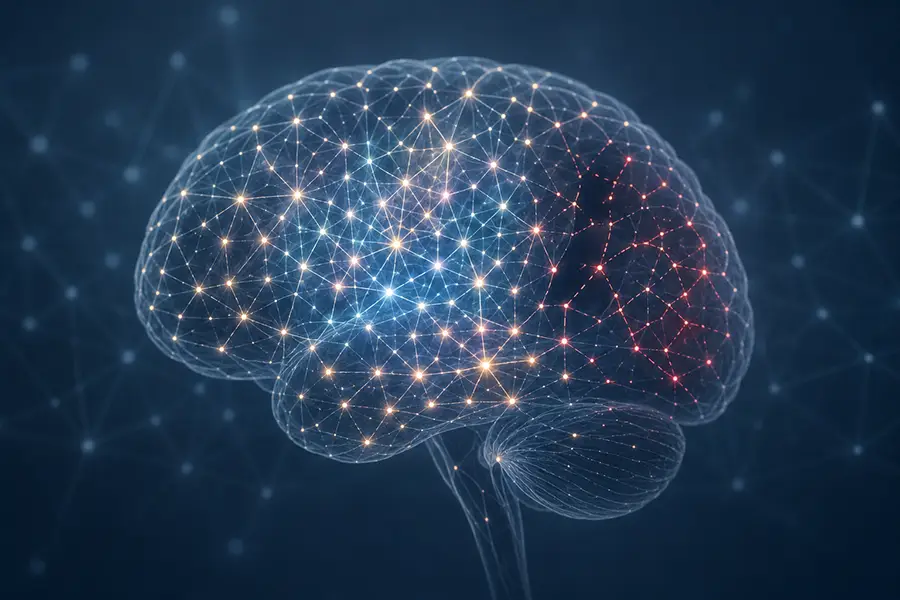
Abstract illustration of a brain-wide memory network, in which numerous interconnected nodes form an integrated representation of stored information. A localized region of weakened and interrupted connections symbolizes the disruptive effects of stress on neural communication and network integration. Source: OpenAI / Bernstein Coordination Site

Bernstein member involved: Lars Schwabe

Here’s a practical example: If a friend shows you her new blue scooter and you later see it parked in front of the library, your brain automatically combines the existing information with the new information to conclude that your friend might be in the library. In psychological research, these flexible conclusions—which go beyond direct observations—are called inferences.

The current study, conducted by researchers at the University of Hamburg, the University of Texas (USA), and the Radboud University Medical Center in Nijmegen (Netherlands), focused on the effects of stress on these processes—particularly on the reactivation of familiar information.

“It is well known that stress can influence the storage and retrieval of information. We examined for the first time how this state alters the integration of related information and were able to show in our study that existing memories are less likely to be reactivated during overlapping experiences under stress, so that they tend to be differentiated from one another rather than integrated,” explains study leader Prof. Dr. Lars Schwabe, Professor of Cognitive Psychology at the Faculty of Psychology and Human Movement Science.

As part of the study, adult participants had to memorize various pairs of images (A+B) on the first day. The next day, they learned other pairs of images that overlapped with the content from the first day (B+C). Later, the researchers tested whether the participants could make the connection from A to C. To observe differences in how the information from the second pair of images was integrated, one group was deliberately put under stress at the start of the second day through a simulated job interview and difficult math problems. The other group, in contrast, performed only a stress-free control task.

Using functional magnetic resonance imaging (fMRI), the researchers were able to see which areas of the brain were activated during the processing of the individual images. The focus was on the hippocampus, a brain region central to memory processes. It turned out that the stressed test subjects were able to remember the second pairs of images as well as the control group. However, the areas responsible for processing information A were less strongly activated in them when viewing image pair B+C. As a result, they sometimes had more difficulty making the connection from A to C. “Our results thus show that acute stress impairs a central mechanism of memory integration,” said Schwabe.

These findings are significant for various fields. It is known, for example, that various psychiatric disorders such as psychoses or anxiety disorders can impair the ability to draw conclusions. “Impaired integration of overlapping memories is also relevant in a legal context when it leads to false conclusions or unjustified accusations. And in education, the linking of related information is the foundation for long-term learning success,” says cognitive psychologist Schwabe. Therefore, understanding the influence of stress on memory integration is an important starting point for interventions and therapies.

Further links

Original press release

> more

Original publication

> more

Limited connections: How stress affects our brain

9. June 2026/in Ausgewählter Aktuelles-Post für die Startseite /by Alexandra Stein

Kontakt Aktuelles

Contact

Prof. Dr. Lars Schwabe

University of Hamburg
Faculty of Psychology and Human Movement Science
Cognitive Psychology
Germany

+49 40 2395-25950
lars.schwabe@uni-hamburg.de

Bernstein Netzwerk Computational Neuroscience Logo

Become a member
Statutes
Donation
Subscribe to Newsletter


Follow us on

LinkedIn
Bluesky
Vimeo
Mastodon
© 2026 Bernstein Network Computational Neuroscience
  • Contact
  • Imprint
  • Privacy Policy
Scroll to top Scroll to top Scroll to top
Cookie-Zustimmung verwalten
We use cookies to optimize our website and our service.
Functional Always active
Der Zugriff oder die technische Speicherung ist unbedingt für den rechtmäßigen Zweck erforderlich, um die Nutzung eines bestimmten Dienstes zu ermöglichen, der vom Abonnenten oder Nutzer ausdrücklich angefordert wurde, oder für den alleinigen Zweck der Übertragung einer Nachricht über ein elektronisches Kommunikationsnetz.
Vorlieben
Die technische Speicherung oder der Zugriff ist für den rechtmäßigen Zweck der Speicherung von Voreinstellungen erforderlich, die nicht vom Abonnenten oder Nutzer beantragt wurden.
Statistics
Die technische Speicherung oder der Zugriff, der ausschließlich zu statistischen Zwecken erfolgt. Die technische Speicherung oder der Zugriff, der ausschließlich zu anonymen statistischen Zwecken verwendet wird. Ohne eine Aufforderung, die freiwillige Zustimmung Ihres Internetdienstanbieters oder zusätzliche Aufzeichnungen von Dritten können die zu diesem Zweck gespeicherten oder abgerufenen Informationen allein in der Regel nicht zu Ihrer Identifizierung verwendet werden.
Marketing
Die technische Speicherung oder der Zugriff ist erforderlich, um Nutzerprofile zu erstellen, um Werbung zu versenden oder um den Nutzer auf einer Website oder über mehrere Websites hinweg zu ähnlichen Marketingzwecken zu verfolgen.
Manage options Manage services Manage {vendor_count} vendors Read more about these purposes
Settings
{title} {title} {title}