
How coordination emerges during real-time social interaction
New study from the Cognition of Interaction Collaborative Research Consortium elucidates continuous dynamics of cooperation and competition
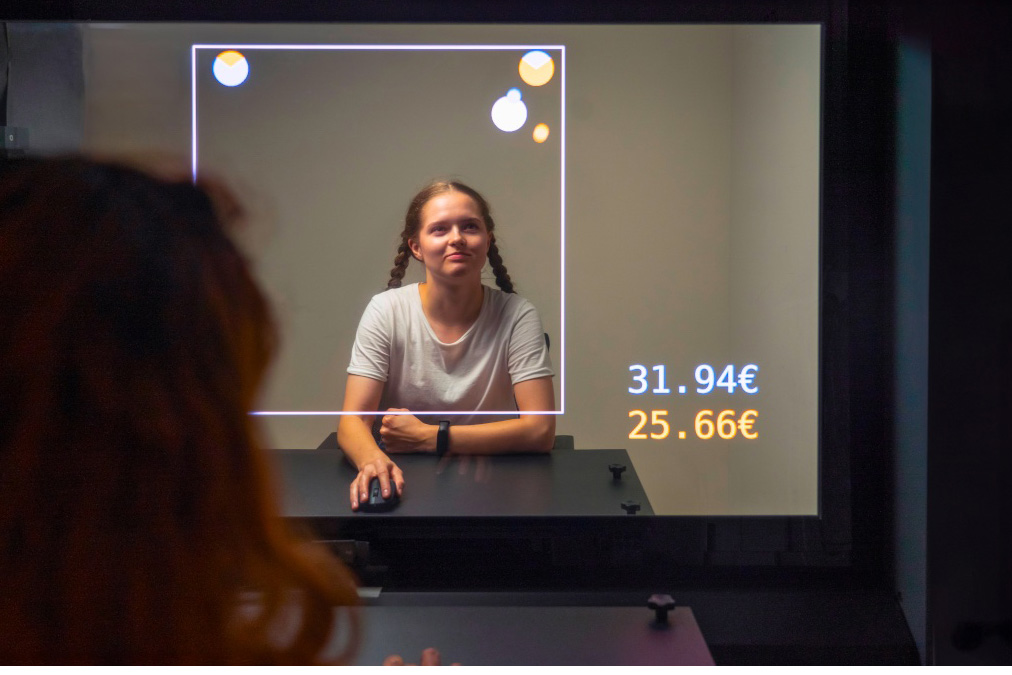
The Dyadic Interaction Platform at the German Primate Center, with two participants playing the Cooperation-Competition Foraging game.
Bernstein members involved: Jonas Dehning, Alexander Gail, Viola Priesemann
When people reach for the same object, walk through a narrow doorway, forage for food, or work together on a shared task, they continuously negotiate—often without noticing—how much to cooperate or compete. Unlike classical laboratory games that force players to choose between fixed options in advance, real-life interactions unfold dynamically, with movement timing and subtle cues shaping social behavior from one moment to the next. A collaborative research team from the Max Planck Institute for Dynamics and Self-Organization (MPI), the University of Göttingen, and the German Primate Center – Leibniz Institute for Primate Research (DPZ) has developed a novel experimental framework that captures this natural complexity. Their study, published in Communications Psychology, reveals how human pairs spontaneously settle into stable cooperative, intermediate or competitive roles—and how these strategies arise from the interplay between social motives, cost-benefit constraints, and sensorimotor skills (Communications Psychology).
A new paradigm for naturalistic social behavior
The researchers developed the novel Cooperation–Competition Foraging game, a continuous – in time and in space – task in which two participants move freely in a shared virtual plane while seeing each other face-to-face. They decide, in real time, whether to collect reward targets individually, only for themselves, or jointly, requiring cooperation. “Unlike traditional turn-based or discrete-choice tasks, our paradigm mirrors the fluidity of real interactions,” says Darius Lewen (MPI), the first author of the study. The study was conducted in the DPZ on the Dyadic Interaction Platform, a novel experimental setup developed for studying social interactions in humans and nonhuman primates.
Across 58 pairs, the team observed that each dyad naturally gravitated toward one of three stable strategies: consistently cooperative, consistently competitive, or a more dynamic mix between cooperation and competition. These strategies were remarkably persistent, even though they emerged spontaneously without any instructions to cooperate or compete.
Predicting social decisions with high accuracy
Despite the apparent behavioral complexity, the team developed a computational model capable of predicting partners’ decisions with a high accuracy. The model integrates factors that closely mirror real-world behavior: the geometry of movement paths, subtle sensorimotor cues between partners, and memory of recent choices.
“This is where the interdisciplinary collaboration truly paid off,” emphasizes Viola Priesemann (MPI), one of the two senior authors. “By combining cognitive psychology, computational modeling, and sensorimotor neuroscience approaches, we were able to develop a compelling paradigm and derive a mechanistic account of how cooperation and competition emerge continuously over time.”
Why cooperate when competition pays more?
A key finding concerns the cost of cooperation. Many pairs had one partner who was faster or more skilled, meaning this player could have earned more overall if acted competitively. Yet many chose to cooperate anyway.
“This shows that prosocial tendencies can outweigh individual advantage,” explains Priesemann. “Many, but not all people are willing to incur costs to maintain mutual coordination—something we also observe in broader social contexts.”
Linking behavior, personality, and neural mechanisms
Beyond the present results, this study helps relate emergent social strategies to individual personality traits, and provides quantifiable metrics for studying the neural basis of naturalistic interactions in humans and nonhuman primates. Such unified cross-species perspective is a long-term goal shared across multiple research groups in the Cognition of Interaction Consortium (CRC 1528, https://uni-goettingen.de/de/652672.html).
“Our approach has broad relevance for social psychology, cognitive science, and neuroscience, as it addresses core aspects of adaptive behavior: the mechanisms of arbitration between cooperation and competition, and the tradeoffs between group success and individual gains—issues of paramount societal importance.” says Igor Kagan (German Primate Center), the other senior author. “The time-continuous and unconstrained nature of these effects enhances their applicability to real-world scenarios. This aligns with the growing emphasis in psychology and neuroscience on studying naturalistic interpersonal dynamics while preserving interpretability, laying the foundation for future comparative work on how the primate brain supports embodied social behavior.”