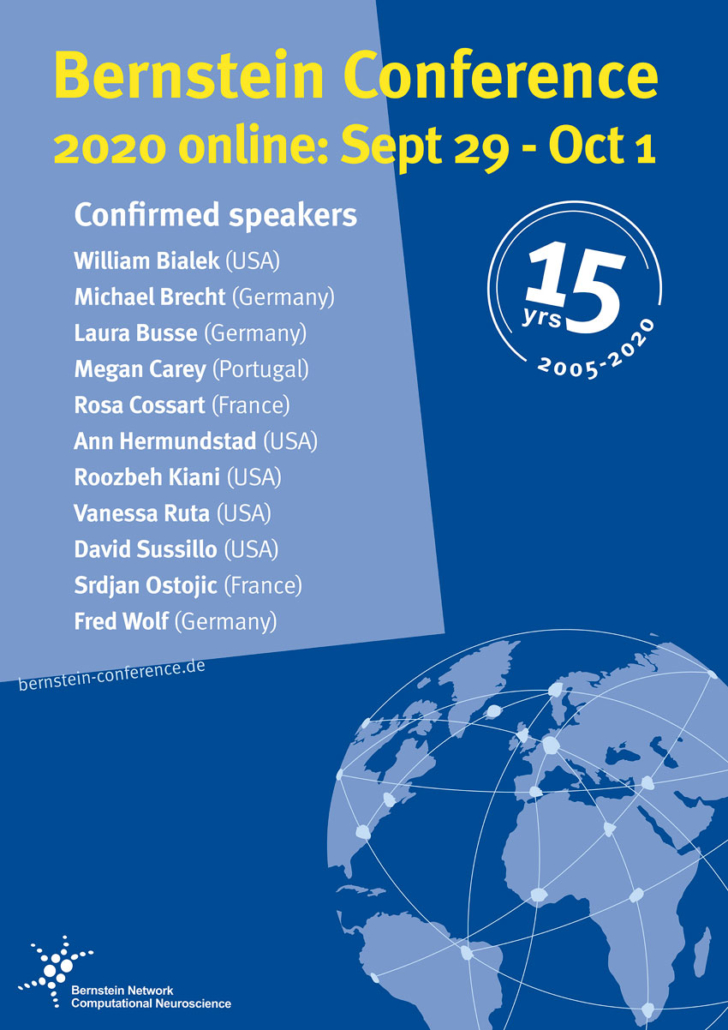
Bernstein Conference 2020
William Bialek | Princeton University, USA
Searching for simplicity
Michael Brecht | HU Berlin, Germany
Isomorphic mapping and computation in cortical circuits
Laura Busse | LMU Munich, Germany
Effects of cortico-thalamic feedback on responses in mouse dLGN
Megan Carey | Champalimaud Center for the Unknown, Lisbon, Portugal
Understanding the complex behaviors of the ’simple‘ cerebellar circuit
Rosa Cossart | Institut de neurobiologie de la méditerranée, Marseille, France
Development and function of cortical hub neurons
Ann Hermundstad | Janelia Research Campus, Ashburn, USA
Adaptive control of behavioral variability through the flexible use of an internal representation
Roozbeh Kiani | New York University, USA
The geometry of the representation of decision variable and stimulus difficulty in the parietal cortex
Vanessa Ruta | The Rockefeller University, New York City, USA
Themes and variations: the circuitry of mate selection and pursuit in Drosophila
David Sussillo | Google AI, Mountain View, USA
Universality and individuality in neural dynamics across large populations of recurrent networks
Srdjan Ostojic | L’École normale supérieure, Paris, France
Complementary roles of dimensionality and population structure in neural computations
Fred Wolf | MPI for Dynamics and Self-Organization, Göttingen, Germany
Evolutionary Transitions in Visual Cortex Design
Kristopher T. Jensen | University of Cambridge, UK
Manifold GPLVMs for discovering non-Euclidean latent structure in neural data
Dmitry Kobak | University of Tübingen, Germany
Phenotypic variation within and across transcriptomic cell types in mouse motor cortex
Felipe Yaroslav Kalle Kossio | University of Bonn, Germany
Drifting assemblies for persistent memory
Subhadra Mokashe | Brandeis University & Duke University, USA
Learning sequences of correlated patterns in recurrent networks
Eleonora Russo | Central Institute of Mental Health, Mannheim, Germany
Coordinated prefrontal state transition leads extinction of reward-seeking behaviors
Sarah Starosta | Washington University, St. Louis, USA
Dopamine and the algorithmic basis of foraging decisions
Balázs B. Ujfalussy | Institute of Experimental Medicine, Budapest, Hungary
Sampling-like representations of prospective locations during hippocampal theta sequences
Oleg Vinogradov | University of Tübingen, Germany
Neuronal cultures self-organize towards excitation/inhibition balance
Here you’ll find invited and contributed talks from the Bernstein Conference 2020 online.
Crossing scales: understanding collective neural activity
Organizers: Anna Levina, Roxana Zeraati
Description:
Growing evidence suggests that to fully understand how the brain operates, we need to study neural activity on the population level. The collective neural activity can manifest across different scales: from localncircuits within a single brain area to activity distributed across the whole brain. Recent advances innexperimental techniques have enabled us to record simultaneously from a large group of neurons (e.g., neuropixel recordings or calcium imaging) or run multimodal recordings across different scales (e.g. NeuralnEvent Triggered fMRI recordings). Thus, we have an unprecedented amount of data to develop and verifyntheories explaining and quantifying collective neuronal activity. The current workshop aims at reviewing what we have learned so far and building bridges between different approaches.
There are many different ways to describe the collective behavior of neuronal populations and analyze the high-dimensional data. One option is to use the statistical physics point of view and study the features ofnsnapshots of the activity. This approach can uncover complex scaling behavior and lead to more universal theories of neuronal dynamics. From a different point of view, we can use large-scale computational models and the dynamical systems approach to describe circuits or even the whole-brain dynamics. Validation of such models in the data requires advanced methods to characterize activity in large-scale neuronal recordings. To this end, novel dimensionality reduction techniques (e.g., finding underlying manifolds of high-dimensional neural activity) can help us to understand the population code better. In this workshop, we aim at bringing together the different views on how the collective neural activity can be characterized and modeled. We invite speakers using different approaches and experimental paradigms to discuss their experimental findings, models, and data analysis tools, and uncover which type of questions they can answer.
Speakers:
Dynamic probabilistic inference in the brain
Organizers: Anna Kutschireiter, Jan Drugowitsch
Description:
Every day, our brain needs to make sense of the rich, dynamic stream of sensory inputs and combine them with prior knowledge about its environment. Ample behavioral evidence suggests that the brain’s processing of information conforms to the rules of probabilistic inference. Most of this evidence came from static trial-by-trial experiments that do not reflect the dynamic nature of our environment, leading to simplified and rather restricted models of how our brains perform such inference. The aim of this workshop is to look beyond such simplified, static models of inference and ask how the brain could perform the continuous-time dynamic inference required to operate in natural environments. Such inference needs to span the range of synapses learning environmental regularities, over the efficient and effective processing of dynamic and continuously changing sensory inputs, to applying continuous-time control in order to act upon the world’s inferred state. Recent experiments have started moving towards more natural behaviors and, as such, provide the ideal benchmark to test the emerging models against.
We will bring together researchers working on models of dynamical inference in the brain, ranging from inference and learning on the level of synapses, single neurons, and neuronal networks to predictions of optimal strategies and behavior, as well as on experiments to test these predictions. More precisely, the goal is to provide a forum to discuss recent developments on all these levels and consider the implications of adding a dynamic component to the usually static inference. By spanning a wide range of research areas, the workshop should appeal to the broad audience attending the main conference.
Speakers:
Frontiers in the Evolution of Neuronal Computation
Organizers: Fred Wolf
Description:
Nervous systems are not designed by smart engineers but are products of the long and winding, branching roads of animal evolution stretching back to the emergence of the first animals about 800 million years ago. In this process, neural cells and circuits have been tuned molecularly for improved performance, optimized for energy efficiency, and restructured by disruptive innovations in neural information processing. A long-standing objective of computational neuroscience is to identify, model, and explain the information processing principles underlying the evolutionary optimization of neural systems design. Recent experimental progress has opened new and stringent perspectives on the evolution of central nervous system structure, information processing, and development. The maturation of powerful computational optimization theories for neuronal circuits has undergone a parallel revolutionary change. Together, these developments are setting the stage to take a novel approach and directly address information processing challenges, the mechanisms of nervous system modification, and the resulting remodeling of neuronal information processing from an evolutionary perspective.
The workshop “Frontiers in the Evolution of Neuronal Computation” will present, in three topical sessions, selected lines of research at the frontier of computational neuroscience and evolutionary biology. Session “Emergence and Design of the First Nervous Systems” will focus on recent work opening novel perspectives on the original evolutionary invention of nerve cells, synapses, and the first neural circuits controlling animal behavior. Session “Invariance, Universality and Optimization in the Evolution of Sensory Systems” will present research that aims to identify evolutionary invariants of sensory information processing and the mechanisms underlying its developmental and evolutionary optimization. Finally, the session “Principles of Cortical Circuit Evolution” will focus on work that strives to decipher the principles and processes underlying fundamental transformations of the circuit structure of the cerebral cortical learning machine in the evolution of modern mammals. Overall, the research presented at the workshop is chosen to foster discussion, refining, and advancing research questions on frontier topics in evolutionary neuroscience and to highlight the novel opportunities and challenges for computational neuroscience they offer. Each session will conclude with a group discussion to mark common ground and to identify overarching research goals and unsolved problems from a computational and theoretical perspective.
Speakers:
Inferring and testing optimality in perception and neurons
Organizers: Matthew Chalk, Wiktor Młynarski
Description:
Many influential theories of neural computation are based on the idea that the brain has evolved to perform certain computations near-optimally. Prominent examples of theoretical frameworks grounded in the notion of optimality include efficient encoding, decision making, and reinforcement learning. Despite their conceptual importance, these theories are often difficult to test and/or falsify on real neural data. This is primarily because currently we lack statistical tools to rigorously define and quantify the degree of optimality of a given neural system. Further, it is unclear how such optimality theories can be applied to neural data when we don’t know a priori what computation is being performed by the system in question.
Recently, a number of approaches aimed at rigorously testing and inferring optimal computations in neural systems and behaviour have emerged. In this workshop, we will bring together neural theorists and cognitive scientists to discuss these recent developments. We will examine the overlap and similarities between seemingly disparate domains by asking when and how it could be possible to infer signatures of optimality in animals and neurons. We will also ask how approaches based on notions of optimality could be complemented by traditional, bottom-up statistical models of neural coding and behaviour.
Speakers:
Leveraging Open Datasets from the Allen Brain Observatory for Computational Neuroscience
Organizers: Saskia de Vries, Josh Siegle
Description:
This program will teach participants how to take advantage of Allen Brain Observatory data, via hands-on tutorials and a showcase of scientific talks. Our publicly available datasets include both 2-photon calcium imaging and dense electrophysiological recordings from the visual cortex of awake mice. The data has been collected under highly standardized conditions using rich visual stimulus sets to facilitate comparisons across experiments and recording modalities. These readily accessible, well-documented datasets can be used by the community to test new analysis methods, evaluate models of neural function, or generate ideas for targeted studies.
We will begin by introducing participants to the scientific motivation and technical details of the Allen Brain Observatory experiments. We will then demonstrate how to use the AllenSDK, an open-source Python library that provides a convenient interface for data retrieval and analysis. A hands-on tutorial will prepare participants to dive into their own analysis of these neural recordings. In the second half of the workshop, invited speakers from both inside and outside the institute will provide examples of work that has already been carried out with Allen Brain Observatory data.
Speakers:
Neural computations: Learning and dynamics in recurrent networks
Organizers: Manuel Beiran, Friedrich Schuessler
Description:
Trained recurrent neural networks (RNNs) have become an important tool to understand how biological neural networks perform cognitive tasks. On the one hand, RNNs can help to understand the computations that are needed to solve a task and how these are implemented by the network. On the other hand, learning itself can be studied in RNNs, with the goal of understanding general underlying mechanisms that are also relevant in biology. Both aspects, learning and dynamics, are far from being fully understood, but the last years have brought exciting insights.
In this workshop, we will hear about recent works from both perspectives. We will see how the activity of trained RNNs can be framed in the language of dynamical systems. This reveals how networks implement computations and multitasking based on low-dimensional activity. We will further hear about the interaction between neural dynamics and learning, and how biological constraints can be incorporated into the learning algorithms. Finally, we will see how trained RNNs can be applied to understand neural recordings and make experimental predictions. The workshop will end with a discussion on how the insights into learning and dynamics together can form a unified perspective on tasks, learning algorithms, and the necessary underlying computations.
Speakers:
Neurons are cells: the role of cellular properties in neural circuit computations
Organizers: Cian O’Donnell, Philipp Berens
Description:
Neuroscience is challenging because the brain is multi-scaled: computations are performed by molecules, cells, microcircuits, and whole-brain networks, together and in parallel. Systems neuroscientists traditionally focus on the computations performed by neural circuits, while abstracting or ignoring mechanisms of single cells. Single-neuron researchers, on the other hand, have uncovered the complexity of neuronal gene expression, dendritic physiology, and synaptic signalling. But only limited sharing of ideas has occurred between these two fields. There is little role for single-neuron mechanisms in current theories of brain computation. This workshop aims to bridge this divide by bringing together computational and experimental researchers who study single-cell processes and consider their implications for brain circuit function.
The talks will come from three perspectives: experimentalists, data analysts, and theoretical modellers. The workshop will ask all speakers and attendees to jointly address three high-level questions:
Speakers:
The making and breaking of E/I balance
Organizers: Loreen Hertäg, Henning Sprekeler
Description:
The coordinated interplay between excitation (E) and inhibition (I) is the backbone of neuronal activity and cortical computations. New techniques for cell type-specific neural recordings in behaving animals provide an opportunity to revisit the concept of E/I balance and address long-standing questions. How specific is E/I balance in space and time? How does its specificity influence cortical computations? How do different types of inhibitory interneurons contribute to the co-activation of excitation and inhibition? What is the function of E/I balance and disruptions thereof? How does it shape information processing and learning?
Tackling these questions will require a combination of experiment and theory. The goal of this workshop is therefore to bring together theoreticians and experimentalists with different perspectives on the interaction of excitation and inhibition. We hope to facilitate scientific exchange that inspires new ideas about how E/I balance shapes sensory processing and behavior.
Speakers:
Understanding Computations of Basal Nervous Systems: From Paramecium to Jellyfish
Organizers: Fabian Pallasdies, Jan-Hendrik Schleimer, Susanne Schreiber
Description:
As „nothing in biology makes sense except in the light of evolution,“ a theory on the origins of nervous systems is crucial for our understanding of how the structure of nerve tissue evolved to satisfy the computational demands of animals at large. This topic has been addressed in many different fields of biology, yet communication across fields is sparse. To shed light on the evolutionary trajectories, however, a more holistic understanding of the systems studied is required, encompassing the macroscopic behavior of simple animals to the electrophysiological details of their nervous systems.
Our aim is to bring together researchers with expertise across different species from jellyfish and corals to ctenophores and sponges to investigate the evolutionary origins of neurons and information-processing nerve nets. Our focus is to discuss how modelling can aid in the study of early nervous systems and what we can learn from these comparatively simple organisms about the computations performed by the nervous systems of higher animals.
Speakers:
Visuomotor coordination: from physiology to control systems
Organizers: Egidio d’Angelo, Sacha van Albada
Description:
Visuomotor coordination involves a highly complex set of brain functions encompassing a large number of brain regions, which interact dynamically not only with each other but also with the environment. Understanding these processes requires expertise from multiple angles, including physiology, systems neuroscience, and control systems. In this workshop, we aim to bring together insights from experimental and computational studies of visuomotor coordination, covering the main brain regions involved (cerebellum, cerebral cortex, basal ganglia), and their interactions. The interpretation of observed brain activity requires knowledge about the information processing it represents, and the motor behavior it results in. Embodiment and interactions with the environment are therefore considered in the context of neurorobotic control systems.
Speakers: