
Bernstein Network Computational Neuroscience
  • Home
  • Network
    • The Bernstein Network
    • Bernstein Centers
      • Berlin
      • Freiburg
      • Göttingen
      • Munich
      • Tübingen
      • Heidelberg-Mannheim
    • Bernstein Nodes
      • Bernstein Node Bochum
      • Bernstein Node Bonn-Cologne
      • Bernstein Node Chemnitz
      • Bernstein Node Hamburg
      • Bernstein Node Marburg
      • Bernstein Node Paris
      • Bernstein Node Rhine-Main Region
      • Bernstein Node Taiwan
    • Bernstein Facilities
      • High Performance Simulation and Data Analysis
      • Research Data Management
      • Bernstein Coordination Site (BCOS)
    • Awards and Initiatives
      • Valentin Braitenberg Award
      • Brains for Brains Young Researcher Award
      • Promoting Young Scientists
    • Committees
    • Network Ethics and Values
    • Statutes
    • Membership
    • History
    • Donation
    • Contact
  • Newsroom
    • Newsroom
    • News
    • Events
    • Calls
    • Media Coverage
    • Network Publications
    • Bernstein Bulletin
    • Press
  • Teaching and Research
    • Teaching and Research
    • Meet the Scientist
    • Find a Scientist
    • Degree Programs
      • Master Programs
      • PhD Programs
    • Study and Training
      • Bernstein Student Workshop Series
      • Online Learning
      • Advanced Courses
      • Internships and Master theses
      • Podcasts
  • Career
    • Career
    • Job Pool
    • Calls
    • Internships and Master theses
  • Bernstein Conference
    • Bernstein Conference
    • Abstract Submission
    • Registration
    • Exhibition
    • Main Conference
      • Program at a Glance
      • Satellite Workshops
      • Conference Dinner
    • Early Career Scientists
      • Travel Grants
      • PhD Symposium
      • Postdoc Meeting
    • General Information
      • Important Dates & FAQ
      • Plan Your Visit
      • Press
      • Code of Conduct
      • PR Media Policy
      • Data Policy
    • Past and future Bernstein Conferences
  • DE
  • EN
  • Click to open the search input field Click to open the search input field Search
  • Menu Menu
You are here: Home1 / Newsroom2 / News3 / When the map needs an update
Bonn, Germany – June 15, 2026

When the map needs an update

Every time we move through a familiar environment, the hippocampus consults an internal map, a detailed spatial representation that is built up through repeated experience. But what happens when something unexpected occurs on a well-known route? Researchers at the University Hospital Bonn (UKB) and the University of Bonn were able to demonstrate in a mouse model that the brain does not redraw its maps from scratch. Instead, it annotates them: preserving the underlying spatial layout while overlaying new information on top of the existing map. Their findings have now been published in the journal PNAS.
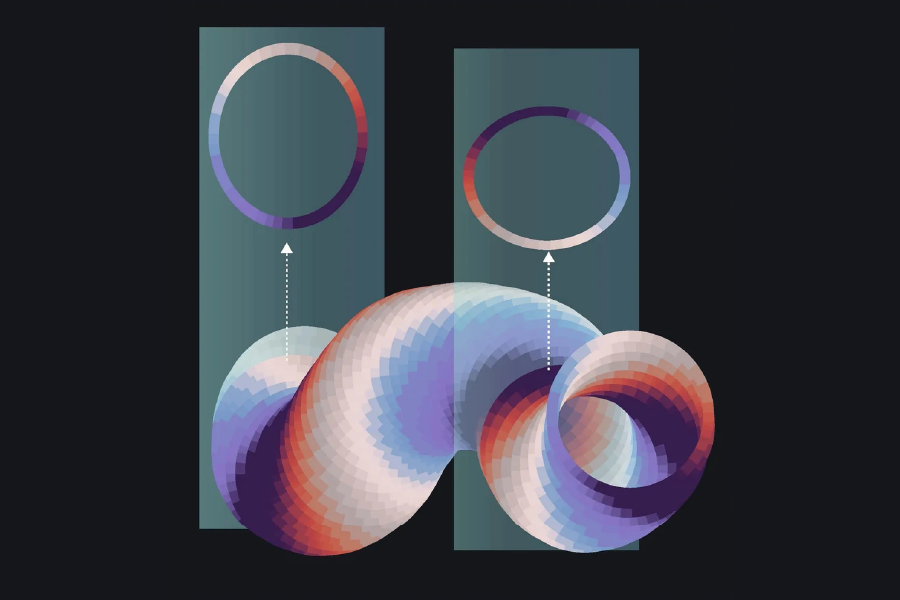
The diversity of neural activity can adapt to accommodate new information. New information can deform the neural activity manifold.© University Hospital Bonn (UKB) / Julia Kuhl

Bernstein member involved: Tatjana Tchumatchenko

The hippocampus, the brain’s working memory, is shaped like a seahorse and is located in the temporal lobe of both the left and right hemispheres. Hippocampal CA3 circuits, which link information and support the recognition of memories, keep their spatial maps stable while layering new annotations on top, much like a navigation app that preserves your route while flagging an incident ahead. A Bonn-based research team has now arrived at these findings. To do so, they recorded the activity of CA3 axons in mice traversing a familiar linear running route. At a fixed point along the route, the scientists introduced a mildly aversive but harmless air puff stimulus, comparable to an unexpected obstacle on a road, and tracked how the hippocampal network updated its representation before, during, and after the event.

“What surprised us most was that the spatial map itself never changed. The basic spatial map remained completely intact, while the network simultaneously incorporated a new annotation. It’s as if the hippocampus has a versioning system that writes new experiences as a separate layer over a map,” says co-senior author Prof. Heinz Beck from the Institute for Experimental Epileptology and Cognitive Sciences at the UKB. He is a member of the ImmunoSensation3 Cluster of Excellence and the Transdisciplinary Research Area (TRA) “Life & Health” at the University of Bonn.

Nevertheless, the system did not react blindly to the new event. “We found that the gust of air generated systematic geometric deformations in the shared manifold of population dynamics that reliably marked the location and time of the event. However, these deformations did not overwrite the underlying spatial map but rather superimposed themselves on it,” says first author Albert Miguel-López. “The result functioned simultaneously as a positional map and as an event log, so that both levels could be read independently of one another.”

Updating the maps is a collaborative effort of the neural network

The study compared two different types of CA3 axons, each connecting the dorsal hippocampus, which is responsible for memory recollection and orientation, of one hemisphere to the dorsal hippocampus of the other hemisphere. Both circuits updated their maps in a similar manner and distributed the update signal evenly across place cells, which are responsible for orientation in the environment, and non-place cells. These results suggest that the hippocampus does not leave map revisions to a small team of specialized neurons, but rather distributes the update across the entire network of nerve cells, thereby ensuring that the new annotation is stably integrated into the existing map. “Our findings make it clear that hippocampal maps do not represent a static image of the environment, but rather evolve in subtle, continuous steps, constantly embedding new information while the basic geometric structure of the space remains intact,” says co-senior author Prof. Tatjana Tchumatchenko from the Institute for Experimental Epileptology and Cognitive Research at the UKB. She is a spokesperson for the TRA “Life & Health” and a member of the TRA “Modeling” at the University of Bonn. “The mathematical separability of the spatial map and the annotation layer shows that while the brain stores these two types of information together, it organizes them in such a way that they do not overwrite each other. This expands our understanding of how the brain structures information and how it ensures both stability and flexibility at the same time.”

Further links

Original press release

> more

Original publication

> more

When the map needs an update

16. June 2026/in Ausgewählter Aktuelles-Post für die Startseite /by Elena Reiriz Martinez

Kontakt Aktuelles

Contact

Prof. Tatjana Tchumatchenko

Scientific contact
Institute for Experimental Epileptology and Cognitive
Research - University Hospital Bonn
TRA “Modelling” and TRA “Life & Health” - University of Bonn
Germany

tatjana.tchumatchenko@uni-bonn.de

Bernstein Netzwerk Computational Neuroscience Logo

Become a member
Statutes
Donation
Subscribe to Newsletter


Follow us on

LinkedIn
Bluesky
Vimeo
Mastodon
© 2026 Bernstein Network Computational Neuroscience
  • Contact
  • Imprint
  • Privacy Policy
Scroll to top Scroll to top Scroll to top
Cookie-Zustimmung verwalten
We use cookies to optimize our website and our service.
Functional Always active
Der Zugriff oder die technische Speicherung ist unbedingt für den rechtmäßigen Zweck erforderlich, um die Nutzung eines bestimmten Dienstes zu ermöglichen, der vom Abonnenten oder Nutzer ausdrücklich angefordert wurde, oder für den alleinigen Zweck der Übertragung einer Nachricht über ein elektronisches Kommunikationsnetz.
Vorlieben
Die technische Speicherung oder der Zugriff ist für den rechtmäßigen Zweck der Speicherung von Voreinstellungen erforderlich, die nicht vom Abonnenten oder Nutzer beantragt wurden.
Statistics
Die technische Speicherung oder der Zugriff, der ausschließlich zu statistischen Zwecken erfolgt. Die technische Speicherung oder der Zugriff, der ausschließlich zu anonymen statistischen Zwecken verwendet wird. Ohne eine Aufforderung, die freiwillige Zustimmung Ihres Internetdienstanbieters oder zusätzliche Aufzeichnungen von Dritten können die zu diesem Zweck gespeicherten oder abgerufenen Informationen allein in der Regel nicht zu Ihrer Identifizierung verwendet werden.
Marketing
Die technische Speicherung oder der Zugriff ist erforderlich, um Nutzerprofile zu erstellen, um Werbung zu versenden oder um den Nutzer auf einer Website oder über mehrere Websites hinweg zu ähnlichen Marketingzwecken zu verfolgen.
  • Manage options
  • Manage services
  • Manage {vendor_count} vendors
  • Read more about these purposes
Settings
  • {title}
  • {title}
  • {title}