
Convergent evolution of mechanisms for spatial navigation
Researchers from the Bernstein Center for Computational Neuroscience Munich, LMU, and Cornell University reveal that zebrafish and fruit flies share the same internal compass mechanism, despite being separated by more than 550 million years of evolution.
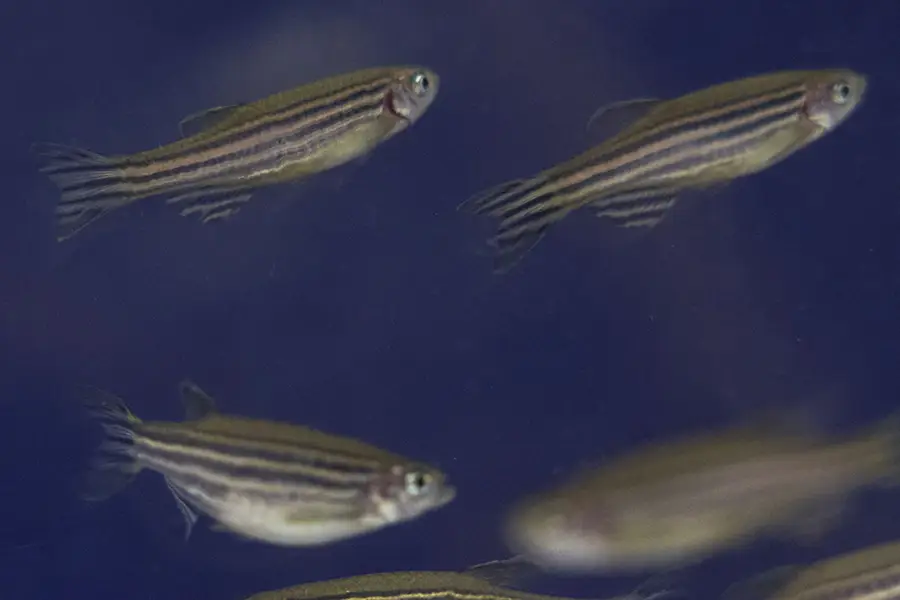
A school of zebrafish (Danio rerio) exploring its environment. To navigate, the fish rely on sensory cues, such as visual landmarks, and a memory of heading. This internal "compass" is updated by integrating angular head velocity conveyed by the fish's vestibular system, optic flow, and motor efference signals. Mei et al. combined neurophysiological experiments with computational modelling and mathematical analysis to uncover the detailed compass mechanism, revealing that it mirrors that of fruit flies. Since both species diverged over 550 million years ago, the functional similarity of their compass systems likely reflects convergent evolution.Photograph by Carolin Bleese, LMU.
Bernstein member involved: Andreas Herz
Even in darkness, many animals retain a sense of orientation because their nervous system sustains a memory of heading encoded by the activity of head-direction (HD) cells. Animals continuously update this internal compass by temporally integrating angular head velocity relayed by vestibular, optic flow, and motor efference signals. External cues, such as visual landmarks, are utilized to counteract cumulative integration errors.
HD cells have been found across many species, including flies, rodents, bats, and fish. However, whether the HD compass relies on a universal mechanism has remained an open question. To address this fundamental issue, theoretical neuroscientists led by Andreas Herz (LMU and Bernstein Center for Computational Neuroscience Munich) teamed up with experimentalists from Ruben Portugues’ lab (formerly TUM, now Cornell University). Their findings have just been published in the scientific journal Current Biology.
Two alternative mechanisms for the compass have been proposed in the literature, both postulating at least one functional ring of HD neurons that sustains a localized bump of neuronal activity. According to the first theory, three circuits move this bump as the animal turns: one dedicated to HD representation and two “shifter rings” that are also sensitive to clockwise and counterclockwise head rotations, respectively.
In the fruit fly, distinct anatomical structures instantiate the three rings. In vertebrates, however, no clear anatomical delineation has been found, leaving open the possibility of a second mechanism—one where angular head velocity modulates synaptic connectivity within a single ring to move the activity bump without any need for shifter circuits.
Three compass rings in one
Indeed, Ruben Portugues and his group originally discovered a single-ring compass in zebrafish. However, as Siyuan Mei, the first author of the new study explains: “The truth is more convoluted: the zebrafish has a single anatomical scaffold, but on this scaffold there lie hidden three intermingled rings that behave just like the fly circuit.” As shown mathematically by the Herz group, the activity bump in all three functional rings can overlap perfectly, making it impossible to distinguish the rings except through the shifter neurons’ characteristic tuning to heading and angular velocity.
The method for identifying ring networks developed by Mei et al. is remarkably simple. It will prove particularly useful for vertebrate species in which identifying the anatomical circuit connectivity is currently not feasible. Crucially, the theoretical framework provides evidence that the rodent HD system constitutes a multiring shifter circuit, indicating that a key computational principle for spatial navigation is conserved from fish to mammals. Given that zebrafish and fruit flies diverged at least 550 million years ago, the functional similarity of their compass systems likely reflects convergent evolution.