
Bernstein Network Computational Neuroscience
  • Home
  • Network
    • The Bernstein Network
    • Bernstein Centers
      • Berlin
      • Freiburg
      • Göttingen
      • Munich
      • Tübingen
      • Heidelberg-Mannheim
    • Bernstein Nodes
      • Bernstein Node Aachen-Jülich
      • Bernstein Node Bochum
      • Bernstein Node Bonn-Cologne
      • Bernstein Node Chemnitz
      • Bernstein Node Hamburg
      • Bernstein Node Marburg
      • Bernstein Node Paris
      • Bernstein Node Rhine-Main Region
      • Bernstein Node Taiwan
    • Bernstein Facilities
      • High Performance Simulation and Data Analysis
      • Research Data Management
      • Bernstein Coordination Site (BCOS)
    • Awards and Initiatives
      • Valentin Braitenberg Award
      • Brains for Brains Young Researcher Award
      • Promoting Young Scientists
    • Committees
    • Network Ethics and Values
    • Statutes
    • Membership
    • History
    • Donation
    • Contact
  • Newsroom
    • Newsroom
    • News
    • Events
    • Calls
    • Media Coverage
    • Network Publications
    • Bernstein Bulletin
    • Press
  • Teaching and Research
    • Teaching and Research
    • Meet the Scientist
    • Find a Scientist
    • Degree Programs
      • Master Programs
      • PhD Programs
    • Study and Training
      • Bernstein Student Workshop Series
      • Online Learning
      • Advanced Courses
      • Internships and Master theses
      • Podcasts
  • Career
    • Career
    • Job Pool
    • Calls
    • Internships and Master theses
  • Bernstein Conference
    • Bernstein Conference
    • Abstract Submission
    • Registration
    • Exhibition
    • Main Conference
      • Program at a Glance
      • Satellite Workshops
      • Conference Dinner
    • Early Career Scientists
      • Travel Grants
      • PhD Symposium
      • Postdoc Meeting
    • General Information
      • Important Dates & FAQ
      • Plan Your Visit
      • Press
      • Code of Conduct
      • PR Media Policy
      • Data Policy
    • Past and future Bernstein Conferences
  • DE
  • EN
  • Click to open the search input field Click to open the search input field Search
  • Menu Menu
You are here: Home1 / Newsroom2 / News3 / Special glove helps people with paralyzed hands grasp objects
Munich, Germany – July 6, 2026

Special glove helps people with paralyzed hands grasp objects

The Technical University of Munich (TUM) has developed a soft, pneumatic glove that restores the ability of people with paralyzed hands to grasp objects. To achieve this, researchers at the TUM Chair of Cognitive Systems use electrical signals from the forearm muscles to reliably predict when a person intends to grasp an object. The invention could one day help people whose hands have been paralyzed as a result of accidents or neurological disorders.
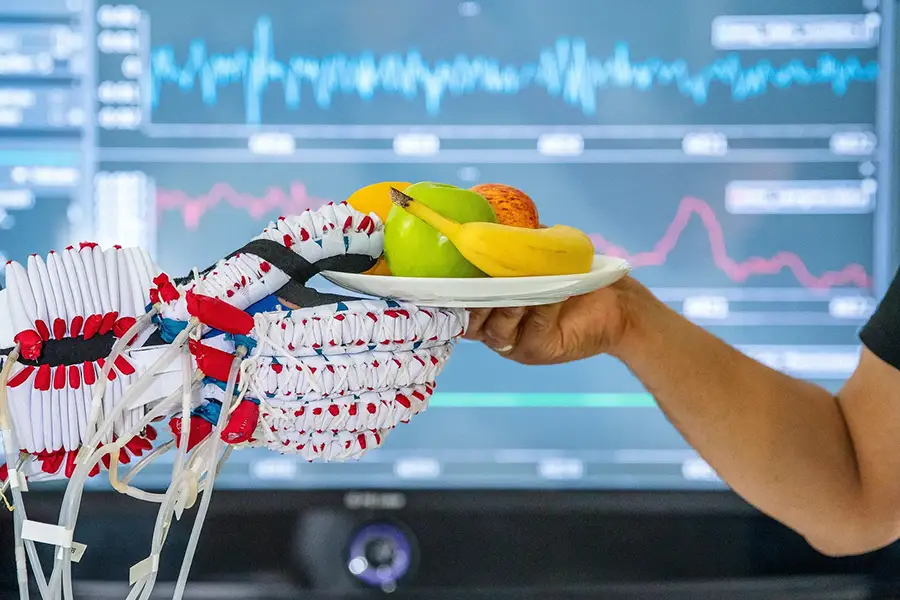
The Soft-Hand exoskeleton assists people with paralysed hands. Photo: Astrid Eckert / TUM

Bernstein member involved: Nicolas Berberich

The “soft-hand exoskeleton” consists of a fabric glove developed by the researchers, with air cushions attached to its outer surface. The air cushions are inflated through a total of 13 tubes, providing targeted support for the hand movements needed to hold a plate or grasp a glass, fork or spoon. The air-filled cushions allow each finger to be bent and straightened individually while also rotating the wrist, enabling objects to be held securely in the hand.

To determine when a person intends to grasp an object, the researchers measure muscle activity in the forearm. Sensors attached to the forearm capture electrical signals, which are analyzed using machine learning to reliably determine the intended movement. “To prevent objects from being dropped accidentally, we use additional motion sensors to detect transport movements and keep the exoskeleton’s grip securely closed throughout the movement,” says researcher Nicolas Berberich.

A soft-hand exoskeleton that anyone can afford

“Our solution is intelligent in two ways,” explains his colleague, Dr. John Nassour. “On the one hand, we’ve developed a highly reliable method of predicting grasping movements by inferring intentions from signals with 97% reliability. On the other hand, with our glove, we’ve developed hardware that optimally supports the intended movements.” Another advantage is that Nassour sewed the glove himself, and the required fabric costs very little. At first glance, the glove doesn’t look high-tech, but it can be used by many people with paralysis. “We’ve found a solution that anyone can afford but still works very well,” says Prof. Gordon Cheng, director of the Institute for Cognitive Systems. Close collaboration with a patient with amyotrophic lateral sclerosis (ALS) was crucial to the development of the soft-hand exoskeleton.

People with ALS gradually lose control of their movements. This is because the nerve cells responsible for skeletal muscle contraction are damaged and continue to degenerate. At the start of the project, the patient already had very little control over his hands, but was still able to move the first thumb joint. The researchers based their experiment on the strongest signals generated by the thumb muscles. To record this electromyogram, they attached a sensor to the forearm that detects the strongest signals from the flexor pollicis longus muscle as soon as it is moved. These signals trigger the inflation of the glove’s air cushions.

ALS patient picks up a fork for the first time in four years

Despite very weak signals, the system recognized the patient’s intention in 9 out of 10 cases. He was able to reach for objects, hold a fork for the first time in four years, and pick up small cubes and drop them into a container. A video game also contributed to this success. The patient had to make a character jump using only the movement of his thumb joint. The researchers found that just five minutes are enough to greatly improve the patient’s ability to grasp objects. “This patient has shown us that our soft-hand exoskeleton can support him despite one of the most severe neurological disorders,” says Prof. Cheng.

“We are now adapting the concept for other patients, such as stroke survivors,” the researcher adds. A key finding of the current study is that people with severe impairments can regain the ability to grasp objects more effectively with the help of the glove. Neurologist Prof. Tobias Wächter from the partner institution Klinik Passauer Wolf is convinced of the potential of the new specialized glove: “In principle, this glove can help people with flaccid paralysis, including, for example, people who have sustained peripheral nerve damage following motorcycle or bicycle accidents, or patients with polyneuropathy,” says Prof. Wächter.

Further links

Original press release

> more

Original publication

> more

Video: Neues Soft-Hand-Exoskelett für schwere Lähmungen an der Hand

> more

Special glove helps people with paralyzed hands grasp objects

10. July 2026/in /by Elena Reiriz Martinez

Kontakt Aktuelles

Contact

Scientific contact

Prof. Gordon Cheng
Institute for Cognitive Systems
Technical University of Munich (TUM)
Germany

gordon@tum.de

Press contact

Andreas Schmitz
Corporate Communications Center
Technical University of Munich
Germany

015114272515
presse@tum.de

Bernstein Netzwerk Computational Neuroscience Logo

Become a member
Statutes
Donation
Subscribe to Newsletter


Follow us on

LinkedIn
Bluesky
Vimeo
Mastodon
© 2026 Bernstein Network Computational Neuroscience
  • Contact
  • Imprint
  • Privacy Policy
Scroll to top Scroll to top Scroll to top
Cookie-Zustimmung verwalten
We use cookies to optimize our website and our service.
Functional Always active
Der Zugriff oder die technische Speicherung ist unbedingt für den rechtmäßigen Zweck erforderlich, um die Nutzung eines bestimmten Dienstes zu ermöglichen, der vom Abonnenten oder Nutzer ausdrücklich angefordert wurde, oder für den alleinigen Zweck der Übertragung einer Nachricht über ein elektronisches Kommunikationsnetz.
Vorlieben
Die technische Speicherung oder der Zugriff ist für den rechtmäßigen Zweck der Speicherung von Voreinstellungen erforderlich, die nicht vom Abonnenten oder Nutzer beantragt wurden.
Statistics
Die technische Speicherung oder der Zugriff, der ausschließlich zu statistischen Zwecken erfolgt. Die technische Speicherung oder der Zugriff, der ausschließlich zu anonymen statistischen Zwecken verwendet wird. Ohne eine Aufforderung, die freiwillige Zustimmung Ihres Internetdienstanbieters oder zusätzliche Aufzeichnungen von Dritten können die zu diesem Zweck gespeicherten oder abgerufenen Informationen allein in der Regel nicht zu Ihrer Identifizierung verwendet werden.
Marketing
Die technische Speicherung oder der Zugriff ist erforderlich, um Nutzerprofile zu erstellen, um Werbung zu versenden oder um den Nutzer auf einer Website oder über mehrere Websites hinweg zu ähnlichen Marketingzwecken zu verfolgen.
  • Manage options
  • Manage services
  • Manage {vendor_count} vendors
  • Read more about these purposes
Settings
  • {title}
  • {title}
  • {title}