Emma’s first Bernstein Conference: A personal perspective
Emma Lehmann is a master’s student in Cognitive and Integrative Systems Neuroscience at the University of Marburg, Germany. Having recently joined the Bernstein Network, she attended the Bernstein Conference in September 2026 — her first time participating in a scientific conference. In this article, she shares her personal impressions of the three days of the Main Conference.
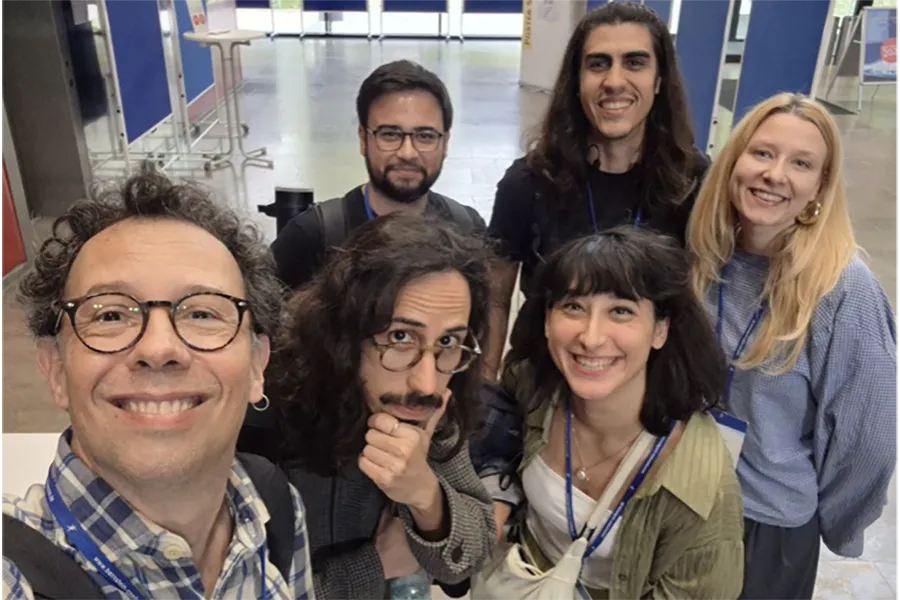
Coffee break with Ece Çağlayan, Tulio Almeida, Daniel Miranda Castro, Mauro Copelli and Pedro Pinheiro. Photo: Emma Lehmann
A guest article from Emma Lehmann
Day 1 – Tuesday, September 29
After two days of Satellite Workshops, the Main Conference began on Tuesday afternoon, and one of the day’s highlights followed soon after. Xiao-Jing Wang received the Valentin Braitenberg Award for Computational Neuroscience before taking the stage to present key ideas from his research career.
It soon became clear that the questions Wang raised on stage had wider implications. Ritu Panda, who is nearing the completion of her PhD at Ashoka University in New Delhi, had traveled to her first scientific conference outside India. One idea from Wang’s talk particularly stayed with her: “How to ground your modeling and mathematical work in the neurobiology and in experiments is extremely important,” she says.
Simon Roth, a student in Vienna, also names Wang’s lecture as one of the most interesting talks of the day, although it was a different aspect that caught his attention. He was particularly inspired by the growing technological possibilities for recording ever more extensive brain activity, and the prospect of working with data from “larger and larger brain regions.” Roth himself comes from a computer science background. At the conference, he hoped not only to present his own poster, but also to learn more about the neuroscientific side of the field.
That intersection between computer science and neuroscience is also what brought Nico Dunajski from Sheffield to Frankfurt. The undergraduate computer science student is already conducting research in computational neuroscience and hopes to pursue a master’s degree in neuroscience next. Rather than looking for the answer to one particular research question, he came to the conference to explore, as he puts it, “the future of my career path.”
Already on the first day, the conference was therefore about more than the research presented on stage — it was also a place where people at very different stages of their careers could see how others were approaching the same emerging field.
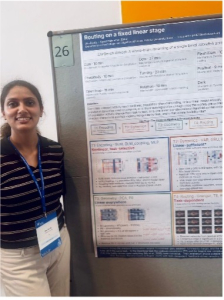
Ritu Panda with her poster „Routing on a fixed linear stage“. Photo: Emma Lehmann
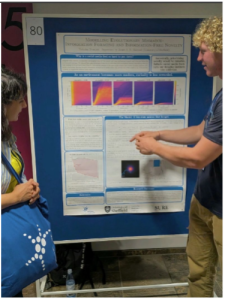
Nico Dunajski explaining his poster “Modelling Evolutionary Mismatch: Information Foraging and Information-Free Novelty” to Ece Çağlayan. Photo: Emma Lehmann
Day 2 – Wednesday, September 30
The impressions Panda, Roth, and Dunajski described on the first day of the conference all touched on the same underlying question: how can mathematical models be connected to biological data in a way that produces genuinely new insights into the brain?
On Wednesday, Salar Nouri from the Frankfurt Institute for Advanced Studies offered a particularly vivid example of how this question can be explored. His team had placed an artificial agent in a simulated environment and let it search for food. The agent did not simply maximize reward but also had to keep an internal state in balance and could, in a sense, become “hungry”. As its “hunger” increased, it began to explore its surroundings faster and more widely. An abstract model had started to display behavior reminiscent of an animal foraging for food.
At the same time, the day’s talks raised a more fundamental question about whether increasingly biologically realistic models and ever more detailed neural data necessarily lead to a better understanding of the brain.
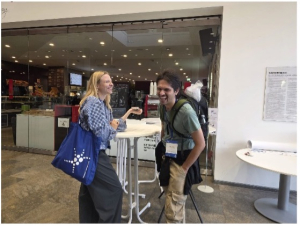
Emma interviewing Francesco Siano. Photo: Emma Lehmann
This question lay at the heart of John Krakauer’s “Lessons at the Cognitive-Motor Interface”, a talk that stayed with me and, as I later discovered, with other attendees, too. For relatively simple motor processes, Krakauer argued, the link between neural circuitry and behavior can still appear fairly direct. For example, a medical student can draw a stretch reflex on a board, showing how neurons are connected and how a response emerges from those connections. But the same logic becomes much harder to apply once we move towards complex thought. Krakauer illustrated this with a deceptively simple question: if a medical student can draw a stretch reflex, what would a comparable diagram look like if it were meant to explain how we understand an abstract concept such as “justice”? The example highlights a limitation of purely neural explanations. While neuroscientific data can alter, constrain, or confirm a model, complex psychological phenomena may require a different explanatory language. As he put it, “Even if you use neural data to update your model, the language of your model will never be neural.”
The talk also resonated with Francesco Siano, a PhD student in Behavioral Neuroscience at Sapienza University of Rome. Siano, who has been working on motor systems since his master’s degree, describes Krakauer’s lecture as his favorite of the conference so far. He was impressed not only by the subject matter, but also by Krakauer’s humor and his ability to keep drawing the audience into the discussion.
Day 3 – Thursday, October 1
On the final day of the conference, attention shifted to the different rhythms at which the brain operates. Some neural processes unfold within milliseconds, while others persist much longer. These differences in timing may help determine how information is processed, held in mind, and eventually stored as memory.
The final three talks followed this idea from neural activity to memory. Anna Levina, from the University of Tübingen, examined intrinsic neural timescales, while Sara Varetti, from SISSA in Trieste, connected them to working memory. In her model, strongly interconnected groups of neurons develop slower dynamics, allowing information to remain available for longer without explicitly training the model to do so. Sandro Romani, from Janelia Research Campus, then moved from short-term retention to memory formation. He discussed behavioral timescale synaptic plasticity, a mechanism that can link neural events several seconds apart and may help explain how a single experience leaves a lasting memory trace.
Mauro Copelli, professor at the Federal University of Pernambuco in Recife, Brazil, was attending the Bernstein Conference in person for the first time. Although behavior is not the main focus of his own research, he was particularly fascinated by the talks by Marieke Schölvinck (Ernst Strüngmann Institute) and Ewelina Knapska (Nencki Institute of Experimental Biology), which showed how new methods are changing the ways we quantify behavior.
For Copelli, however, what makes a conference valuable goes beyond the science. At a good conference, he says, it is roughly “30% science and 70% human connections.” Learning about new research matters, but so do conversations with old friends, collaborators, and people one has never met before. “The coffee breaks, lunches and dinners are sometimes as important as the talks,” he says.
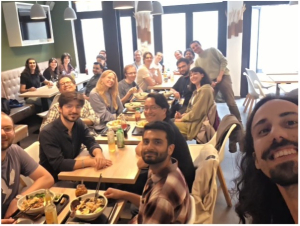
Farewell dinner. Photo: Emma Lehmann
Daniel Miranda Castro, a postdoctoral researcher at Jülich Research Centre, came to a similar conclusion. After finally seeing people in person he had previously known mostly through email, he says, “Meeting people was definitely the best part.”
Across the three days, the conference moved from models of behavior to questions about complex thought, working memory, and the formation of new memories. Yet many of the ideas continued beyond the scheduled talks, in conversations between people with different backgrounds and at different stages of their careers.
Copelli, who had previously attended the conference online in 2020, perhaps captures this most simply. Thinking about the spontaneous conversations during coffee breaks, over lunch, or at dinner, he says, “There’s no online substitute for that.”
Are you a member of the Bernstein Network and interested in contributing an article to our newsroom? Get in touch with the Bernstein Coordination Site at bernstein.communication@fz-juelich.de.