
Bernstein Network Computational Neuroscience
  • Home
  • Network
    • The Bernstein Network
    • Bernstein Centers
      • Berlin
      • Freiburg
      • Göttingen
      • Munich
      • Tübingen
      • Heidelberg-Mannheim
    • Bernstein Nodes
      • Bernstein Node Aachen-Jülich
      • Bernstein Node Bochum
      • Bernstein Node Bonn-Cologne
      • Bernstein Node Chemnitz
      • Bernstein Node Hamburg
      • Bernstein Node Marburg
      • Bernstein Node Paris
      • Bernstein Node Rhine-Main Region
      • Bernstein Node Taiwan
    • Bernstein Facilities
      • High Performance Simulation and Data Analysis
      • Research Data Management
      • Bernstein Coordination Site (BCOS)
    • Awards and Initiatives
      • Valentin Braitenberg Award
      • Brains for Brains Young Researcher Award
      • Promoting Young Scientists
    • Committees
    • Network Ethics and Values
    • Statutes
    • Membership
    • History
    • Donation
    • Contact
  • Newsroom
    • Newsroom
    • News
    • Events
    • Calls
    • Media Coverage
    • Network Publications
    • Bernstein Bulletin
    • Press
  • Teaching and Research
    • Teaching and Research
    • Meet the Scientist
    • Find a Scientist
    • Degree Programs
      • Master Programs
      • PhD Programs
    • Study and Training
      • Bernstein Student Workshop Series
      • Online Learning
      • Advanced Courses
      • Internships and Master theses
      • Podcasts
  • Career
    • Career
    • Job Pool
    • Calls
    • Internships and Master theses
  • Bernstein Conference
    • Bernstein Conference
    • Abstract Submission
    • Registration
    • Exhibition
    • Program
      • Schedule
      • Satellite Workshops
      • Conference Dinner
    • Early Career Scientists
      • Travel Grants
      • PhD Symposium
      • Postdoc Meeting
    • General Information
      • Important Dates & FAQ
      • Plan Your Visit
      • Press
      • Code of Conduct
      • PR Media Policy
      • Data Policy
    • Past and future Bernstein Conferences
  • DE
  • EN
  • Click to open the search input field Click to open the search input field Search
  • Menu Menu
You are here: Home1 / Newsroom2 / News3 / How deeply do spiders sleep?
Bonn, Germany – October 27, 2026

How deeply do spiders sleep?

Humans and vertebrates go through various stages of sleep, including REM (rapid eye movement) sleep characterized by rapid eye movements and muscle twitches. Can a similar sleep state be observed in spiders? Researchers from the Institute of Organismic Biology at the University of Bonn investigated this in the Australian jumping spider Portia fimbriata.
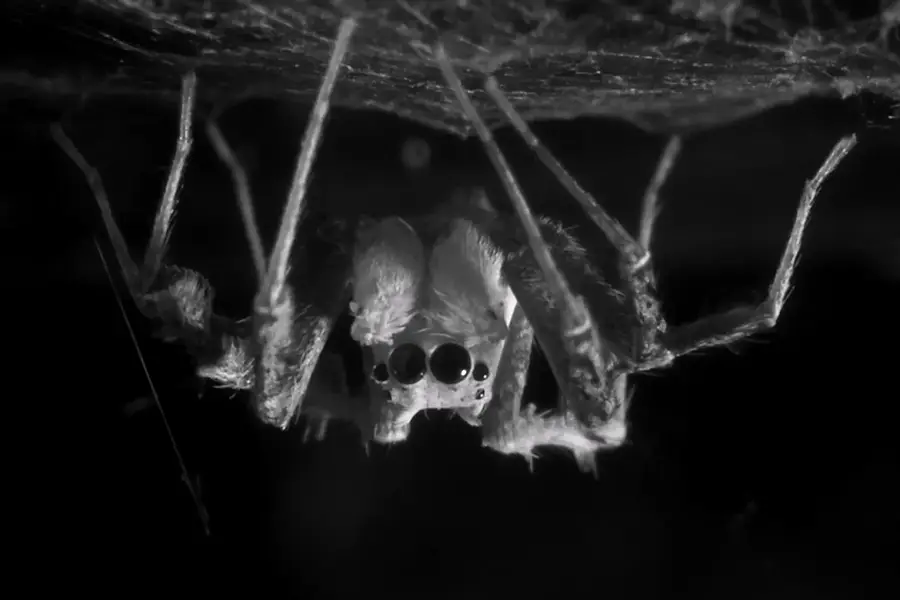
The spider Portia fimbriata in a sleeping position, hanging upside down beneath its self-spun web. © Daniela C. Rößler

Bernstein member involved: Armin Bahl

What is this about?

We investigated whether spiders actually sleep—and whether, like humans and other animals, they go through different stages of sleep. To do this, we recorded the behavior of the Australian jumping spider Portia fimbriata in high resolution over several days and nights and conducted experimental tests. What we know about sleep comes almost exclusively from vertebrates. Until now, experimental evidence for true sleep behavior in spiders was lacking.

What kind of spider is Portia fimbriata?

Species of the genus Portia feed on other spiders. Their diverse hunting strategies are often interpreted as a sign of intelligence: for example, they mimic the vibrations of wriggling insects caught in the web to attract web-building spiders. Their sophisticated hunting behavior suggests special learning abilities. That’s what makes this spider so interesting. With modest dimensions: The Australian jumping spider Portia fimbriata, which we studied, is about the size of a one-euro coin when fully grown.

What is the most important finding?

The spider exhibits true, regulated sleep with two clearly distinguishable sleep stages, including a REM-like state characterized by eye movements and muscle twitches. This provides the first comprehensive confirmation of sleep behavior in a spider.

How did you proceed?

We observed individuals of the species Portia fimbriata in small plastic dishes, each 12 centimeters in diameter, under varying lighting conditions over several days to record day-night rhythms. For nighttime recordings, we used infrared cameras to document sleep positions, resting phases, and REM-like phases in detail. We verified whether the animals were actually in a sleep state using an acoustic stimulus and measuring their reaction times. In addition, we tested whether the spiders exhibited “sleep rebound”—that is, making up for lost sleep—after sleep disruption.

What was the biggest challenge?

The biggest challenge was finding a stimulus for the arousal experiments to which the animals would respond reliably. After all, spiders perceive the world very differently from us. At the same time, we had to remain cautious so as not to overinterpret the REM-like movements, but rather to test, step by step, whether they really mean what we suspected. And we had to do all of this without being able to measure brain activity, relying solely on the animals’ behavior. This required very detailed and, above all, lengthy video documentation, which in turn resulted in enormous amounts of data—yet another challenge.

Is there any practical application?

Yes, in basic research. The results help us understand how sleep has evolved and how widespread REM-like states are in the animal kingdom. This opens up new perspectives for comparative behavioral, neuro-, and chronobiology, as well as for research into simpler nervous systems.

Based on the results, what do you recommend?

We recommend studying sleep not only in classic model organisms or vertebrates, but also broadening the field taxonomically—in particular, we should study sleep in animals with vastly different nervous systems or that exhibit extreme adaptations. This can help identify universal principles and a potentially primordial function of sleep. After all, despite intensive research on the topic, there are still a surprising number of gaps in our understanding of sleep—even in humans.

What’s next?

We are investigating how sleep, particularly REM-like sleep, has evolved across the entire diversity of spiders. We are also comparing the sleep behavior of spiders in the wild and in the laboratory. Further studies aim to clarify how sleep is related to cognitive abilities and what happens in the brains of arachnids and insects during sleep. We also want to understand how climate change and other anthropogenic influences—particularly artificial light at night (ALAN)—affect the sleep behavior of these animals.

Further links

Original press release

> more

Original publication

> more

How deeply do spiders sleep?

11. November 2026/in /by Elena Reiriz Martinez

Kontakt Aktuelles

Contact

Dr. Daniela C. Rößler

Scientific contact
Bonn Institute for Organismic Biology
Emmy Noether Group Leader, member of the transdisciplinary research areas “Life & Health” and “Sustainable Futures” at the University of Bonn

+49 228 735125
daniela.c.roessler@gmail.com

Nadja Geiger

Scientific contact
Bonn Institute for Organismic Biology

+49 228/735759
ngeiger@uni-bonn.de

Bernstein Netzwerk Computational Neuroscience Logo

Become a member
Statutes
Donation
Subscribe to Newsletter


Follow us on

LinkedIn
Bluesky
Vimeo
Mastodon
© 2026 Bernstein Network Computational Neuroscience
  • Contact
  • Imprint
  • Privacy Policy
Scroll to top Scroll to top Scroll to top
Cookie-Zustimmung verwalten
We use cookies to optimize our website and our service.
Functional Always active
Der Zugriff oder die technische Speicherung ist unbedingt für den rechtmäßigen Zweck erforderlich, um die Nutzung eines bestimmten Dienstes zu ermöglichen, der vom Abonnenten oder Nutzer ausdrücklich angefordert wurde, oder für den alleinigen Zweck der Übertragung einer Nachricht über ein elektronisches Kommunikationsnetz.
Vorlieben
Die technische Speicherung oder der Zugriff ist für den rechtmäßigen Zweck der Speicherung von Voreinstellungen erforderlich, die nicht vom Abonnenten oder Nutzer beantragt wurden.
Statistics
Die technische Speicherung oder der Zugriff, der ausschließlich zu statistischen Zwecken erfolgt. Die technische Speicherung oder der Zugriff, der ausschließlich zu anonymen statistischen Zwecken verwendet wird. Ohne eine Aufforderung, die freiwillige Zustimmung Ihres Internetdienstanbieters oder zusätzliche Aufzeichnungen von Dritten können die zu diesem Zweck gespeicherten oder abgerufenen Informationen allein in der Regel nicht zu Ihrer Identifizierung verwendet werden.
Marketing
Die technische Speicherung oder der Zugriff ist erforderlich, um Nutzerprofile zu erstellen, um Werbung zu versenden oder um den Nutzer auf einer Website oder über mehrere Websites hinweg zu ähnlichen Marketingzwecken zu verfolgen.
  • Manage options
  • Manage services
  • Manage {vendor_count} vendors
  • Read more about these purposes
Einstellungen
  • {title}
  • {title}
  • {title}