
How to test whether brain organoids possess conciousness
A clump of cells in a petri dish can hardly tell you whether it thinks or feels anything. Yet it may be possible to test whether it possesses a mind, says Lucia Melloni.
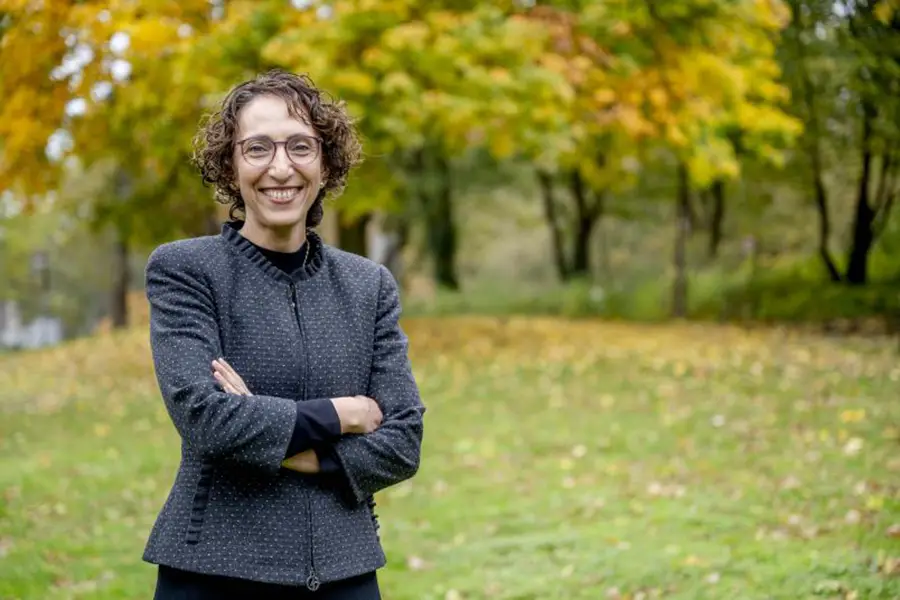
Lucia Melloni heads the Predictive Brain Department at Ruhr University Bochum and is a member of the University Alliance Ruhr’s Research Center One Health Ruhr. © RUB, Marquard
The development of brain organoids is advancing at a breakneck pace. Researchers are creating tiny cell clusters in the lab that behave like fragments of the human brain. Whether such organoids could develop intelligence—or even consciousness—remains a matter of debate. Professor Lucia Melloni of Ruhr University Bochum, Germany, and Professor Stanislas Dehaene of the Collège de France in Paris propose an experimental framework to answer this question. Their article appeared in a special issue on brain organoids of the journal “Neuron” on November 11, 2026.
“I don’t believe that brain organoids currently possess consciousness,” says Lucia Melloni, who conducts research at Ruhr University Bochum and at the Research Center One Health Ruhr within the University Alliance Ruhr. “But given the pace with which the technology is advancing, they may do so in future. That’s why we need to start thinking about how we can find out.” Melloni and Dehaene have developed an experimental approach to do just that.
What organoids are and what they are capable of
Organoids are grown from human pluripotent stem cells. Through specific chemical treatments, they differentiate into tiny cell clusters in a petri dish that behave, for example, like specific brain regions, the heart, or the gut. Researchers have already shown that human organoids can be implanted into mouse embryos, where they form connections with the embryo.
Different types of organoids can be coupled into assembloids in order to study their interactions. For instance, one group reconstructed a pain signaling pathway by coupling four organoids; they demonstrated that the assembloid reacted to capsaicin, the active compound in chili peppers.
Neural correlates of mind and consciousness
“A reaction, however, is not proof that the tissue feels anything,” Lucia Melloni clarifies. “To address the question of whether tissue could develop a mind—or even consciousness—we first asked what cognitive computations underlie the behavior of adult humans, particularly behaviors we associate with consciousness.”
Imagine a person repeatedly hearing a sequence of syllables: ba-ba-ba-ba-bu, ba-ba-ba-ba-bu, and so on. They quickly detect the difference between ba and bu, a pattern that requires no conscious processing. Over time, however, they can learn the full pattern i.e., that four ba syllables are followed by a bu syllable. If, after several repetitions, they hear the sequence ba-ba-ba-ba-ba, they consciously perk up because the expected bu is missing.
Electrical stimulation tests with organoids
Comparable tests could also be performed on organoids: Researchers could stimulate the tissue with different sequences of electrical signals and measure its electrical response. This would reveal whether an organoid, too, reacts to the absence of an expected stimulus.
Melloni and Dehaene propose eight tests using different stimulation sequences that require varying degrees of complex neural processing; some of these processes are typically associated with consciousness. “If an organoid were to respond to several of these tests in a certain way,” Melloni explains, “that would be evidence that it has developed something akin to a mind—or even consciousness.”
Engaging all stakeholders
The Bochum neuroscientist anticipates groundbreaking insights from organoid research in the future. “For example, in curing certain diseases and in understanding how the human body responds to climate change,” she elaborates. Together with colleagues, she advocates for the establishment of an international board to regulate organoid research. “The goal must be to gain knowledge and cure diseases in an ethically responsible way—involving the society,” Melloni says. A first step towards a debate with all relevant actors was taken at the Asilomar Conference in California in 2025, which Lucia Melloni attended.
Engaging all relevant stakeholders is also the approach of the Ruhr Innovation Lab, a consortium of Ruhr University Bochum and TU Dortmund University that will be funded as a Consortium of Excellence starting January 1, 2027. Melloni is a member of the Ruhr Innovation Lab’s potential area “The Healthy Mind in a Complex World”.