Wulfram Gerstner wins the 2026 Swartz Prize
EPFL neuroscientist Wulfram Gerstner has received the 2026 Swartz Prize for Theoretical and Computational Neuroscience for his contributions to understanding how neurons process information and how the brain learns.
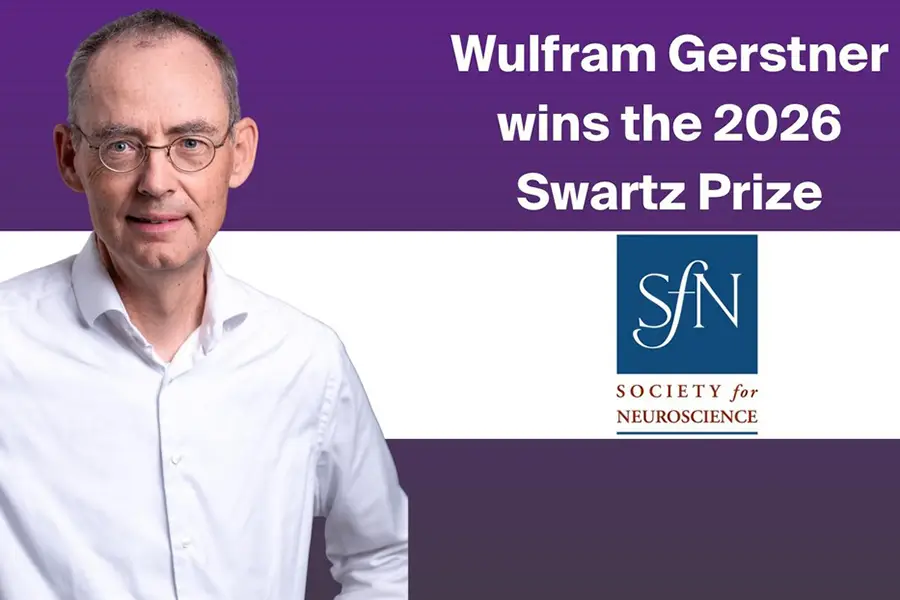
Wulfram Gerstner © 2026 EPFL
The Swartz Prize for Theoretical and Computational Neuroscience is awarded by the Society for Neuroscience to “honor an individual whose activities have produced a significant cumulative contribution to theoretical models or computational methods in neuroscience or who has made a particularly noteworthy recent advance in theoretical or computational neuroscience.” The Prize recognizes advances in our understanding of the brain through mathematics, theoretical research, and computer modeling.
The Society for Neuroscience (SfN) has awarded the 2026 prize to Wulfram Gerstner, head of the Laboratory of Computational Neuroscience at EPFL. The SfN cites Gerstner for “foundational contributions to nearly every pillar of theoretical and computational neuroscience”.
Gerstner’s research examines how neurons communicate, how connections between them change during learning, and how networks of neurons process information. Among his major contributions is the theoretical prediction of spike-timing-dependent plasticity, a mechanism through which the timing of electrical signals between neurons influences the strength of their connections. His work anticipated experimental findings and helped establish a mathematical framework for understanding how the brain learns from experience.
His laboratory also investigates learning through surprise and synaptic plasticity, including how signals beyond the activity of individual neurons influence changes in their connections.
Another area of his research is reinforcement learning, through which humans and animals learn from the consequences of their actions. His team investigates how rewards, expectations, and previous experiences influence learning and decision-making, using mathematical models to explore the underlying neural mechanisms.
Gerstner has also developed influential mathematical models of individual neurons and neural networks, including the Adaptive Exponential Integrate-and-Fire Model, developed with Romain Brette and widely used in computational neuroscience. His contributions have helped shape modern computational neuroscience, bringing together mathematical theory, experimental neuroscience, and machine learning.