Bernstein Network Computational Neuroscience
  • Home
  • Network
    • The Bernstein Network
    • Bernstein Centers
      • Berlin
      • Freiburg
      • Göttingen
      • Munich
      • Tübingen
      • Heidelberg-Mannheim
    • Bernstein Nodes
      • Bernstein Node Bochum
      • Bernstein Node Bonn-Cologne
      • Bernstein Node Chemnitz
      • Bernstein Node Hamburg
      • Bernstein Node Marburg
      • Bernstein Node Paris
      • Bernstein Node Rhine-Main Region
      • Bernstein Node Taiwan
    • Bernstein Facilities
      • High Performance Simulation and Data Analysis
      • Research Data Management
      • Bernstein Coordination Site (BCOS)
    • Awards and Initiatives
      • Valentin Braitenberg Award
      • Brains for Brains Young Researcher Award
      • Promoting Young Scientists
    • Committees
    • Network Ethics and Values
    • Statutes
    • Membership
    • History
    • Donation
    • Contact
  • Newsroom
    • Newsroom
    • News
    • Events
    • Calls
    • Media Coverage
    • Network Publications
    • Bernstein Bulletin
    • Press
  • Teaching and Research
    • Teaching and Research
    • Meet the Scientist
    • Find a Scientist
    • Degree Programs
      • Master Programs
      • PhD Programs
    • Study and Training
      • Bernstein Student Workshop Series
      • Online Learning
      • Advanced Courses
      • Internships and Master theses
      • Podcasts
  • Career
    • Career
    • Job Pool
    • Calls
    • Internships and Master theses
  • Bernstein Conference
    • Bernstein Conference
    • Abstract Submission
    • Exhibition
    • Program
      • Program at a Glance
      • Satellite Workshops
      • Conference Dinner
    • Early Career Scientists
      • Travel Grants
      • Postdoc Meeting
    • General Information
      • Important Dates & FAQ
      • Plan Your Visit
      • Press
      • Code of Conduct
      • PR Media Policy
      • Data Policy
    • Past and future Bernstein Conferences
  • DE
  • EN
  • Click to open the search input field Click to open the search input field Search
  • Menu Menu
You are here: Home1 / Newsroom2 / News3 / Do ChatGPT and the human brain have anything in common?
Aachen, Germany – March 11, 2026

Do ChatGPT and the human brain have anything in common?

Neural networks are Alexander van Meegen’s main area of interest. He has been conducting research in this field as a junior professor at RWTH Aachen University since February.
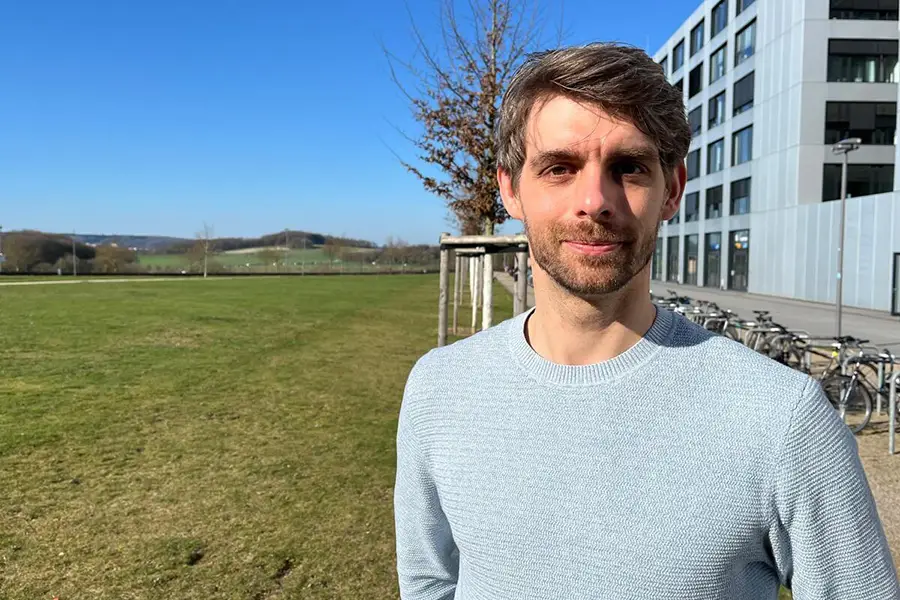
Alexander van Meegen is a junior professor of statistical physics of information processing in neural networks at RWTH Aachen University. © Judith Peschges

“Research is great fun. I just love getting to the bottom of things,” says Alexander van Meegen. Since February, the junior professor of statistical physics has been researching and teaching information processing in neural networks at RWTH Aachen University.

He is currently researching the similarities between artificial and biological neural networks. Both systems have neural connections through which information is exchanged. Van Meegen says that this works very well on both the biological and technical sides. However, there are still many unanswered questions: “I want to use my research to find out exactly how information is processed and exchanged,” explains the junior professor.

Van Meegen and other researchers have already made some interesting observations in the field of artificial intelligence. “We know that technical neurons learn useful ways to represent data. So if a pixel in an image is changed, the network doesn’t usually deduce that it’s a completely different image.” What’s exciting is that certain neurons always react when they recognize a dog, for example. This information, explains van Meegen, is clearly visible to researchers in the network in form of so called ‘coding schemes’ .

The key question is whether such findings can also be partially transferred to the human brain and vice versa. “It can work both ways”, says van Meegen. However, there are limitations: technical systems are much easier to study than neural networks in the brain. “For example, we often don’t know exactly which neurons in the brain are connected to each other.”

So far, there is only one complete picture of the neural connections in the brain of fruit flies. In addition, the human brain is much more complex than today’s artificial intelligence. Van Meegen returned to Germany through a nationwide return program, the aim of which is to attract top talent in the field of future computing to North Rhine-Westphalia.

The program supports ambitious young scientists, who are given the opportunity to “establish their own research groups with international appeal at one of our universities,” says Science Minister Ina Brandes, adding: “The interest in a scientific career in North Rhine-Westphalia impressively demonstrates that researchers find an optimal environment for their work here.”

There were also personal reasons why he chose Aachen. On the one hand, the move was a good fit for his family. On the other hand, the scientist cites more altruistic motives: “I would like to give something back after receiving a very good education in Germany; all of which I received free of charge.” In many other countries, university tuition fees are high. In addition, the topic of AI is very prominent at RWTH, especially in physics. There are several renowned researchers here who are working in this field.

Van Meegen completed his bachelor’s degree in physics at Heidelberg University, followed by a master’s degree at Humboldt University in Berlin. He then completed his doctorate with a focus on computational neuroscience very close to his current place of work, at Forschungszentrum Jülich. His postdoctoral work took him to the Center for Brain Research at Harvard and the Brain Mind Institute in Lausanne.

However, it was not clear from the outset that he would one day work in this field of research. At one point, he also considered studying philosophy or sports. “I also thought long and hard about studying psychology—but in the end, I think I made the right decision in combining these interests,” says the researcher.

Further links

Original press release

> more

Do ChatGPT and the human brain have anything in common?

8. May 2026/in /by Elena Reiriz Martinez

Kontakt Aktuelles

Contact

Prof. Dr. rer. nat. Alexander van Meegen

Scientific contact
Junior Professor for Statistical physics of information processing in neuronal networks
Building: 4272, Room: MBP 112
Otto-Blumenthal-Str. 12
52074 Aachen
Germany

+49 241 80-40310
vanmeegen@physik.rwth-aachen.de

Bernstein Netzwerk Computational Neuroscience Logo

Become a member
Statutes
Donation
Subscribe to Newsletter


Follow us on

LinkedIn
Bluesky
Vimeo
Mastodon
© 2026 Bernstein Network Computational Neuroscience
  • Contact
  • Imprint
  • Privacy Policy
Scroll to top Scroll to top Scroll to top
Cookie-Zustimmung verwalten
We use cookies to optimize our website and our service.
Functional Always active
Der Zugriff oder die technische Speicherung ist unbedingt für den rechtmäßigen Zweck erforderlich, um die Nutzung eines bestimmten Dienstes zu ermöglichen, der vom Abonnenten oder Nutzer ausdrücklich angefordert wurde, oder für den alleinigen Zweck der Übertragung einer Nachricht über ein elektronisches Kommunikationsnetz.
Vorlieben
Die technische Speicherung oder der Zugriff ist für den rechtmäßigen Zweck der Speicherung von Voreinstellungen erforderlich, die nicht vom Abonnenten oder Nutzer beantragt wurden.
Statistics
Die technische Speicherung oder der Zugriff, der ausschließlich zu statistischen Zwecken erfolgt. Die technische Speicherung oder der Zugriff, der ausschließlich zu anonymen statistischen Zwecken verwendet wird. Ohne eine Aufforderung, die freiwillige Zustimmung Ihres Internetdienstanbieters oder zusätzliche Aufzeichnungen von Dritten können die zu diesem Zweck gespeicherten oder abgerufenen Informationen allein in der Regel nicht zu Ihrer Identifizierung verwendet werden.
Marketing
Die technische Speicherung oder der Zugriff ist erforderlich, um Nutzerprofile zu erstellen, um Werbung zu versenden oder um den Nutzer auf einer Website oder über mehrere Websites hinweg zu ähnlichen Marketingzwecken zu verfolgen.
Manage options Manage services Manage {vendor_count} vendors Read more about these purposes
Settings
{title} {title} {title}