
Konferenzen, Symposien, Workshops, Kurse. Unsere Mitglieder sind aktiv in vielen Veranstaltungen eingebunden. Hier finden Sie die aktuelle Liste der anstehenden Events, die für Forschende der Computational Neuroscience von Interesse sind.

Veranstaltungen
Veranstaltungen
Groningen Spring School on Cognitive Modeling
30.03. – 02.04.2026
Groningen, Netherlands
Spring School
We are excited to announce the Eighth Spring School on Cognitive Modeling in Groningen, from 30 March-2 April 2026!
The Spring School will cover four different modeling paradigms: ACT-R, Nengo, PRIMs, and for the first time Neuromorphic Intelligence! Each of these topics consists of a series of lectures, as well as a number of hands-on exercises (tutorials).
Beteiligte Bernstein Mitglieder:
Elisabetta Chicca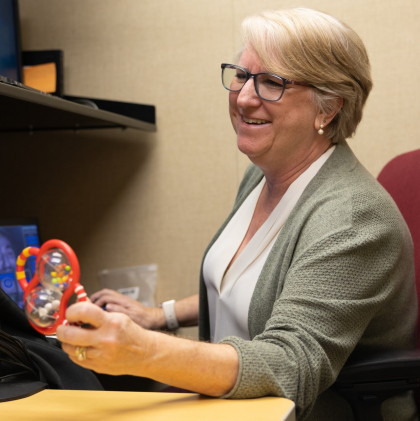
Developing Minds: “Learning to look and looking to learn: Developmental cascades in infant attention” (Lisa Oakes)
02.04. – 02.04.2026
Online
Lecture series
In 1950, Alan Turing asked "Instead of trying to produce a programme to simulate the adult mind, why not rather try to produce one which simulates the child's?" Today, 75 years later, constructing a computer program that can learn like a child and that develops a human-like general intelligence and consciousness is still considered a grand, if not the ultimate, challenge for artificial intelligence (AI). An interdisciplinary community of scientists from AI, Cognitive Science, Psychology, Engineering, and Neuroscience are tackling this grand challenge. In the Developing Minds global lecture series we showcase the progress being made. It is organized by the Developmental AI Task Force of the IEEE Technical Committee on Cognitive and Developmental Systems of the IEEE Computational Intelligence Society. See also: IEEE Int. Conference on Development and Learning (ICDL), IEEE Transactions on Cognitive and Developmental Systems (TCDS).
Beteiligte Bernstein Mitglieder:
Jochen Triesch (Organizer)
RMU AI and Creativity Symposium
16.04. – 16.04.2026
Darmstadt, Germany
Symposium
With the rapid advancement of generative models and autonomous agents, it is becoming increasingly difficult to distinguish between statistical imitation and actual creativity. This interdisciplinary one-day symposium goes beyond established narratives surrounding artificial intelligence and explores the structural and cognitive parallels between biological and artificial forms of creation. By bringing together leading researchers from the fields of machine learning and cognitive science, the symposium aims to create a space for in-depth analysis and interdisciplinary exchange, enabling new insights into how AI systems explore large search spaces for novelty and functional utility, and into the creative potential already inherent in current systems.
Beteiligte Bernstein Mitglieder:
Matthias KaschubeJonas Elpelt

Berlin Brains: Die Musik in unserem Gehirn
20.05. – 20.05.2026
Berlin, Germany
Öffentliche Veranstaltung
Dass unsere Erfahrungen und deren Speicherung – also Lernen und Gedächtnis – mit räumlichen und zeitlichen Mustern neuronaler Aktivität verknüpft sind, gehört mittlerweile zum Allgemeinwissen. Doch wie funktioniert das genau? Welche Gehirnbereiche sind beteiligt, was geschieht an den Kontaktstellen der Nervenzellen, den Synapsen? Und wie wirken Rhythmen, wenn wir neue Inhalte im Netzwerk unseres Gehirns abspeichern und sie später wieder abrufen, wenn wir uns also erinnern? Mit Fragen wie diesen beschäftigen sich Dietmar Schmitz und Alexandra Tzilivaki von der Charité-Universitätsmedizin Berlin im Rahmen eines Projekts im Sonderforschungsbereich 1315. Gemeinsam geben sie einen Überblick darüber, welche Rolle Rhythmen bei der Erinnerung spielen und welche Musik die Nervenzellen unseres Gehirns spielen.
Beteiligte Bernstein Mitglieder:
Alexandra Tzilivaki
EMBO Workshop on DENDRITES 2026
19.05. – 22.05.2026
Heraklion, Greece
Workshop
Understanding how the brain generates perception and behavior remains a major challenge in neuroscience. Neurons communicate through synaptic inputs located on dendrites, complex, highly branched structures that shape sensory processing, memory formation, and behavior. Advances in imaging, electrophysiology, and computational modeling now allow researchers to explore dendritic function across multiple scales, from single-synapse plasticity to dendritic computations driving behavior. This EMBO Workshop brings together leading scientists from molecular, biophysical, anatomical, computational, and functional neuroscience, as well as neuro-inspired AI, to advance our understanding of dendrites in cognition and disease. By fostering interdisciplinary collaboration, we aim to uncover fundamental principles governing dendritic computations and their broader implications, including how they may be incorporated into new AI architectures for more efficient or brain-like computation. Set on the stunning island of Crete, this EMBO Workshop is designed to encourage scientific exchange beyond traditional presentations, creating an engaging and interactive environment. Dedicated sessions will support young researchers, such as (1) work-life balance, (2) mentorship across career stages, and (3) career paths within and beyond academia. Through open discussions and collaborative experiences, this meeting will inspire new insights into the role of dendrites in brain function and dysfunction, paving the way for important future discoveries in neuroscience.
Beteiligte Bernstein Mitglieder:
Corette WierengaJulijana Gjorgjieva
Panayiota Poirazi
Tatjana Tchumatchenko
Katharina Wilmes
Naturalistic Neuroscience: From perception to action and back
28.05. – 29.05.2026
Bonn, Germany
Symposium
In the real world, sensory information shapes our decision and actions, but the reverse is equally true: our actions determine which information we obtain next. From the perspective of the brain, this closed-loop planning problem is radically more complex than the open-loop setting common in cognitive and systems neuroscience, where a brain is stimulated and its response recorded in short trials. Naturalistic neuroscience seeks to understand this perspective with experimental paradigms that seek to strike a balance between full experimental control and full realism. This international symposium brings together experts from diverse fields to explore the current state and future directions for naturalistic neuroscience research. As a two-day event, NN2026 spotlights substantive research, novel neurotechnology, and theoretical underpinnings in naturalistic neuroscience. In addition to a series of distinguished keynote talks, participants will have the opportunity to present their work through oral or poster presentations. During the symposium, it will also be possible to visit local naturalistic neuroscience and virtual reality facilities.
Beteiligte Bernstein Mitglieder:
Dominik Bach (organizer)
Bio-inspired DL workshop 2026: Neuromorphic Computing
09.06. – 12.06.2026
Mainz, Germany
Workshop
We are pleased to announce a workshop on bio-inspired deep learning led by Prof. Elisa Donati from the University of Zurich and ETHZ, Zurich and funded by the support of the Joachim Herz Foundation. This workshop will provide attendees with a unique opportunity to learn from one of the leading experts in the field and explore the intersection of mathematical modelling, machine learning, and data analysis to understand how the brain works. We believe this workshop will be of great interest to those wishing to learn how recent advances in bio-inspired small ‘shadow networks’ and feature engineering allow us interface with the nervous system. Furthermore, you will learn how these systems can be used to build closed-loop hybrid artificial and biological neural processing systems.
Beteiligte Bernstein Mitglieder:
Patrick BöschPietro Verzelli (organizer)
Munich Brain Day 2026
12.06. – 12.06.2026
Martinsried-Planegg, Germany
Symposium
The Munich Brain Day is dedicated to promoting neuroscience in Munich. This third edition of our event will happen on June 12th 2026 and will be held at the Max Planck Institute for Biological Intelligence starting at 9 am. We have selected 12 dynamic speakers to present their latest data, which will be accompanied by a poster session and data blitz from PhD and post-docs. There will be poster prizes! The event is free of charge, and there will be a social gathering in the evening. With this event we hope to catalyze collaboration, foster the exchange of ideas, raise the profile of early career scientists, and promote innovative interdisciplinary research across institutes. The Munich Brain day is an initiative of the Munich Center for Neurosciences (MCN).
Beteiligte Bernstein Mitglieder:
Simon JacobWiktor Młynarski
Benedikt Grothe
Bernhard Wolfrum
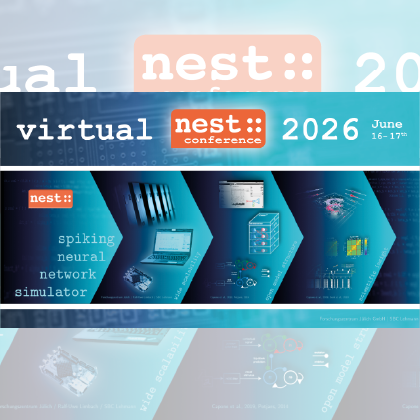
The Virtual NEST Conference 2026
16.06. – 17.06.2026
Online
Conference
The NEST Initiative invites everyone interested in Neural Simulation Technology and the NEST Simulator to the annual virtual NEST Conference. The NEST Conference provides an opportunity for the NEST Community to meet, exchange success stories, swap advice, learn about current developments in and around NEST spiking network simulation and its application. Take the opportunity to advance your skills in using NEST at our workshops! We particularly encourage young scientists to participate in the conference!
Beteiligte Bernstein Mitglieder:
Hans-Ekkehard Plesser (Organizer)
AREADNE 2026: Research in Encoding and Decoding of Neural Ensembles
23.06. – 27.06.2026
Milos, Greece
Conference
The AREADNE Conferences have been created to gather global scientific
leaders who work on neural ensembles and establish a touch-point for the
widely disparate and hybrid field. With a beautiful setting on Milos,
the conferences have been carefully planned to foster discussion and
interaction between attendees to encourage the establishment of lasting
professional relationships. The meetings continue our efforts to promote
systems neuroscience in Greece through creating a world-class forum for
cutting-edge research. For 2026, we will be Celebrating Twenty Years of
AREADNE Conferences!
Beteiligte Bernstein Mitglieder:
Julijana GjiorgjievaPanayiota Poirazi

Braitenberg 100: Computational Neuroscience – Past, Present, and Future
29.06. – 01.07.2026
Tübingen, Germany
Symposium
A landmark symposium in computational neuroscience, gathering the field’s foremost experts from around the world to celebrate past achievements, share current breakthroughs, and brainstorm future directions.
Beteiligte Bernstein Mitglieder:
Ad AertsenSacha van Albada
Sonja Grün
Peter Dayan
Wulfram Gerstner
Li Zhaoping

ICNCE 2026
29.06. – 02.07.2026
Aachen, Germany
Conference
The International Conference on Neuromorphic Computing and Engineering brings together a diverse community of researchers, from students to leading experts in academia, startups, and industry, to advance the understanding and engineering of brain-inspired computing technologies. The program spans electrical engineering, neuroscience, IT, materials science, physics, AI, philosophy, and ethics. Building on the success of the first ICNCE (2024), which gathered over 500 participants, this year's event will be held at the Eurogress Aachen, located in the heart of the historic city near RWTH Aachen University and Forschungszentrum Jülich.
Beteiligte Bernstein Mitglieder:
Abigail Morrison (organizer)Friedemann Zenke
FENS Forum 2026
06.07. – 10.07.2026
Barcelona, Spain
Forum
The FENS Forum of neuroscience is the largest international neuroscience meeting in Europe. Taking place in even years, the FENS Forum rotates between different European countries and attracts more than 7,000 international delegates. In 2026, FENS, in collaboration with the Spanish Society of Neuroscience, is excited to welcome scientists from all corners of the world to Barcelona to unite in celebration of neuroscience. This forum will bring together leading experts, researchers, and students from around the world to explore the latest breakthroughs in neuroscience. With an inspiring programme of scientific sessions, thought-provoking talks, and ample networking opportunities, the FENS Forum 2026 is the perfect place to shape the future of neuroscience.
The Bernstein Network will have an information booth at this event!
Neuromatch Academy
06.07. – 24.07.2026
Online
Course
Neuromatch Academy teach skills and techniques for computational sciences and research in Neuroscience, Climate Science, and Artificial Intelligence and Machine Learning. It serves thousands of students each year with hundreds of teaching assistants (TA). Students learn by solving problems in small groups and by running group projects; they learn in many languages in an incredibly supportive environment.

2026 Eresfjord Summer School in Computational Neuroscience
06.07. – 24.07.2026
Eresfjord, Norway
Summer school
Computational Neuroscience and Inference from data are disciplines that extensively use tools from Mathematics and Physics to understand the behavior of model neuronal networks and analyze data from real experiments. Due to its interdisciplinary nature and the complexity of the neuronal networks, the list of techniques that are borrowed from Physics and Mathematics is an extensive one. Although using tools from standard curriculum of Physics, Mathematics and Engineering is common, more advanced research requires methods and techniques that are not usually covered in any single discipline. To fill in this gap, this summer school covers some of the most important methods used in computational neuroscience research through both main lectures and scientific seminars (5-6 main lectures per topic and 1-2 seminars by each invited seminar speaker). The program is primarily intended for PhD students, but advanced Master’s students (who will have defended before July 2026) and first-year postdoctoral researchers are also welcome to apply. There are no registration fees. Accommodation and meals will be covered for all selected participants. Attendance for the full duration of the school is mandatory. Application deadline: March 15, 2026
Beteiligte Bernstein Mitglieder:
Srdjan OstojicNicolai Waniek

Systems Vision Science Virtual Summer School & Symposium
08.07. – 31.07.2026
Online
Summer School + Symposium
Applications are invited for a virtual edition of the Systems Vision Science Summer School and Symposium that took place in Max Planck Institute for Biological Cybernetics in Tuebingen, Germany in August 2023 and August 2025 and virtual in 2024. This year, the virtual edition enables students to attend from afar by formal lectures via Zoom and informal and social communications via a Slack channel. Systems Vision Science combines computational, behavioral, and neuroscience methods to discover functions and algorithms for vision in various brain regions and their implementations in neural circuits. This summer school is designed for everyone interested in gaining a systems level understanding of biological vision. We plan a coherent, graduate-level, syllabus on the integration of experimental data with theory and models. The Summer School will be followed by a Systems Vision Science Virtual Symposium on July 31st. All admitted summer school students will be invited to attend this symposium and are encouraged to submit for a presentation at the symposium. The symposium will also feature two invited keynote presentations.

The Brain Prize Course – Computational and Theoretical Neuroscience
13.07. – 31.07.2026
Lisbon, Portugal
Summer school
Understanding how the brain gives rise to behavior requires computational and theoretical methods. These allow us to formalize the function of neural circuits and to quantify behavior, as well as to analyze and understand complex high-dimensional datasets. Theoretical and experimental approaches work synergistically in modern neuroscience, where computational methods are critical for designing and interpreting experiments. This course teaches concepts, methods, and practices of modern computational neuroscience through a combination of lectures and hands-on project work. During the course’s mornings, distinguished international faculty deliver lectures on topics across the entire breadth of experimental and computational neuroscience. For the remainder of the time, students work on research projects in teams of 2 to 3 people under close supervision of expert tutors and faculty. Research projects are proposed by faculty before the course, and include the modeling of neurons, neural systems, and behavior, the analysis of state-of-the-art neural data (behavioral data, multi-electrode recordings, calcium imaging data, connectomics data, etc.), and the development of theories to explain experimental observations.
Beteiligte Bernstein Mitglieder:
Julijana GjiorgjievaOmri Barak
Susanne Schreiber
Jakob Macke
Wiktor Młynarski
Laura Busse
Yiota Poirazi
Alex Cayco Gajic
Advanced Neural Data Analysis and Neuroinformatics (ANDA-NI)
27.07. – 31.07.2026
Jülich, Germany and online
Summer school
The ANDA-NI school consists of three modules: Two online courses, ANDA and NI, and the in-person ANDA-NI Retreat for collaborative projects to put the learned material into practice on your own favorite datasets. Each online course is available for standalone enrollment. Participation in the ANDA-NI Retreat requires to take part in both online courses (ANDA and NI).
Beteiligte Bernstein Mitglieder:
Michael DenkerSonja Grün
Thomas Wachtler
Martin Nawrot
Udo Ernst
Cognitive Computational Neuroscience 2026
03.08. – 06.08.2026
New York City, USA
Conference
CCN is an annual forum for discussion among researchers in cognitive science, neuroscience, and artificial intelligence, dedicated to understanding the computations that underlie complex behavior. The conference began in 2017, with a goal to deepen interactions between these disciplines and to discover ways that the communities can benefit one another and leverage each other’s successes, articulated in this TICS commentary paper. The conference is primarily single-track featuring keynote speakers and oral presentations. Paper submissions are presented as posters with a few additionally selected for oral presentations. Community-proposed programming happens in single-track and parallel sessions, including "GACs", "K&Ts", and other community events. Generative Adversarial Collaborations (GACs), are symposia designed to clarify theoretical debates and scaffold forward progress. Keynote-and-Tutorial presentations (K&Ts) foster science and skill-building, presenting cutting-edge science as a talk, followed by the code and a tutorial of how to execute those methods. Open events are designed to welcome all creative ideas for community building, skill building, science exchange, mentorship and career development. We aspire to have an active, open, and responsive culture to meet the needs of this dynamic growing field. We encourage participation from experimentalists and theoreticians investigating complex brain computations in humans and animals.
Beteiligte Bernstein Mitglieder:
Shervin Safavi (organizer)
Summer School for Primate Cognitive Neuroscience 2026
26.07. – 07.08.2026
Bad Bevensen, Germany
Summer school
he fourth instantiation of this European Summer School will bring together PhD students, early postdocs, and an international list of faculty for an intense training programme in primate cognitive and systems neuroscience. It will provide an outstanding training opportunity for young scientists working with non-human primates. Teaching will focus on cognitive processes in primate sensory and motor systems as well as in social settings and decision making, and will include important and novel results and methodologies. Topics of animal welfare, ethics, and media outreach will also be covered. Each faculty member will teach for about one half-day and furthermore will be available for individual scientific discussions, career planning advice, and scientific networking. Participants are expected to present their ongoing work in a poster presentation.
Beteiligte Bernstein Mitglieder:
Hansjörg ScherbergerAlexander Gail
Ziad Hafed

Methods in Computational Neuroscience
24.07. – 21.08.2026
Woods Hole, MA, USA
Summer school
Animals interact with a complex world, encountering a variety of challenges: They must gather data about the environment, discover useful structures in these data, store and recall information about past events, plan and guide actions, learn the consequences of these actions, etc. These are, in part, computational problems that are solved by networks of neurons, from roughly 100 cells in a small worm to 100 billion in humans. Methods in Computational Neuroscience introduces students to the computational and mathematical techniques that are used to address how the brain solves these problems at levels of neural organization ranging from single membrane channels to operations of the entire brain.
Beteiligte Bernstein Mitglieder:
Srdjan Ostojic
Bernstein Conference 2026
28.09. – 01.10.2026
Frankfurt am Main, Germany
Conference
Each year the Bernstein Network invites the international computational neuroscience community to the annual Bernstein Conference for intensive scientific exchange. It has established itself as one of the most renowned conferences worldwide in this field, attracting students, postdocs and PIs from around the world to meet and discuss new scientific discoveries.

The 18th International Conference on the Simulation of Adaptive Behavior (SAB 2026)
19.10. – 22.10.2026
Berlin, Germany
Conference
The objective of this interdisciplinary conference is to bring together researchers in computer science, artificial intelligence, artificial life, control, robotics, neurosciences, ethology, evolutionary biology and related fields in order to further our understanding of the behaviors and underlying mechanisms that allow natural and artificial animals to adapt and survive in uncertain environments. The conference will focus on models of adaptive behavior and its underlying mechanisms, and on experiments grounded on well-defined models including robot, computer simulation and mathematical models designed to help characterize and compare various principles or architectures underlying adaptive behavior in real animals and in synthetic agents, the “animats”. Selected papers will be invited to a special issue in the journal Adaptive Behavior and will be published with Springer Nature.
Beteiligte Bernstein Mitglieder:
Pawel RomanczukGregor Schöner
Jochen Triesch
Florentin Wörgötter
Folgen Sie uns auf