
Specialists at work – Nerve cells adapt their structure and function to their task
An international research team led jointly by the University Medical Center Göttingen (UMG), the University of Göttingen, and the University of Western Ontario in London, Canada, has shown that nerve cells in the brain specialize in different tasks when processing visual information. The research focused on working memory — a complex network of different brain regions that stores and links information. A disruption in this information processing can lead to neurological and neuropsychiatric disorders. The study results could help identify new treatment approaches for these disorders and have been published in the journal Nature Communications.
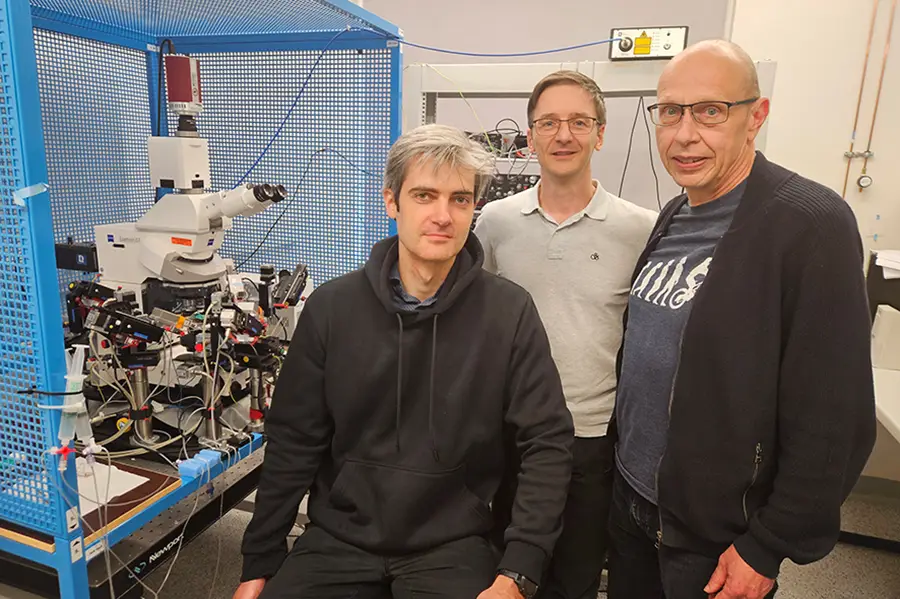
Dr. Stefan Pommer, research associate in the Department of Neuroanatomy at the University Medical Center Göttingen (UMG), Dr. Andreas Neef, head of the Laboratory of Neurophysics at the Göttingen Campus Institute for Dynamics of Biological Networks (CIDBN), and Prof. Dr. Jochen Staiger, director of the Department of Neuroanatomy at UMG (from left to right). Photo: cidbn/felix preuß
Bernstein member involved: Andreas Neef
Humans and other primates possess a highly developed and hierarchically organized visual processing system in the brain. The conscious processing of visual information begins in the primary visual cortex. Here, features such as edges, lines, motion, and color are detected and ultimately relayed to higher-level areas such as the lateral prefrontal cortex. This brain region plays a key role in working memory, which is also essential for processing complex visual information, such as navigating urban traffic. The extent to which nerve cells in these two brain regions are involved in performing these various tasks has not yet been fully elucidated.
An international team of researchers led jointly by the University Medical Center Göttingen (UMG), the University of Göttingen, and the University of Western Ontario in London, Canada, has studied nerve cells from the primary visual cortex and the lateral prefrontal cortex in marmosets, measuring the cells’ three-dimensional structure and electrical function. Three of the nerve cell types studied showed differences in structure and function depending on whether they originated from primary or higher brain regions that process visual information. The study was conducted as part of the subproject “In vitro physiology, morphology, and circuitry of working memory” within the international NeuroNex research project, which was funded by the German Research Foundation (DFG).
“For the first time, these findings provide us with comprehensive insights into the differences between nerve cells in various brain regions and their functional significance,” says Prof. Dr. Jochen Staiger, director of the Department of Neuroanatomy at the University Medical Center Göttingen (UMG) and senior author of the study. “We see that nerve cells appear to adapt structurally and functionally depending on the task at hand and their location in the brain, and to a much greater extent in primates than in rodents. This is an important finding that serves as a starting point for a better understanding of working memory, which appears to play a role in the development of neurological and neuropsychiatric disorders such as schizophrenia.” Dr. Andreas Neef, head of the Laboratory of Neurophysics at the Göttingen Campus Institute for Dynamics of Biological Networks (CIDBN) and also senior author of the study, adds: “Our electrical and structural investigations bridge the gap between other research branches of the NeuroNex project, which focus on molecular biology and computational neuroscience. Together, we are gaining a comprehensive picture of working memory, a specialization found in such a pronounced form in very few animal groups other than humans and other primates.”
The findings have been published in the journal Nature Communications.
The study in detail
The study examined the electrophysiological properties of 483 nerve cells in various brain layers of marmosets at the German Primate Center – Leibniz Institute for Primate Research in Göttingen — 214 in the primary visual cortex and 269 in the lateral prefrontal cortex. The data obtained were then compared with previously known data from mice and human nerve cells. To this end, a machine learning-based method was developed — a computer program trained using existing data from mice and humans to distinguish between different classes of nerve cells, each composed of distinct cell types. In addition, whole nerve cells were filled with dye and, in a complex process taking approximately 80 hours per cell, converted into a 3D model on the computer. In this way, the individual cells and their location in the brain could be visualized and analyzed.
By comparing the data, three distinct classes were identified in the two brain regions studied in marmosets: (1) nerve cells that excite downstream nerve cells, thereby transmitting information; (2) nerve cells that rapidly and selectively inhibit other nerve cells; and (3) nerve cells that inhibit other nerve cells slowly but over a longer period of time. The inhibition of nerve cells prevents the uncontrolled transmission of excitatory signals, which, for example, makes precise sensory perception possible in the first place.
Specialized structures for complex information
The results show that excitatory neurons in the lateral prefrontal cortex — the brain region where complex visual information is processed — exhibit a specialized structure. The extensions through which signals from other cells are received — known as dendrites — are more numerous and more branched in this brain region than in the primary visual cortex. “We already know that part of the information processing takes place directly in these extensions. Therefore, it is possible that the larger and more finely branched extensions develop here so that the more complex computations in this brain region can proceed more effectively,” explains Dr. Neef.
In addition, a specific group of inhibitory nerve cells stood out in this area. When stimulated, they responded completely differently from their direct counterparts in the primary cortex: they fired an extremely rapid sequence of impulses, thereby inhibiting downstream cells particularly effectively.
Project partners involved
In addition to the UMG, represented by Prof. Staiger and lead author Dr. Stefan Pommer from the Institute of Neuroanatomy, and the University of Göttingen, represented by Dr. Neef, there was close collaboration with Prof. Dr. Stefan Treue and Prof. Dr. Rabea Hinkel from the German Primate Center – Leibniz Institute for Primate Research (DPZ), as well as with Prof. Dr. Julio Martinez-Trujillo, also one of the study’s co-authors, and first author Dr. Michael Feyerabend, both from the University of Western Ontario in London, Canada. Also involved were the Center for Biostructural Imaging of Neurodegeneration (BIN) at UMG, the Max Planck Institutes for Multidisciplinary Sciences (MPI-NAT) and for Dynamics and Self-Organization (MPI-DS), the German Centre for Cardiovascular Research (DZHK) in Göttingen, the University of Veterinary Medicine Hannover, as well as the Yale School of Medicine in New Haven, Connecticut, USA, the University of Pittsburgh in Pittsburgh, Pennsylvania, USA, and, the University of Toronto in Toronto, Ontario, Canada.