
Xiao-Jing Wang receives the 2026 Valentin Braitenberg Award for Computational Neuroscience
Xiao-Jing Wang receives this year’s Valentin Braitenberg Award for his “enormous contributions across many subfields, from biophysics to computational psychiatry” (the award committee). The award ceremony will take place during the Bernstein Conference on September 29, 2026, in Frankfurt am Main.
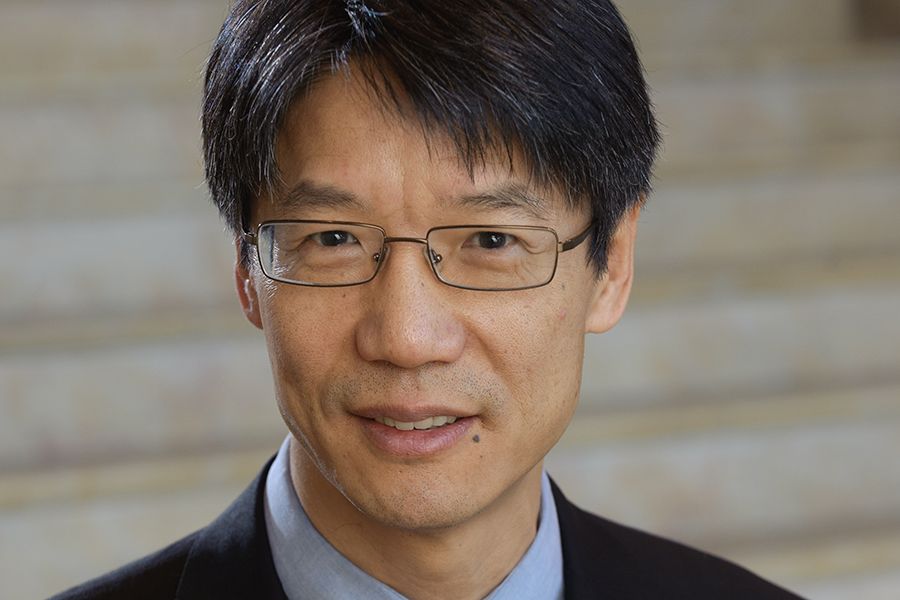
Professor Xiao-Jing Wang, winner of the 2026 Valentin Braitenberg Award for Computational Neuroscience. Photo: NYU
Xiao-Jing Wang is a theoretical physicist and neuroscientist. His research focuses on the neural circuit mechanisms and computational principles underlying cognitive processes such as decision-making and working memory, as well as on connectome-based modeling of large-scale brain circuits for distributed cognition. Wang earned his PhD in physics with the highest distinction from the Université libre de Bruxelles in Belgium in 1987. Since then, he has authored more than 100 scientific publications, and his work has been cited over 53,000 times.
Now, Wang has been named the recipient of the 2026 Valentin Braitenberg Award for Computational Neuroscience for his outstanding contributions to the field. “I am honored to receive the Valentin Braitenberg Award,” Wang said upon hearing the news. “It is a recognition of all my former students, postdoctoral fellows, and collaborators whom I have had the privilege to work with, as well as a testament to the idea that basic and open science knows no borders.”
Wang transitioned from physics to the then-emerging field of computational neuroscience after completing his PhD. In 1988, he participated in the inaugural Computational Neuroscience Summer School at the Marine Biological Laboratory in Woods Hole, Massachusetts, and went on to build his academic career in the United States. His work has been recognized through numerous honors, including the 2017 Swartz Prize for Theoretical and Computational Neuroscience from the Society of Neuroscience. He currently serves as Distinguished Global Professor of Neural Science and Adjunct Professor of Physics and Mathematics at New York University.
Wang’s long-standing research interest is the prefrontal cortex, often described as the “CEO of the brain.” The prefrontal cortex plays a critical role in higher cognitive functions and is implicated in numerous psychiatric disorders. This line of research led Wang to work with others in launching the field of Computational Psychiatry for integrating basic and clinical research on mental disorders.
The award committee recognizes Wang as “one of the most influential computational neuroscientists of his generation.” A defining feature of his work is the close connection between theoretical approaches and experimental neuroscience — many of his models were developed in dialogue with neurobiological findings and later tested through experimental research. Among Wang’s most influential contributions are computational models explaining how networks of neurons in the prefrontal cortex generate stable activity patterns associated with working memory and support decision-making. Several of these frameworks have become foundational references in computational neuroscience and continue to shape research on cognition and brain disorders.
In addition to his scientific achievements, the award committee acknowledges Wang’s “service to the scientific community” through his teaching, mentoring, and editorial activities. Over the course of his career, he has helped shape international training and exchange formats in neuroscience, including co-founding the Gordon Research Conference on the Neurobiology of Cognition and founding and co-directing the international Computational and Cognitive Neuroscience Summer School at Cold Spring Harbor Asia. In addition, he has trained numerous early-career researchers, with more than 30 former lab members now serving as professors or leading their own research groups worldwide.
More recently, Wang authored the textbook Theoretical Neuroscience: Understanding Cognition, published by CRC/Taylor & Francis in 2025. The book brings together decades of research in theoretical and computational neuroscience to present an accessible framework for understanding the neural circuit mechanisms of cognition.
The Valentin Braitenberg Award will be formally presented to Xiao-Jing Wang at the Bernstein Conference on Tuesday, September 29, 2026. Following the award ceremony, Wang will deliver the Valentin Braitenberg Lecture, presenting highlights of his research.
The Valentin Braitenberg Award
The award is named after Valentin Braitenberg (1926, Bolzano – 2011, Tübingen), one of the founding directors of the Max Planck Institute for Biological Cybernetics in Tübingen, Germany. Braitenberg’s research focused on the fine structure of the brain and its functional principles, with groundbreaking contributions to the understanding of the cerebral and cerebellar cortex.
With the financial support of the Autonomous Province of Bolzano – South Tyrol, the Valentin Braitenberg Award for Computational Neuroscience is awarded every two years by the Bernstein Network as part of the Bernstein Conference. An additional award is being presented in 2026 to commemorate the 100th anniversary of Valentin Braitenberg’s birth.