Novel learning mechanism for brain-inspired networks
A research team led by the University of Bern has developed a novel learning mechanism for neural networks modeled after the human brain. “Spike-based Alignment Learning” uses random fluctuations in the activity of artificial neurons to reveal asymmetric connections, allowing synapses that are far apart to autonomously align with one another without communicating directly. This approach could help us better understand learning processes in the brain and develop robust, energy-efficient, brain-inspired computer systems.
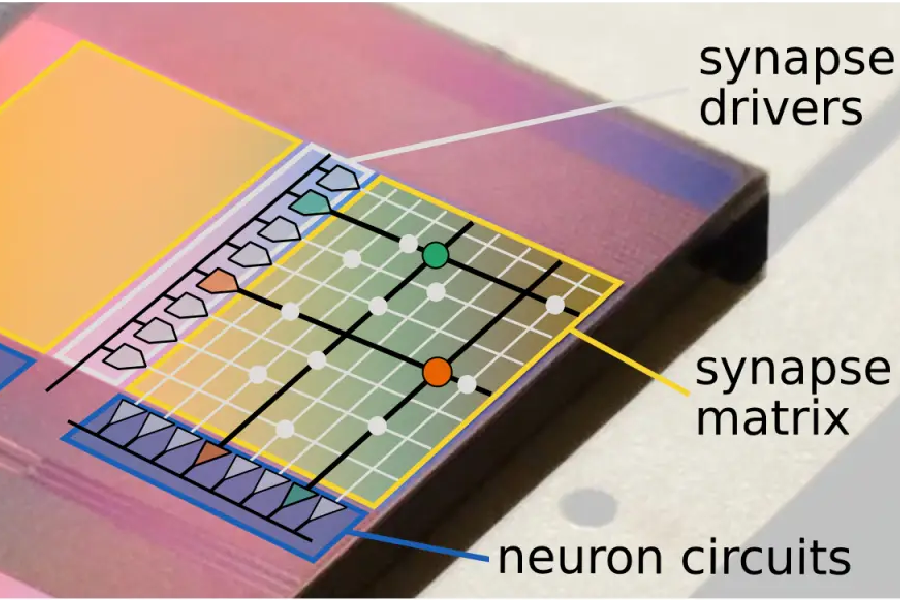
BrainScaleS-2 neuromorphic chip with schematic overlay. From Fig. 2a of Gierlich et al. (2026). Chip photo by Eric Müller, Heidelberg University, CC BY-ND 4.0.
Artificial neural networks – the foundation of the modern AI revolution – are indeed inspired by the brain, but they learn using mathematical methods for which no corresponding mechanisms are yet known to exist in biology. A key method for training such networks is “error backpropagation.” In this process, error signals are fed back through the artificial neural network so that the connections between neurons can be adjusted. For this to work, the connections for forward and backward transmission must be precisely coordinated. In digital computers, this is technically easy to implement, but not in the biological brain or in brain-inspired (neuromorphic) computer systems: in both cases, the connections – known as synapses – between neurons are unidirectional, meaning that forward and backward information between pairs of neurons necessarily flows through separate channels. This fundamental problem was recognized as early as the 1980s and was long considered evidence that our brain is incapable of error backpropagation.
A research team led by the Institute of Physiology at the University of Bern is now presenting a new approach that demonstrates how brains – both biological and neuromorphic – can easily circumvent this problem. The newly developed learning mechanism, known as “Spike-based Alignment Learning” (SAL), allows connections to be adjusted using information directly available at each connection. Timo Gierlich and Dr. Mihai A. Petrovici, from the NeuroTMA research group at the University of Bern, developed the approach in collaboration with researchers from the University of Heidelberg and the Okinawa Institute of Science and Technology. Petrovici leads the Neuro-inspired Theory, Modeling, and Applications (NeuroTMA) research group at the Institute of Physiology. This group develops theoretical models of neural networks to better understand biological information processing and apply these insights to neuromorphic computer systems. The study was published in Nature Communications.
How noise becomes a learning signal
Biological neurons transmit information by firing short electrical impulses, known as “spikes”. The exact time intervals between these spikes vary slightly. SAL uses these small, random fluctuations in the signal, or “noise,” to identify connections in the network that are not yet well-coordinated. These connections can then adjust themselves without requiring information from distant parts of the network. If a pair of neurons is asymmetrically connected forward and backward, this manifests as asymmetry in their spike patterns: one neuron causes the other to fire more frequently than vice versa. Individual synapses have direct access to these spike patterns and can adapt themselves accordingly to compensate for any asymmetries without needing information from distant parts of the network. Here, “noise” does not refer to sound, but rather to the small, random variations that occur in the brain and electronic components. “In electronic systems, noise is usually considered a disruptive factor. In our approach, however, it provides the very variation from which the network derives information about its connections,” says Timo Gierlich, a doctoral student at the University of Bern’s Institute of Physiology and the study’s first author.
Solving a fundamental learning problem
The researchers tested SAL in various artificial networks, ranging from brain-like models to image recognition systems. In all cases, SAL successfully coordinated the necessary connections despite each synapse using only information from its immediate surroundings. Even in image recognition, SAL yields much better results than models that cannot compensate for asymmetric connections. While classical backpropagation of errors remains the most accurate, it requires the exchange of information between parts of the network that are far apart – something that is difficult to implement in the brain and in neuromorphic computer systems. “Our goal is not to replace backpropagation on conventional computers,” says Dr. Mihai A. Petrovici. “We want to understand how a network can learn effectively when each connection uses only the information available at its location. This will enable us to design novel computing architectures that do not require transporting large amounts of information over long distances, thereby achieving significantly greater speed and better energy efficiency.”
From brain research to computer chips
SAL could be particularly interesting for neuromorphic computing, which takes inspiration from brain to improve information processing in artificial systems. In these systems, electronic components, much like nerve cells, are never completely identical and can change over time. SAL can compensate for these differences, contributing to more robust, adaptive systems. Researchers cite possible future applications, including smart sensors and wearable devices that function reliably even when their components or environment change.
So far, SAL has only been studied using mathematical analyses and computer simulations, but individual components of the model have already been investigated experimentally. Neuromorphic developers are also now in the process of implementing the mechanism in their systems. “The next step is to test our theoretical predictions on real systems,” says Petrovici. “Combining theoretical neuroscience and neuromorphic computing allows us to investigate fundamental questions about how physical neural systems can learn efficiently and robustly.”