
Bernstein Network Computational Neuroscience
  • Home
  • Network
    • The Bernstein Network
    • Bernstein Centers
      • Berlin
      • Freiburg
      • Göttingen
      • Munich
      • Tübingen
      • Heidelberg-Mannheim
    • Bernstein Nodes
      • Bernstein Node Aachen-Jülich
      • Bernstein Node Bochum
      • Bernstein Node Bonn-Cologne
      • Bernstein Node Chemnitz
      • Bernstein Node Hamburg
      • Bernstein Node Marburg
      • Bernstein Node Paris
      • Bernstein Node Rhine-Main Region
      • Bernstein Node Taiwan
    • Bernstein Facilities
      • High Performance Simulation and Data Analysis
      • Research Data Management
      • Bernstein Coordination Site (BCOS)
    • Awards and Initiatives
      • Valentin Braitenberg Award
      • Brains for Brains Young Researcher Award
      • Promoting Young Scientists
    • Committees
    • Network Ethics and Values
    • Statutes
    • Membership
    • History
    • Donation
    • Contact
  • Newsroom
    • Newsroom
    • News
    • Events
    • Calls
    • Media Coverage
    • Network Publications
    • Bernstein Bulletin
    • Press
  • Teaching and Research
    • Teaching and Research
    • Meet the Scientist
    • Find a Scientist
    • Degree Programs
      • Master Programs
      • PhD Programs
    • Study and Training
      • Bernstein Student Workshop Series
      • Online Learning
      • Advanced Courses
      • Internships and Master theses
      • Podcasts
  • Career
    • Career
    • Job Pool
    • Calls
    • Internships and Master theses
  • Bernstein Conference
    • Bernstein Conference
    • Abstract Submission
    • Registration
    • Exhibition
    • Program
      • Schedule
      • Satellite Workshops
      • Conference Dinner
    • Early Career Scientists
      • Travel Grants
      • PhD Symposium
      • Postdoc Meeting
    • General Information
      • Important Dates & FAQ
      • Plan Your Visit
      • Press
      • Code of Conduct
      • PR Media Policy
      • Data Policy
    • Past and future Bernstein Conferences
  • DE
  • EN
  • Click to open the search input field Click to open the search input field Search
  • Menu Menu
You are here: Home1 / Newsroom2 / News3 / Can sadness be measured?
Cologne, Germany – September 26, 2026

Can sadness be measured?

Researchers at the University of Cologne are heading a new collaborative project funded by the German Federal Ministry of Research, Technology and Space to investigate how technologies are changing our understanding of sadness, anxiety, and pain.
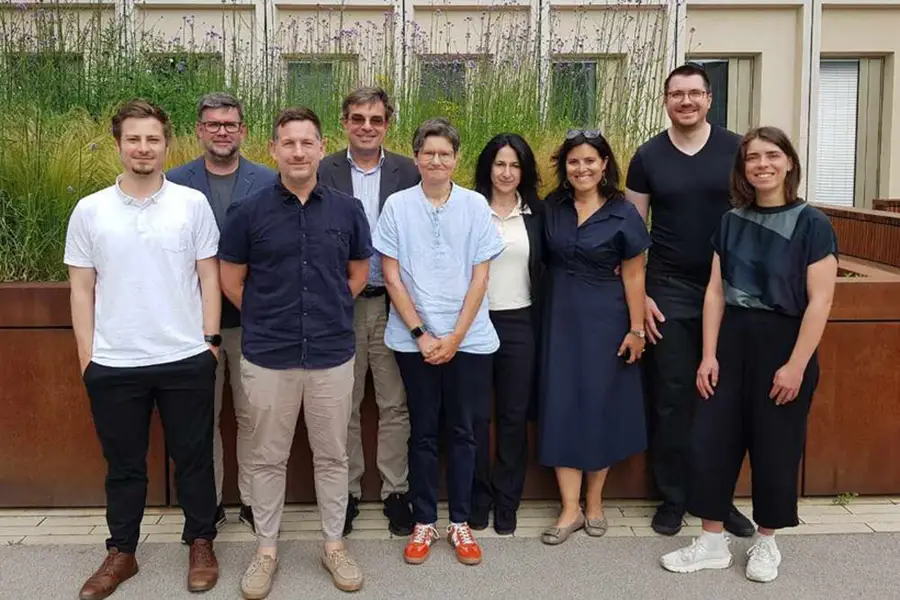
From left: Sebastian Nähr-Wagener, Sebastian Schleidgen (both University of Cologne), Jeremy Lefint (KIT-ITAS), Andreas Fallgatter (University Hospital Tübingen), Nora Weinberger (KIT-ITAS), Orsolya Friedrich (University of Cologne), Claudia Bozzaro, Dominik Koelsing (both University of Münster), Lydia Federmann (Hertie AI). Not pictured: Kerstin Ritter (Hertie AI).

Bernstein member involved: Kerstin Ritter

An interdisciplinary collaborative project, led by the University of Cologne’s Institute for the History and Ethics of Medicine, is studying the consequences of the use of technologies in relation to medicine, society, and the way we deal with human emotions. “ShiftAffect – Shifted Boundaries” was launched in 2026 and is being funded by the Federal Ministry of Research, Technology and Space until February 2029, with a total grant of 1,017,132 euros. Of this amount, 344,161.13 euros will go to the University of Cologne; the remaining funds will go to other project partners.

Sadness, anxiety, and pain are among the experiences that affect us most directly. Technologies designed to detect, interpret, and influence such emotional states are increasingly being used, for instance, affective computing applications that infer emotional states from speech, facial expressions, or body language; virtual reality and neuromodulation techniques; and smartphone-based applications that track moods in everyday life.

What constitutes ‘normal’ versus ‘needs treatment’ is shifting

ShiftAffect is based on the observation that such technologies can do more than simply help to alleviate anxiety, pain, or sadness. They also alter our understanding of what these conditions involve and where the line is drawn between a normal experience and a condition needing treatment. If an application presents sadness as a measurable pattern, or if a system flags anxiety as abnormal once a certain threshold is reached, it is not just the treatment that changes, but the category itself. These shifts, as demonstrated by the project’s subtitle ‘Shifted Boundaries’, are at the heart of the project.

The head of the research network, Professor Dr Dr Orsolya Friedrich from the Institute for the History and Ethics of Medicine, says: “Our aim is ultimately to provide ethically sound recommendations for the responsible development, clinical application, and regulation of technologies that detect, analyse, and modulate human emotions.” The team has already taken the first steps in this direction: researchers are reviewing the current state of research and have drawn up interview guidelines with which they aim to incorporate the perspectives of those affected, clinicians, and developers.

At the same time, they are planning an online lecture series and an expert workshop to be held in Cologne in March 2027 on the topic of ‘Emotions and Technology’, in which they hope to engage in dialogue with leading figures from the fields of philosophy, technology, and medicine, as well as with interested members of the public.

Interdisciplinary research with practical relevance

The research team consists of Professor Dr Dr Orsolya Friedrich and Dr Sebastian Schleidgen (Cologne), Professor Dr Claudia Bozzaro (Münster), Dipl.-Ing. Nora Weinberger (KIT-ITAS), Professor Dr Andreas Fallgatter (University Hospital Tübingen), and Professor Dr Kerstin Ritter (Hertie Institute for AI in Brain Health). Together, the project leaders at these sites and their teams are investigating the implications of the examined shifts for clinical practice, for the relationship between healthcare professionals and patients, and for society’s perceptions of normality, health, and illness.

ShiftAffect combines philosophical, ethical, and conceptual analyses with empirical research and participatory processes, in which developers, clinicians, those affected, and other stakeholders work together to explore possible future developments. At the end of the project, the team plans to provide ethically grounded recommendations for policy, medicine, technological development, and society alongside publications in scientific journals. The first findings are expected by the end of 2027.

Further links

Original press release

> more

Can sadness be measured?

2. October 2026/in Ausgewählter Aktuelles-Post für die Startseite /by Elena Reiriz Martinez

Kontakt Aktuelles

Contact

Professor Dr Dr Orsolya Friedrich

Scientific contact
Institute for the History and Ethics of Medicine
University of Cologne and University Hospital Cologne

sekretariat.igem@uk-koeln.de

Eva Schissler

Press and Communications Team
University of Cologne

+49 221 470 4030
e.schissler@verw.uni-koeln.de

Bernstein Netzwerk Computational Neuroscience Logo

Become a member
Statutes
Donation
Subscribe to Newsletter


Follow us on

LinkedIn
Bluesky
Vimeo
Mastodon
© 2026 Bernstein Network Computational Neuroscience
  • Contact
  • Imprint
  • Privacy Policy
Scroll to top Scroll to top Scroll to top
Cookie-Zustimmung verwalten
We use cookies to optimize our website and our service.
Functional Always active
Der Zugriff oder die technische Speicherung ist unbedingt für den rechtmäßigen Zweck erforderlich, um die Nutzung eines bestimmten Dienstes zu ermöglichen, der vom Abonnenten oder Nutzer ausdrücklich angefordert wurde, oder für den alleinigen Zweck der Übertragung einer Nachricht über ein elektronisches Kommunikationsnetz.
Vorlieben
Die technische Speicherung oder der Zugriff ist für den rechtmäßigen Zweck der Speicherung von Voreinstellungen erforderlich, die nicht vom Abonnenten oder Nutzer beantragt wurden.
Statistics
Die technische Speicherung oder der Zugriff, der ausschließlich zu statistischen Zwecken erfolgt. Die technische Speicherung oder der Zugriff, der ausschließlich zu anonymen statistischen Zwecken verwendet wird. Ohne eine Aufforderung, die freiwillige Zustimmung Ihres Internetdienstanbieters oder zusätzliche Aufzeichnungen von Dritten können die zu diesem Zweck gespeicherten oder abgerufenen Informationen allein in der Regel nicht zu Ihrer Identifizierung verwendet werden.
Marketing
Die technische Speicherung oder der Zugriff ist erforderlich, um Nutzerprofile zu erstellen, um Werbung zu versenden oder um den Nutzer auf einer Website oder über mehrere Websites hinweg zu ähnlichen Marketingzwecken zu verfolgen.
  • Manage options
  • Manage services
  • Manage {vendor_count} vendors
  • Read more about these purposes
Settings
  • {title}
  • {title}
  • {title}