
Bernstein Network Computational Neuroscience
  • Home
  • Network
    • The Bernstein Network
    • Bernstein Centers
      • Berlin
      • Freiburg
      • Göttingen
      • Munich
      • Tübingen
      • Heidelberg-Mannheim
    • Bernstein Nodes
      • Bernstein Node Aachen-Jülich
      • Bernstein Node Bochum
      • Bernstein Node Bonn-Cologne
      • Bernstein Node Chemnitz
      • Bernstein Node Hamburg
      • Bernstein Node Marburg
      • Bernstein Node Paris
      • Bernstein Node Rhine-Main Region
      • Bernstein Node Taiwan
    • Bernstein Facilities
      • High Performance Simulation and Data Analysis
      • Research Data Management
      • Bernstein Coordination Site (BCOS)
    • Awards and Initiatives
      • Valentin Braitenberg Award
      • Brains for Brains Young Researcher Award
      • Promoting Young Scientists
    • Committees
    • Network Ethics and Values
    • Statutes
    • Membership
    • History
    • Donation
    • Contact
  • Newsroom
    • Newsroom
    • News
    • Events
    • Calls
    • Media Coverage
    • Network Publications
    • Bernstein Bulletin
    • Press
  • Teaching and Research
    • Teaching and Research
    • Meet the Scientist
    • Find a Scientist
    • Degree Programs
      • Master Programs
      • PhD Programs
    • Study and Training
      • Bernstein Student Workshop Series
      • Online Learning
      • Advanced Courses
      • Internships and Master theses
      • Podcasts
  • Career
    • Career
    • Job Pool
    • Calls
    • Internships and Master theses
  • Bernstein Conference
    • Bernstein Conference
    • Abstract Submission
    • Registration
    • Exhibition
    • Program
      • Schedule
      • Satellite Workshops
      • Conference Dinner
    • Early Career Scientists
      • Travel Grants
      • PhD Symposium
      • Postdoc Meeting
    • General Information
      • Important Dates & FAQ
      • Plan Your Visit
      • Press
      • Code of Conduct
      • PR Media Policy
      • Data Policy
    • Past and future Bernstein Conferences
  • DE
  • EN
  • Click to open the search input field Click to open the search input field Search
  • Menu Menu
You are here: Home1 / Newsroom2 / News3 / Beyond COVID-19: Fundamental principles that shape pandemics
Göttingen, Germany – August 5, 2026

Beyond COVID-19: Fundamental principles that shape pandemics

Pandemics follow common fundamental principles despite their differences. The course of pandemics arises from the interplay of biological, mathematical, and social mechanisms. Understanding these principles can improve preparedness and response to future pandemics.
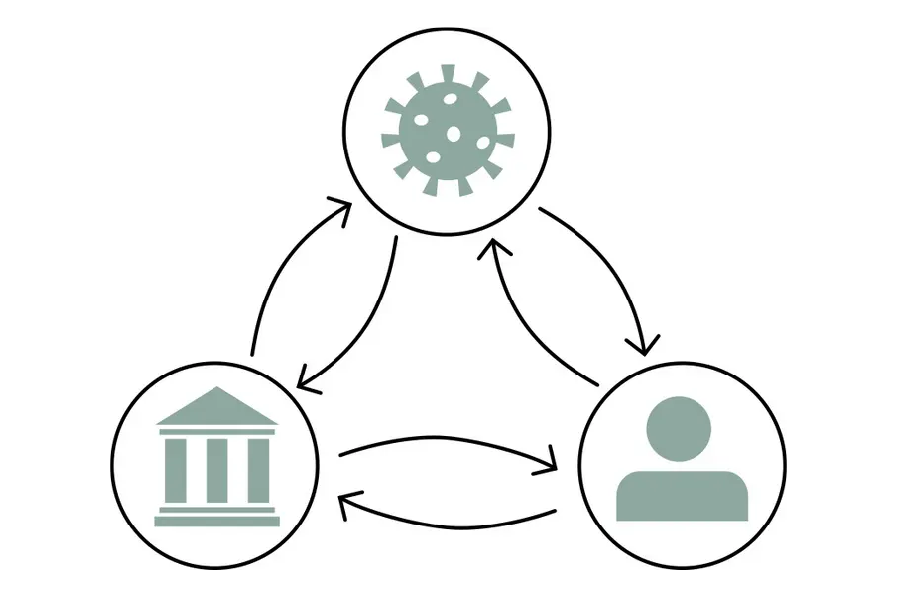
Scientists at the MPI-DS have compiled ten fundamental mechanisms governing the course of pandemics from various disciplines. These are intended to aid in preparing for future pandemics and to provide a framework for policymakers, public health authorities, the scientific community, and the general public. © MPI-DS

Bernstein members involved: Rodrigo Amaral Lind, Viola Priesemann

Every pandemic is different. Nevertheless, certain commonalities can be identified across all pandemics. Researchers at the Max Planck Institute for Dynamics and Self-Organization (MPI-DS), together with an interdisciplinary team of experts, have compiled ten fundamental mechanisms that can be used to describe the development of pandemics. The study brings together insights from epidemiology, sociology, mathematics, physics, political science, psychology, and public health.

“Many of these mechanisms have long been known in their respective fields and are considered fundamental knowledge there,” says Viola Priesemann, professor and group leader at MPI-DS. “However, they are rarely considered together.” The COVID-19 pandemic has once again demonstrated that outbreaks of infection cannot be explained by biological factors alone. While the development of a pandemic clearly depends on the characteristics of the pathogen, its spread is modulated by social interaction, societal response, and the implementation of measures. The researchers selected ten examples and thereof described fundamental and robust mechanisms that are common across various diseases and social contexts.

The mechanisms described include established mathematical principles, such as e.g. the exponential growth of infections in the early phase of an outbreak. Small changes in the intensity or timing of measures can thus have a major impact on the subsequent course of the outbreak. “Reducing group sizes at events or in school classes also has an interesting and clear effect on the number of expected new infections – and it’s quadratic,” explains Sydney Paltra, doctoral candidate at the Technical University of Berlin. “If the number of people were halved, for example, only a quarter of the infections would be expected,” Paltra continues.

Social mechanisms such as trust in institutions, solidarity, and risk perception also shape people’s behavior and the course of a pandemic. While crises can initially strengthen social cohesion, in the long term they can also exacerbate social divisions and erode trust. Understanding these dynamics is crucial for developing effective communication strategies and maintaining public support during a prolonged health crisis.

“Of course, these mechanisms do not operate in isolation,” emphasizes Philip Bechtle, a lecturer at the University of Bonn. “The goal is to understand their interplay more precisely and thus make the measures even more effective. To do this, we need data on the pandemic that is as accurate as possible and publicly available, such as infection figures and mobility data,” Bechtle explains further. In addition to rapid data exchange and interdisciplinary collaboration, the researchers believe that reliable surveillance systems and open scientific cooperation are also crucial. At the same time, long-term funding for independent basic research creates a knowledge base that helps prepare for unexpected challenges.

Even though the acute phase of the global COVID-19 pandemic is over, pandemics are expected to arise in the future as well. The mechanisms compiled by the scientists help ensure robust pandemic preparedness, regardless of the pathogen. They thus provide a framework for policymakers, health authorities, the scientific community, and the public.

Further links

Original press release

> more

Original publication

> more

Beyond COVID-19: Fundamental principles that shape pandemics

17. August 2026/in /by Elena Reiriz Martinez

Kontakt Aktuelles

Contact

Dr. Manuel Maidorn

Press officer
Max Planck Institute for Dynamics and Self-Organization

+49 551 5176 668
manuel.maidorn@ds.mpg.de

Bernstein Netzwerk Computational Neuroscience Logo

Become a member
Statutes
Donation
Subscribe to Newsletter


Follow us on

LinkedIn
Bluesky
Vimeo
Mastodon
© 2026 Bernstein Network Computational Neuroscience
  • Contact
  • Imprint
  • Privacy Policy
Scroll to top Scroll to top Scroll to top
Cookie-Zustimmung verwalten
We use cookies to optimize our website and our service.
Functional Always active
Der Zugriff oder die technische Speicherung ist unbedingt für den rechtmäßigen Zweck erforderlich, um die Nutzung eines bestimmten Dienstes zu ermöglichen, der vom Abonnenten oder Nutzer ausdrücklich angefordert wurde, oder für den alleinigen Zweck der Übertragung einer Nachricht über ein elektronisches Kommunikationsnetz.
Vorlieben
Die technische Speicherung oder der Zugriff ist für den rechtmäßigen Zweck der Speicherung von Voreinstellungen erforderlich, die nicht vom Abonnenten oder Nutzer beantragt wurden.
Statistics
Die technische Speicherung oder der Zugriff, der ausschließlich zu statistischen Zwecken erfolgt. Die technische Speicherung oder der Zugriff, der ausschließlich zu anonymen statistischen Zwecken verwendet wird. Ohne eine Aufforderung, die freiwillige Zustimmung Ihres Internetdienstanbieters oder zusätzliche Aufzeichnungen von Dritten können die zu diesem Zweck gespeicherten oder abgerufenen Informationen allein in der Regel nicht zu Ihrer Identifizierung verwendet werden.
Marketing
Die technische Speicherung oder der Zugriff ist erforderlich, um Nutzerprofile zu erstellen, um Werbung zu versenden oder um den Nutzer auf einer Website oder über mehrere Websites hinweg zu ähnlichen Marketingzwecken zu verfolgen.
  • Manage options
  • Manage services
  • Manage {vendor_count} vendors
  • Read more about these purposes
Settings
  • {title}
  • {title}
  • {title}